In August 2013, the fiftieth anniversary of the March on Washington, I had the opportunity to interview African-American feminist and lesbian Cheryl Clarke about her participation in the March on Washington. A poet, essayist and literary critic, Cheryl has been an activist, a teacher and an artist for her entire adult life. She is the author of numerous books of poetry and essays, including Experimental Love (1993), nominated for a 1994 Lambda Literary Award; and Living as a Lesbian (1986). In addition to her work as a scholar , essayist and poet, Clarke was formerly the Director of the Office of Diverse Community Affairs and Lesbian-Gay Concerns at Rutgers University. She lives in Hobart, New York.
—
Claire Potter:In 1963, you were sixteen years old, and the civil rights movement had been unfolding around you all your life. Can you describe how you felt as the March on Washington approached — as a woman, a lesbian and an African-American teenager living in the District of Columbia? Did you know you would want to participate?
Cheryl Clarke: I was nowhere near being a lesbian at that time, though I loved women. As a child of Southern emigrants and D.C. residents (prior to the Civil War) who knew segregation, peonage, and Jim Crow first hand, I was heir to my family’s sense of justice and injustice. They talked politics all the time, especially my mother and her women friends. They were rabid Democratic Party people, though we could not vote in Washington, D.C. until the Kennedy/Nixon election in 1961. As they said, “Every Negro in Washington, D.C. voted for Kennedy.”
CP: Do you remember a specific event that raised your consciousness?
CC: I remember when I was around 13, demonstrations had been organized against Woolworth’s on 14th Street N.W. in sympathy with the sit-ins initiated by the Greensboro 4 but erupting all over the South. Now 14th Street was a big shopping hub for black people in D.C. I was there shopping and went to enter the Woolworth’s, crossing the picket line, because I wanted to shop, you know. One of the demonstrators said to me petulantly, “You don’t want to go in there, do you? Why do it?” I went on in. I was proud that I had done something I thought was rebellious. When I went home, I told my mother, a devout unionist, what I had done. She said, “You crossed a picket line? Don’t ever do something against people who are doing something for you.”
By the time the March on Washington came around I was 16 and a little more mature. I witnessed demonstrations against the White House almost daily from the time I was in the 10th grade, because I had to pass the White House everyday on my way to my high school, which was in what is called Foggy Bottom, just outside of Georgetown. There was already a more militant streak asserting itself within the ranks of the Movement and, of course, outside of it. Remember Malcolm X, who called the March a “big picnic”?
CP: I do. But the organizers didn’t expect it to be a picnic – in fact they urged young people to stay home. How did you decide to attend?
CC:My parents decided to go. I begged them to allow me to go with them. But because the media had hyped the possibility of violence — both on the part of the March participants and racist extremists–my parents, especially my mother, thought it too dangerous for me to go. Finally, they relented.
On the day before, we drove down to one of the March stations in Northwest to pick up route information. It was near Howard University, somewhere between New Hampshire Avenue and Georgia Avenue — if you know anything about D.C. And I jumped out of the car to go inside the building to retrieve the information. As I was crossing the street two people were standing on the other side in front of the building. When I crossed the street, I asked one of them if I was at the right location. As she was directing me inside, I realized the other person with her was Martin Luther King, Jr. He looked just like himself, in a black suit, seemed very tired, but he nodded hello to me. I smiled back but realized I should not try to get an autograph or disturb his aura of reserve. When I got back into the car, I asked my parents if they knew that one of the persons was King. My mother said, “If I wasn’t wearing this ole raggedy house dress, I’d have jumped out and shaken his hand.”
The next morning, we prepared for our trip to the Monument grounds — on the bus. We left my two younger sisters in the care of our aunt, who lived with us. They were to watch it one TV. My father, as always, had his camera around his neck. As we left the house, our dear neighbor, Ms. Flowers, was leaving her house. She asked us if we were going and if she could join us. Of course, we welcomed her. The four of us took the bus to what’s called Federal Triangle at Pennsylvania Avenue. This was at about 9 or 10 in the morning, and it was a lovely day–sunny but not oppressively hot as I remember it. People were gathering and marching toward the Reflection Pool, in front of the Lincoln Memorial.
I saw many young people, college-aged, dressed in the SNCC “uniform” — jeans or overalls and powder blue work shirts or some version thereof. A group of them marched by us chanting, “Hey, hey, hey, ho! Ross Barnett you got to go!” “Hey, hey, hey, ho! George Wallace you got to go!” My mother didn’t like that: it was too undignified and disrespectful, she said. (Of whom, I wondered, was it disrespectful? The old segregationist S.O.B. Ross Barnett and his S.O.B. scion, George Wallace? (That’s when I knew I would have to leave D.C.)
CP: What was the experience of the March like?
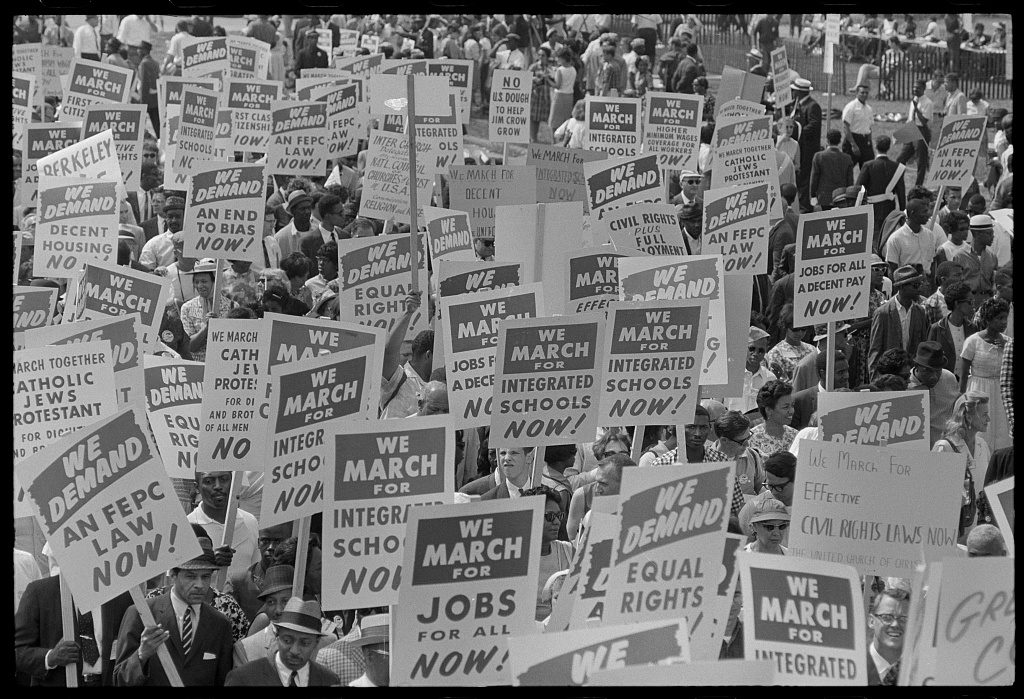
CC:We walked and marched for about five or six hours. I remember a man gave me a sign — I carried it the whole time. I do not remember any of the programming, which didn’t begin until the afternoon. The mood was high. The four of us, me with the sign, got somewhat near the proceedings but did not stay. My mother and our neighbor decided we should head home before the hordes of people started to leave. They wanted me to get rid of my sign, but I refused. I wanted to keep it. My father removed the stick from the back, and I was able to carry it more easily on the bus. I kept that sign in my room until I left Washington. “We Want Jobs and Freedom Now.” Bayard Rustin and A. Philip Randolph added the “Jobs.” We still want jobs and freedom–NOW.
CP: What speeches did you hear?
CC: We didn’t see or hear the famous King “I have a Dream” speech. We knew nothing about the near refusal of the Archbishop of Washington, O’Boyle, to be on the podium if John Lewis gave his speech, which was “too militant.” We saw everything on the television replay, but my sisters and aunt saw it in real time at home. They seemed to be in a state of awe when the three of us came back into the house from our March on Washington sojourn.
CP:What about the role of women in the March?
CC :As I said before, my parents, my neighbor, and I left before the speaking got going and saw it replayed on TV. But I think the only woman on the dais – or at least in the photo of the many men occupying the stage — was Dorothy Height, who made certain she was captured in the photo. Remember, as Paula Giddings says in When and Where I Enter: the Impact of Black Women on Race and Sex in America (1984), there was only an obligatory nod to the “mothers” of the movement, who included women like Rosa Parks and Daisy Bates — neither of whom had children. No women spoke at the March on Washington. Mahalia Jackson, a quite powerful woman in her own right who was a big supporter of King, sang a stirring rendition of her gospel hit, “How I Got Over”– nearly a capella. It is captured quite well in the “Eyes on the Prize” segment. Jackson was one of the greatest singers in the world — gospel or otherwise.
CP: The spirit of Dr. King and the March on Washington opened the door to massive public protest in the 1960s and 1970s — the anti-war movement, feminism, LGBT rights marches. Now we have the Internet!
CC: I think much is to be said about the impact of the March on Washington of 1963 and Dr. King on the movement as a whole. I think the door to ending segregation had been opened prior to the March, but the Southern movement continued to change the power structure segregation had wrought. Remember that aside from the euphoria the March engendered, 1963 was a very bad year: the bombing of the 16th Street Baptist Church in Birmingham and then the assassination of John Kennedy. Activists do have the Internet now and happily some activists, like you, are using it to push progressive thinking and agendas. I, too, want a blog or at least to tweet more regularly. I think “Justice for Trayvon” was a necessary tweet, for example.
CP: As someone who has participated in all of these struggles, what would you say to young people today about the value of putting your body on the street to fight for justice?
CC: I would say to young people about putting your body on the street, having never done that myself in any way that endangered my life, assess the purpose and the goals. Is the gesture symbolic — if so is it worth risking arrest or endangering your life? The March on Washington was a grand symbolic gesture. And television — the parent of the Internet — revealed a sea change in American opinion about injustice on the basis of race. A national conversation about racial injustice began with the March; and it hasn’t really stopped, though it goes out of fashion for some. Now, if only we could have a national conversation about slavery.
The March also revealed how many institutional allies — feminists, people in the anti-war movement — were willing to protest racial injustice. But back to putting your body on the street to fight for justice: clearly and dramatically, the people of the Southern Movement knew they were engaged in a war. As Bernice Johnson Reagon said, reflecting on the music of the movement in A Circle of Trust (Cheryl Greenberg, ed., 1989) the singing gave the movement courage. At the end of a meeting, Reagon continues, people sang with the refrain, “I might not see you in the morning.” And that could certainly be true, not because you might die in your sleep, but because you could be killed on your way home from that meeting by the local white supremacists.
I would also say to young people: Be among people as you make your decisions about the way you fight injustice, because the struggle should not be a solitary, individualist endeavor. I don’t believe courage springs full-blown like Athena from the head of Zeus (pardon this nod to the Greeks.). I think it has to be developed. Develop your courage in concert with others who share your longing for change. I gained the courage to live as a lesbian because I saw other black lesbians out there in the street talking about Pride. I have discussed this elsewhere in my writings.
And maybe there are some things you will never have the courage or talent for. I never had the courage for “street work,” i.e., picketing or petitioning or passing out literature without a permit on behalf of political prisoners, risking being hassled by police, as some of my radical activist friends did in the seventies. Also, I know I couldn’t do prison work. I also know that I couldn’t work on behalf of one political prisoner, like the people who have work on behalf of Mumia Abu Jamal’s freedom all these years. That is why I am happy that Black Panther Assata Shakur escaped from prison when she did — even though there’s that million-dollar reward for her capture flashing on the NJ turnpike. Go on, sweet sister. And all praises to prison activists. And all praises to Mumia, who continues to live a radical life. At least he is off death row and out of solitary–thanks to all those who continue to fight for his freedom.
CP: What lessons would you pass on to young LGBTQ activists?
CC: Learn your limits. Also, what other strategies of dissent are in operation besides the “putting of one’s body on the street”? Should you be engaged in registering voters in areas where there is historic discrimination and repression, radical blogging, educating others and educating yourself about radical life choices, feeding the hungry where no one else is, confronting lawmakers who are doing the opposite of what you put them in office to do, working at local levels? Think about what your town is doing about environmental pollution before you go to Washington with radical environmentalist Bill McKibben[7] to get arrested. I mean no lack of deference to McKibben or his followers. But there is plenty of work to go around, as all the movements that came after 1963 – women’s, anti-war, and LGBTQ — and gained power from the example that was set during the 1963 March on Washington, still show us.
Claire Potter is professor of history at The New School, and Executive Editor of Public Seminar. You can follow her on Twitter.