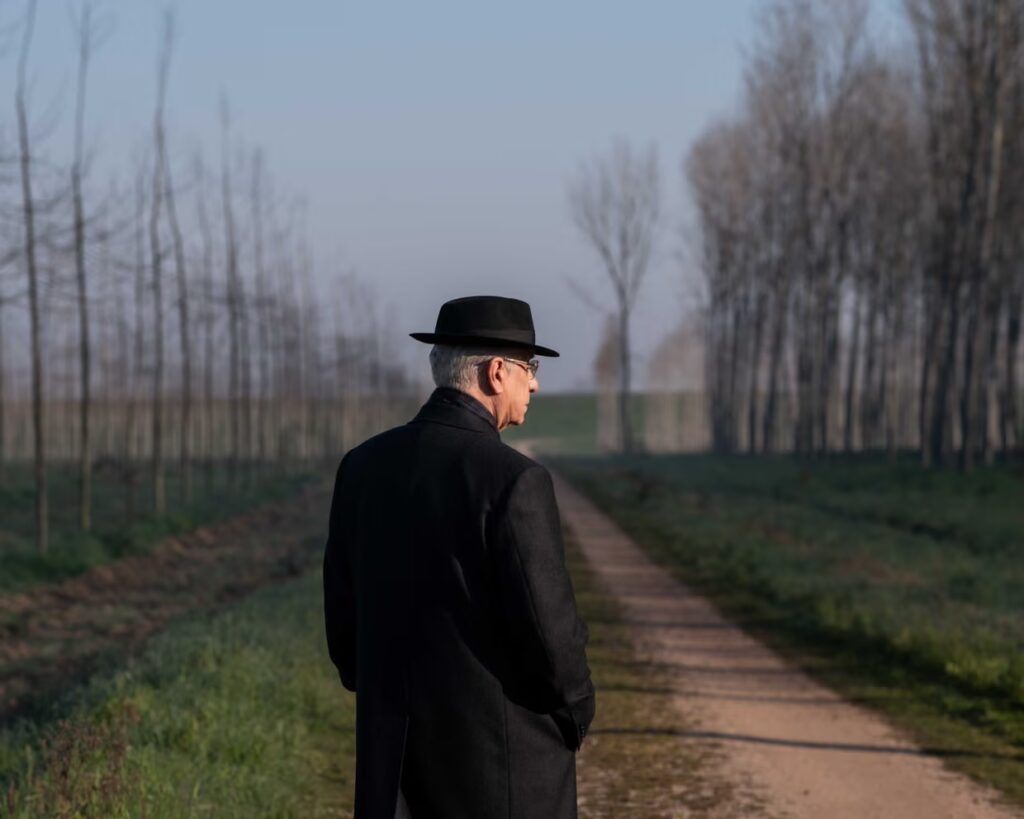
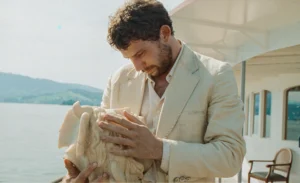
Toni Servillo in director Paolo Sorrentino’s La Grazia (2025) | Photograph: Andrea Pirrello / MUBI
Editorial note: This interview contains spoilers.
Paolo Sorrentino’s films are grand affairs, with elaborate camerawork and stunning settings underscored by memorable music. The plots match the grandeur of the mise-en-scène. In his new film, La Grazia, the purely cinematic elements of the film remain grand—and at times knowingly bizarre, like the president’s love for Italian hip hop—yet they are in service of a simple story, centered around a man who happens to be president of the Republic and is traversing a period of crisis.
He is a man dedicated to his post and his country. Among his accomplishments is the writing of a 2,000-page legal code book. Unlike Sorrentino’s two previous films on politicians, Loro and Il Divo, La Grazia gives us a morally upright, even stiff president, Mariano de Santis—nicknamed “Reinforced Concrete”—played by Sorrentino regular Toni Servillo. This is not a film about elderly politicians lusting after young women; instead, it is filled with admiration for the elite forces of the Italian military, the Alpini and the cuirassiers. The president is a conservative man, personally and politically, but there is nothing condescending about the way Sorrentino depicts him.
In the waning months of his term, the president must make three decisions: whether to pardon two people convicted for murder—one a woman who killed her abusive husband, the other a village schoolteacher who killed his terminally ill wife—and whether to sign a bill, supported by his beloved daughter and adviser, legalizing medically assisted suicide. He is hesitant, wracked with doubts and questions about everything he must deal with, at times even paralyzed. He even hesitates when a young and beautiful ambassador from Lithuania brazenly flirts with him. And yet his hesitancy ultimately proves to be the road to correct conclusions.
I interviewed director Sorrentino when he was in New York for the American premiere of La Grazia at the New York Film Festival.
Mitchell Abidor: There was quite a frenzy before you started shooting La Grazia. Newspapers were speculating on it, even reporting sightings of you eating pizza in Turin. Did this kind of pressure affect you?
Paolo Sorrentino: Nothing. I’m quite used to pressure, and I’m good at not letting that get in my way.
Abidor: Your films are in dialogue with each other. This one seems to be in response to Il Divo and even more, Loro, which feature corruption, sex, and lack of any morality.
Sorrentino: If it appears that way, then it’s more something that critics see when they make this kind of analogy. I don’t see it like that. Yes, it’s a film about politicians, and yes, I made two other films about politicians, but I by no means intended to make a trilogy. It’s not something I’m interested in. The film mirrors something that was very important to me at a certain time in my life.
Abidor: The ethical concerns are far different here than in the other films.
Sorentino: They’re all films about politicians, but they’re very different. Loro is the analysis of one person who really existed, whereas this one starts from a news item I came across about a person requesting a presidential pardon. From that point, I developed the character of the president for La Grazia.
Abidor: Did the teacher, whose request for a pardon was rejected, ever get his pardon in real life?
Sorrentino: He did.
Abidor: The aesthetics of this film are very Sorrentino in the importance granted to space and architecture. But in La Grazia, the space is inhabited by few people instead of large and moving masses. Was the contrast meant to accentuate the private nature of the drama?
Sorrentino: No, it’s nothing but the reality. That’s the way it is. Powerful figures, like Queen Elizabeth, live in huge palaces but their lives are pretty ordinary—like mine or yours. It’s truly a fact of real life, with no metaphorical meaning.
Abidor: A question that several critics with whom I watched the film wondered about: The film takes place in the final six months of his term in office, and he seems to only have the issue of the pardons and the euthanasia law to deal with.
Sorrentino: Yes, yes. It’s quite similar to what happens in reality.
Abidor: Music is important in your films, and usually very present. In this case there was very little, and very different music, including the president’s odd affection for hip hop.
Sorrentino: Normally, the music enters the project with the script. When we get to the editing stage there are things I add, things I remove, things I replace. But in most cases, the music in the film is what I was listening to myself as I wrote the movie.
Abidor: The shot of the Italian astronaut’s tears flowing into space was magnificent. What did the astronaut see on his laptop that made him cry?
Sorrentino: In my mind, it was an email with bad news.
Abidor: I thought he saw his family, and having been in space so long, he missed them.
Sorrentino: As well. That’s even better. I like your idea better.
Abidor: Feel free to use it. In this beautiful film, was there a single shot that you really loved, that made you think, “This is it!”?
Sorrentino: No. I’m not in love with my shots.
Abidor: The mechanical dog that walks with the president to his apartment is a brilliant comic touch. What was it?
Sorrentino: That was truly a bomb-detecting mechanical dog.
Abidor: The army comes off really well in the film. It’s a conservative film in that way, casting an affectionate look at an Italy we seldom hear about, an Italy that is classically conservative … a dream Italy.
Sorrentino: It is a side of Italy that really exists. Some of the governments of the Republic we’ve had over the last few years have characteristics similar to that of the president in the film. Even though this president isn’t inspired by one particular president, he combines traits that many presidents have displayed.
Abidor: He’s very ethical, yet he comes up with the trick of leaving office early, so he can become a senator for life and block Ugo, who he suspects of having an affair with his wife, from becoming president. What happened to his ethics there?
Sorrentino: Ethics stand no chance in the face of jealousy.









It’s hard not to feel for Mitchell here. I can sense the enthusiasm behind his questions, and yet Sorrentino’s responses are often reduced to just a few words as if the conversation never quite had the chance to move forward…