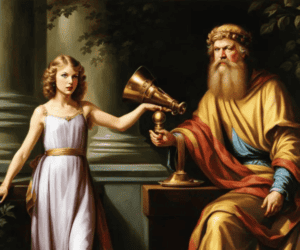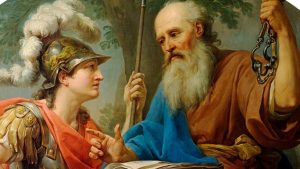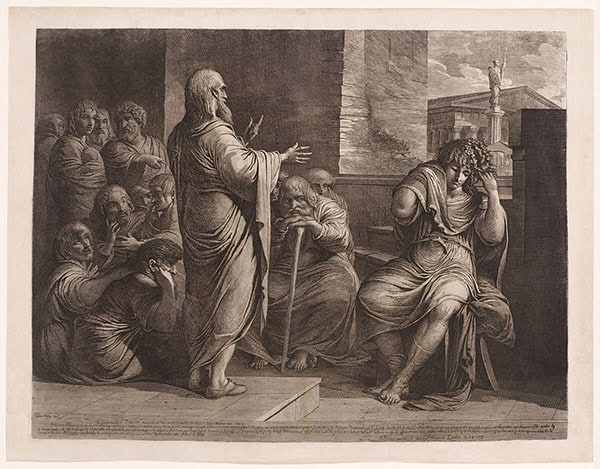
The Conversion of Polemon (1778–90) | James Barry / The Metropolitan Museum of Art / Public Domain
The following conversation was first presented as a public panel on October 9, 2025, as part of the Henry H. Arnhold Forum on Global Challenges at the New School for Social Research.
James Miller: As Dan Edelstein has shown in his important new book, The Revolution to Come, for most of recorded human history sudden changes in social mores and laws have generally been regarded as abhorrent—an evil to be avoided. An epitome of this way of thinking in antiquity was Polybius, whose insights, as Edelstein shows in detail, were cherished by American founders like John Adams, only to be rejected by adamantly progressive modern revolutionaries like Condorcet, Robespierre, Marx, and Lenin.
Yet as James Romm has simultaneously shown in his equally invaluable new study, Plato and the Tyrant, the ancient world produced a striking exception to its own general fear of change: Plato, the greatest philosopher in antiquity, and an inspiration for Polybius, in part by producing works like the Republic that offered an unchanging political ideal, also imagined the possibility of an abrupt conversion experience, a transformative turning of the soul, that might occur in a single person, or simultaneously, within a larger group of souls. This possibility, I’d suggest, was a key factor that led the greatest idealist in antiquity to parlay with tyrants as well as political disciples willing to use armed force to realize his avowed vision of a more perfect polis.
As Romm proves, Plato’s three visits to Sicily illustrate the temptations of unlimited power—that is, literally, tyranny—for a convinced philosophical idealist. Hence a striking paradox: Plato’s love of learning was orderly and defined by a love of dialogue and reasoned deliberation and disagreement. But his personal lust for power proved reckless, as if he were in some way blinded by an overriding faith in an overwhelming revelation, a transcendent political vision.
As a result, I would argue that the roots of the modern revolutionary ideal lie not only (as Edelstein shows) in emergent Enlightenment theories of progress in history as a cumulative learning process but also, and perhaps more crucially, in the irresistible promise for visionaries both ancient and modern, even avowedly conservative thinkers, of a new beginning, a radical change, a sudden reorientation of a people toward pristine ideas of a life lived in the light of truth, justice, and beauty.
I would also argue that one classical way to reconcile a desire for radical changes that are deemed good with the deep desires of most human beings for security and stability is to represent an abrupt break with contemporary forms of life as a restoration, if properly understood, of a prelapsarian golden age. Hence the enduring appeal—even in world politics today—of explicitly counterrevolutionary movements that attempt to make a people or a nation great again.
Today, a significant number of American right-wing intellectuals who are philosophically and theologically sophisticated—I am thinking of people like Curtis Yarvin and Peter Thiel—are as willing as Plato was to parlay with powerful contemporary tyrants like Donald Trump and Viktor Orbán. In order to make a lucky group of chosen people great again, they are as willing as Plato was in Sicily to entertain the possibility of destroying longstanding contemporary institutions and norms in the name of restoring a more perfect and untarnished original state, even if that means suspending the contemporary rule of law.
Dan Edelstein: I’ve actually been mulling over Jim’s comments for the last 24 hours, and I guess I want both to agree and push back a bit.
In short, my book is an attempt to explain how revolution went from being the problem that political philosophy was supposed to solve to becoming, for many political philosophers, the solution to all of the problems that modern societies now face. And I realize now that framing my book in that way may have oversimplified some of the complexities of this story.
In any case, the classical thinkers that I look at, from Plato up to Polybius, all feared change. Most of the examples they studied of change were extraordinarily negative, such as the famous episodic uprisings, or civil wars, or stasis, that they analyze, often in such gruesome detail, that the problem of stasis was still haunting John Adams hundreds of years later when he wrote his Defense of the Constitutions of the United States. So for Adams as for Polybius, change was coded as bad.
At the same time, almost every political philosopher from Plato to Adams also recognized that change was probably inevitable. Nothing lasts forever. Since we’re in a world of change, the question becomes, how do you stave it off for as long as possible? It’s also a question of stability, as Machiavelli would later put it.
So the main story I tell, without thinking too much about Plato but rather focusing on the accounts given by Aristotle and Polybius, is that the reason why states enter into violent change that is disastrous and destructive is because regimes become divided by conflicting social interests. There are the many and there are the few, the poor and the rich, and these conflicts present an engineering problem. You’ve got to find out some kind of way to balance these conflicting interests so that you can reach a state of stability. And it is from this ancient tradition that we get these theories of the well-balanced constitution, or of a mixed government stabilized by checks and balances.
This ideal of mixed constitutionalism essentially grows out of an Aristotelian argument that Polybius applies to the best-known classical example of antiquity, which is the Roman republic.
Now when Aristotle is talking about forms of mixed government or of balanced constitutionalism in politics, he’s also being quite creative. As my colleague Josh [Josiah] Ober has argued, some of Aristotle’s creative constitutional ideas may indeed be imagined to fit new polities, perhaps in the lands of the Persian empire newly conquered by Alexander the Great, Aristotle’s most famous pupil.
And so, even in ancient and early modern contexts where historical change was generally coded as negative, there was still quite a lot of room for creative political thinking. I mean, what were the founders and the framers of the US Constitution doing? They were being extremely creative. They were pulling from all these different places, but they came up with a constitution that they largely invented, even if they still did hope in part to prevent negative future changes.
Here’s one place I would push back: I don’t think that there is actually a paradox between coming up with idealist solutions to political problems and still wanting these solutions to freeze the state, to freeze history, for as long as possible.
Where I will give a little is your point that maybe we have to go back to Plato to really appreciate the important part of the origins of modern revolutionary thinking. I’m reminded of one of my favorite books of political philosophy by Robert Dahl, Democracy and Its Critics. He makes the point that if you look at one-party rule under the ayatollahs in Iran, or the Bolsheviks in the Soviet Union, and you think of what they most look like in terms of a political form, his answer is it looks a lot like Plato’s guardians. And so you could indeed argue that the Platonic model, in which you take the politics out of politics and replace it with a pseudo-scientific form of tyranny, is a road not generally taken until the modern revolutionary period.
As James Romm shows, pursuing the ideal of a philosopher king was a risky option in antiquity. So let’s just figure out this constitutional stuff. Well, once other problems come into play with the modern revolutionary idea that we should just naturally, through historical progress, end up all converging on our opinions and reach another state where politics disappears because we’re all rational and we don’t need to have these arguments anymore, that actually is the moment in which suddenly the Platonic answer reemerges as a good option. So maybe Plato plays a bigger role than I described in my book, but I would say that role grows in the modern, post-Enlightenment period, when linked to modern ideas about progress.
James Romm: So I also want to thank Jim for bringing us together, and The New School for hosting this. I must say it’s a very encouraging size of crowd for late Thursday afternoon. Jim has, for those of you who don’t know it, written a marvelous collection of biographies of philosophers called Examined Lives. And that’s in many ways the inspiration for me because he’s used the tension between the philosopher’s life and his thought as the basis of his critique. And in Plato’s case, that tension is very pronounced. My book deals with the biographical story of his interventions in the city of Syracuse, which at the time was really the superpower of the Greek world and also the main autocratic power because it was ruled by a dynasty of tyrants, a father and son. Plato visited both of them over the course of about 25 years, during which time he was also writing the Republic.
He went there with the very deliberate purpose of trying to get these men, the father and son, both named Dionysius, interested in philosophy and to get them to subscribe to an ethical code that would make them better rulers, perhaps constitutional monarchs in our terms, with limited power and subservient to the law and therefore hopefully adored by their population instead of feared. It was a terrible failure—it blew up in Plato’s face, and he just barely got away with his life. But it’s a fascinating experiment; not entirely an attempt at revolution, but an attempt at political reform spurred by Plato’s own experience of the politics of Athens, his native city, which as he describes in his Seventh Letter was a terrible one. The Seventh Letter is a contested document, but I don’t want to get into the question of its authenticity. I believe it’s genuine, and so I accepted its evidence as a basis for some of my book.
In the Seventh Letter, Plato says he witnessed a revolutionary change at Athens, the regime of the 30 Tyrants, which briefly held power following the end of the Peloponnesian War and resulted in a reign of terror. Plato saw that regime committing horrible abuses. Then it was ousted and replaced by the restored democracy, and that government executed Socrates—as Plato says in the letter, the justest man of his time. So both right wing and left wing, as we might call them, had undermined themselves and invalidated themselves in Plato’s eyes as legitimate forms of government. He was looking for another solution to the problem of politics, and the Republic is that answer: his proposition that only philosophers should hold power—philosopher kings, as we call them. He didn’t use that term when he went to Syracuse.
He had this golden opportunity, as he saw it, to take a ruler with absolute power and make him more philosophical. He describes that goal in his Seventh Letter and the terrible outcome. It’s a paradox (to pick up on some of Dan Edelstein’s remarks) that Plato was trying to institute a regime that would not change, but doing so by making enormous changes, instituting this new form of governance, philosopher kingship. And he says in his last work, the Laws, “Give me a city ruled by a tyrant,” because that’s the way to institute dramatic change. Someone who has absolute power can achieve whatever he wants, can put in place something like the Republic or a regime that’s amenable to philosophical governance. He seems to be describing exactly his own methodology in Syracuse, and I believe he was trying to make an apologia for what the whole Greek world had seen was a terrible failure of that effort.
But he still believes that that was the way to bring about political change: Get buddy-buddy with a tyrant or an autocrat and have that person converted to philosophy. He also says in The Republic (in what’s been described as the most famous sentence in all of Plato) that there are two paths to instituting the ideal regime: Either a philosopher must become king, or a king must become a philosopher. And again, that seems to describe his own attempt in Syracuse. As Dan Edelstein has said, with reference to Thucydides’ description of the Civil War in Corcyra, change in the Greek world was perceived as enormously destructive, and it was, generally speaking. In Plato’s time, the Corcyra stasis described by Thucydides, which was a true horror show, was only one of five civil wars over the next hundred years or so in Corcyra with the popular party and the elites, the oligarchy party taking power by turns and each of them taking vengeance on the one that they had ousted.
So there were cycles of violence and retribution in many Greek cities. Athens somehow managed to escape that fate. The ouster of the 30 miraculously was solved by an amnesty, and the democracy was restored with very little bloodshed, but in most cities change was bad. There’s a Greek word, neoterizo, to make new, which in Plato’s time comes to mean to have a violent revolution; anything new is violent and bloody. And the Republic was an attempt to get out of the cycle of history, to institute a golden age as Jim Miller was discussing—to preserve, to freeze history. I think that was Dan Edelstein’s phrase, to freeze history, so that the deterioration could be held off as long as possible. It would inevitably set in, but the right kind of governance could keep it at bay.
For a good long time, Sparta was the exceptional model in the Greek world for stability and longevity. The Spartan constitution famously had stayed unchanged for hundreds of years. It had been instituted by a man of semi-divine stature—we don’t even know that he existed, but legendarily, his name was Lycurgus. He received his instructions on how to organize Spartan society from the oracle of Delphi. This was handed down from the gods, it had divine authority and was therefore kept in place for literally 400 years by Plato’s time. And Plato looks to the model of Sparta in his Republic.
One of Plato’s other dialogues that deals with politics, a dialogue called Statesman or sometimes translated as Politicus, also envisions a golden age in which humankind was perfectly well governed by divine beings. Then there’s a myth of Atlantis in the Critias, which also goes back 9,000 years to a society founded by gods, a line of kings founded by Poseidon that enjoyed a kind of golden age until the divine blood in the line of kings was gradually adulterated and vice and greed crept in. So all through Plato’s thought we find these visions of earlier ages in which governance was good, informed by divinity, and perhaps could be recovered. And that, I think, was the genesis of his Syracuse project, and its failure must have been a terrible, terrible disappointment.
Gwenda-lin Grewal: Okay, I want to take this in kind of the same direction, but also in a slightly different direction and say something about the return to a golden age. In the past and in some circles of the present, the return to a time of peak greatness means a return to the time of the ancient Greeks. But what is weird is that the Greeks themselves already spoke of a lost golden age. It is not just in Plato but also in Homer, Hesiod, and Thucydides. In Plato, the obvious place to look is the Republic, but like you were saying, James, one can see it too in the Statesman and in the Critias, Timaeus, and the Phaedrus. So I’m going to talk a little bit through that.
In Plato’s Phaedrus, Socrates appeals to a group of unspecified “ancients” as witnesses to the truth about philosophical madness. Philosophy can make you go crazy for timeless beings. It can promise—and this promise is so seductive as to be almost eros incarnate—a change back into a changeless origin from which one has fallen away. Socrates compares it to a Bacchic frenzy, or in his case, possession by local nymphs. The denial of time—or maybe a kind of dissatisfaction with the times or a wish for things not to deteriorate further—somehow produces a cultish belief that one can stand beyond time and history.
I’m also thinking of Marx’s comment that during times of revolutionary crisis, human beings anxiously conjure up “spirits of the past,” borrowing their “names, battle cries, and costumes to perform a new world-historical scene in this time-honored disguise and with this borrowed language.” Revolution springs out from the present into the past, a leap not toward some fringe novelty but into what was already there. The more distant the past is, the more timeless it seems, and so the greater its candidacy for rebirth. Necromancy, however, requires convincing rhetoric, some sort of manifesto that can sell the storyline of what could be as what once was, and so is, clearly manifest for all to see.
In the Timaeus, the proto-tyrant Critias, who will become one of the 30, recalls a story he heard about the lost city of Atlantis. He says it was burned into his memory from childhood. Atlantis was and/or is what Socrates’ fantasy of the perfectly just city would be if it could be brought to life. Luckily, it already existed, or at least it did if having an unforgettable memory of past time is the same as proving the existence of a timeless actuality, which is what Critias seems to claim.
Memory here is obviously really suspicious. It presents the past not as a ghost but as a prophecy. Longing turns to dreaming and dreaming to fate, since hope is more viable when one thinks of it as destiny’s child. But then there’s Greek tragedy. For Oedipus, the truth was revealed when he realized he couldn’t know fate because he was still in real time. I don’t think one sees the revolution coming. Predictions about it always fail.
The people stranded in Plato’s cave think the returned philosopher is not enlightened but insane. His soul has been turned around, and he’s quick to say to the uninitiated that the turn was and is a return, a revolution homeward, a climax of anticlimactic proportions. One just has to remember what happened vividly enough to time travel out of time. Is this brainwashing or truth immemorial? At least in the Phaedrus, truth is the product of having an eros so possessed that the soul begins to forget all of its mortal attachments and suddenly beholds a vision of the ageless idea of its beloved as all there is.
The best time for that kind of madness is when you’re at the apex of youth or on the brink of death. These are the times that Plato depicts Socrates as most open to a sudden dramatic change. In the Phaedo, it is both his strange end-of-life turn to writing and his story about his youthful obsession with a book of Anaxagoras’s that led him to almost give up on ideas. Both interestingly have to do with writing’s seductions, which I’ll come back to in a minute.
The Republic, too, focuses on the young and the old. Changes of regime are described as the change of heart that estranges a child from their parents, and the self from itself. Children rebel against what they inherit when they realize that the tradition they were born into is hostile to their autonomy. Yet the last change in the sequence hovers between what looks like the best and the worst regime. Socrates stops short of the best. The tyrant who rises from democracy is not a happy coincidence of philosophy and power, but rather a paranoid ghostwriter of the whims of the people. It could have been otherwise. But philosophy’s mad lust for truth is an ongoing issue.
That brings me to a comment on Plato’s Seventh Letter. The letter, like the Phaedrus, discusses the failures of the written word. Plato doubts Dionysius’s attempt to write down the things that he said (and which he said only on a single occasion) as if they were Dionysius’s own technê or art. While at first this appears to be an issue of intellectual copyright, it leads Plato into a condemnation of writing as such. Writing is a business that serious people don’t get involved in. Only lovers of honor do that kind of thing. In other words, people inclined to want to be famous and powerful—to have their words transcend time. Maybe this exempts playful people. While serious people write texts of indoctrination—textbooks, constitutions, manifestos—other writers perhaps write dialogues. So maybe Plato is thinking of his own mode.
Dionysius, however, thought that what Plato said could be formulated in an artful way, as a technê, but Plato says it really comes to be from sunousia. Sunousia is a really weird Greek word. It can mean sex, intercourse, hanging out, lecturing, some sort of a get-together. What is he talking about when he says that? Sunousia comes to be all of a sudden in the soul, he says. Whatever happens in that cataclysmic moment, it cannot be expressed (rhêton) in writing. Or, if it can be, the best person to do it is Plato. For if someone badly writes it down, Plato says that he is the one who would be most pained. But what precisely is Plato worried about here? Did he have a secret he was afraid of being published? Don’t tell anyone the revolution is coming or it won’t come?
James Romm offers a guess that I really like, that there might’ve been a love triangle going on between Plato, Dionysius, and his advisor, Dion. Overthrowing governments and erotic conquest do seem to go together—like love and death—and they were also together in a famous story that the Greek historians tell about Harmodius, Aristogeiton, and Hipparchus.
It goes like this: Harmodius and Aristogeiton were in a lover-beloved relationship. Hipparchus propositioned Harmodius and was rejected. Aristogeiton tattled on him. Hipparchus got angry and then humiliated Harmodius’s sister in a procession. (That’s a longer story, but it involved carrying a basket and being a virgin.) In response, Harmodius and Aristogeiton plot to overthrow the tyranny—not just to kill Hipparchus, but also his brother Hippias, who was in power at the time. They seem to imagine that Hipparchus’s sexual liberty is the sign of Hippias’s unhinged power.
Ironically, this only makes the tyranny stronger because they don’t entirely succeed. They only kill Hipparchus, and Hippias just becomes more powerful. But there is something about the promise of desire’s unrestrained success—at first an innocent wish for the collision of the true and the good—that feeds tyranny all the more. In Aristophanes’s The Birds, two Athenians try to start a new Athens in the sky where no beloved can refuse a lover’s sexual advance. It doesn’t end well. Then there is Thucydides’s description of the Sicilian expedition as an erotic longing for what is absent.
Eros gains more power when its beloved is not there. And for reasons that I’m not going to go into right now, it might be that the beloved is never there. So eros begins to see the beloved’s reflection in every object, in every cloud, in every word. You would stop at nothing to get a grip on this absent presence, whether that be world-domination-slash-world-destruction-slash-perpetual-peace or some sort of revisionist history that philosophy must commit when it suddenly recognizes the universal patterns of the cosmos, which were conspiring all along to produce the phenomena we fall for in our waking lives. God forbid philosophers write their ideas down.
Socrates, back in the Phaedrus, lists Solon, Lycurgus, and Darius as examples of immortal speechwriters. An immortal speechwriter is not exactly a god (although, as James said, in Lycurgus’s case, the writing sort of comes from god). But an immortal speechwriter is someone who writes something so powerful it reads as if it were an unforgotten truth.
“Write with blood,” demands Nietzsche’s Zarathustra. Ink is bloodless, but good writers possess the power to make you behold ideas as if they were living thoughts, as if they were there so present to you that it is as if you yourself thought of them. This sudden possession by words of the past—by spirits of the past—is more liable to happen in times when you’re most at a loss to recognize yourself.
Where are we now? What next? Who are we?
It’s really strange how being in adolescence and being close to death likewise produce revolutionary thoughts of eternity. But perhaps it is not so strange when one thinks again of writing. The unrecognizability of antiquity as remote from us makes it peculiarly ripe for restorative self-understanding. Beyond that is the doorstep of metaphysics, the timeless golden age that always was and ever is tempting the thought of indelibility. The ability to reread, also a feature of writing, can bring this temptation back down to earth. But it takes a certain sort of careful reader or writer to go to and from the cave—to admit you went insane—the careful sort of reader or writer that Plato seems to doubt exists, at least aside from himself and his vision of Socrates. Was that Plato’s pessimism about his own travels to Sicily during turbulent times, or was it a zeitgeist more generally—a sign of the play of chance coincidences that animate understanding and revolution alike?
I don’t know where you guys want to go now, but that’s what I’m thinking.
Miller: That was lovely, Gwen.
I want to go back to something James Romm said, about how Plato’s trips to Syracuse were an experiment in political change. I’m not sure you used the word revolution. What I’d like to suggest is that Plato’s trips to Sicily were more specifically an experiment in philosophical and political conversion, and that the technique of conversion and the mysteries that surround it, many of which have been so richly evoked by Gwen, play a much more important role in the history of political thought than they’re usually credited with. Given the nature of the various classical regimes you had to choose from—democracy, oligarchy, or tyranny—it seemed obviously easier to convert one person who has absolute power than to convert the many, or even a group of rich people who share absolute power.
In the ancient world, and in Plato’s academy, philosophy was a way of life that demanded for its sincere reception an explicit conversion from a previous way of thinking and acting to the new, more philosophical way of life. It was not simply about reading treatises and mastering a set of analytic arguments. The idea that a philosopher might be able to turn the soul of someone with unlimited power in a direction that would lead to a kind of infinite good became a wager that some ancient philosophers were prepared to make.It’s one reason why Aristotle agrees to train Alexander of Macedonia. It’s the wager that Seneca makes when he tries to teach, and convert, Nero. And I guess the one possible success story in antiquity is Marcus Aurelius, the Stoic philosopher-emperor of Rome.
Now what I’d like to suggest is that there is a modern restoration of this obsession with conversion, but it takes a new turn. What’s crucial is the apparent success of the mass conversion that was achieved by the disciples of Jesus Christ. It took a century or two, but eventually a new Christian epoch dawned in Europe and the Middle East, and it was such a complete 180-degree turn from pagan antiquity that after Constantine makes Christianity the official religion of the Roman Empire, it’s a new regime for a new era. It is precisely this model of the new beginning that is at issue in both the American and French revolutions. In the case of the French Revolution, it’s quite explicit: You create a new calendar, you go head to head with Christianity, you convert Notre Dame into a “temple of reason,” and you proceed.
The idea of a collective conversion experience was like catnip to mainstream modern continental philosophy. I don’t think it’s a coincidence that the German idealists were trained in divinity schools by Lutheran teachers—Kant, Fichte, Schelling, Hegel, all of them. Nietzsche was the son of a Lutheran pastor. Marx inherits the idea of a mass conversion through his worship of Hegel, and through his love for Feuerbach. The idea of a mass conversion reappears in the twentieth century as what I would call a “big bang” theory of history in Heidegger’s Being and Time. It’s when there’s a turning of the soul and a moment of vision, in an Augenblick, the blink of an eye (the language is lifted from Kierkegaard, another Lutheran). The people who are listening to Heidegger at the time in his lectures are, among other people, Leo Strauss, Hannah Arendt, and Herbert Marcuse. Marcuse, for one, comes away with a “big bang” theory of history: Instead of Heidegger’s hero Hitler, Marcuse just prefers Lenin. Alexandre Kojève, in his wild synthesis of Heidegger with Hegel in the 1930s, imagined that Stalin was the world spirit riding in a tank instead of on horseback. After all, it’s true that a lot of the great revolutions of the eighteenth and nineteenth century were led by men on horseback, George Washington being one, Napoleon being another.
In any case, it seems to me that this question of conversion and to what extent mass conversion is feasible or thinkable—if only through emulating the example of a heroic and sagacious leader like Jesus or George Washington or Gandhi—is not discussed enough. Because if such a mass conversion experience is possible, then I think idealists will feel a constant temptation, bolstered by their faith in conversion, that a great man, a hero with tyrannical powers, may be able, in the blink of an eye, to save the secular world. This was the intuition that I had when I was reading both The Revolution to Come and The Philosopher and the Tyrant.
This is both a political prospect and a clearly theologically inflected idea, because Augustine is someone who believes in conversion. He’s looking for a turning of the soul. This is a man in late antiquity who has never met a total program for a new way of life that he hasn’t wanted to test out. We have his gnostic period, his Ciceronian rhetorical period, and his Neoplatonic period—crowned of course by the moment when he belatedly decides that he’s going to convert to Christianity after he hears the Life of St. Anthony, Athanasius’s narrative of a desert saint. Augustine decides that he’s going to create a kind of ideal academy of Christians who are also philosophical souls who will embark on intense communal study to turn their souls towards the true, the good, and the beautiful. He writes his Soliloquies, in which he conducts an internal dialogue between an aspirationally better self and a currently existing self, in which he stages a quest for moral perfectionism.
Augustine never renounces that text. It remains in his official list of works, but in a later “retraction,” he says, “I was wrong. I got it wrong.” These early dialogues, they were on a path, but it’s not the correct path yet, because he has yet to realize that ordinary people are incapable by themselves of such moral perfection; they require the grace of God. You may approach that ideal in a small community of like-minded souls, but if you’re preaching to a large flock of people, a lot of people don’t know anything about philosophy, so you end up with a dichotomous social structure in which the priests pursue philosophy while a much simpler set of doctrines, a catechism, is conveyed to the many as a way to facilitate the ongoing mass conversion of ordinary people to a shared set of ideals.
I think the great problem with moral perfectionism is that if you are besotted with the possibility of mass conversion, one of the temptations (which is horrific in its consequences, but sometimes seen as emancipatory by “big bang” philosophers of history) is the possibility of forced conversions. I think that is one reason why Montaigne, whose mother was probably a converso from Spain, came to understand the wisdom in being happy to just play with appearances and keep quiet about what you really believe. Let me stop there.
Dan?
Edelstein: My brain has actually found a sort of thread between what you were saying about conversion and where you’re talking about golden ages and even sex. I’m reminded of this passage in Camus’s The Rebel where he says nobody becomes a Marxist by reading Marx. First you convert, then you read the fathers of the church. I’ve often thought about that line because it just sort of hits home. The question of conversion in the modern revolutionary mode is really central. It can’t just be about Marx, it can’t be just about the ideas. No one converts because their reading Das Kapital got them so excited that they’re going to go join a barricade. I think it has more to do with the sort of imagination of revolution, which is an imagination that often draws on these sorts of golden age ideas.
At first it was puzzling to me because indeed that’s a classical trope. The idea that the golden age would come back is itself a classical idea. Virgil famously uses that idea, in the greatest work of Western propaganda ever written, the Aeneid, to salute Augustus. But I think that in its modern incarnation, there is a twist. I’m sort of also digging in my heels here on making the case for a modern difference and a revolutionary mind. I don’t think that any classical writer or any early modern writer who’s picking up on this theme of bringing back the golden age ever thinks that it’s going to last forever. You bring back the golden age, it’s Augustus—but Tiberius, let alone Nero, no one has this idea that once it’s brought back, we’re good, we’re going to stay in the golden age forever.
And that’s why actually it’s such a powerful motif. There’s a really nice book by Harry Levin called The Myth of the Golden Age in the Renaissance that goes over how with every two-bit renaissance ruler at the moment of accession to the throne or to whatever ducal position, it’s always, “Oh, and he will bring back the golden age.” It’s almost like if you don’t say that, it’s like throwing salt over your left shoulder. It’s such a commonplace, but it only works if no one expects the golden age to stick. And that’s the difference that happens with the modern vision of history, which isn’t one that is premised on constant change. It’s instead this belief in a classic Hegelian way that we’re going to come to an end of history, and suddenly the golden age acquires a very different value.
It becomes this final stage of human history. I think that’s how the conversion works. In Flaubert’s posthumous novel [Bouvard et Pécuchet], he describes this socialist schoolteacher, and it’s just the most biting sarcasm. Flaubert is a total reactionary. He calls socialism “magic,” but the speech that the schoolteacher gives is like, “We’re going to have to abolish the judges, get rid of the courts. We’ll have a golden age—no more armies with a good dictator in charge.” And it’s kind of fascinating because although this is just satire, it shows the way in which the coherence is not what’s driving this— a dictator, and no judges and no courts, no armies. It is the golden age that’s this exciting thing: “Come on, just get over all your petty politics.”
We’re this close. We’re going to abolish all social classes, just one little more push and we’re going to reach the end of history.” And that’s the draw.
To get to sex, I actually think that the free love imagination was always baked into these revolutionary fascinations. Go back to Saint-Simonians, one of the modern fathers of revolutionary thinking and certainly of the revolutionary imaginary. He’s ridiculed because everybody thinks that the people in Ménilmontant, which was where the San Simonians hang out, were all sleeping with each other. Marx was criticized for advocating for abolishing marriage, and while he turned it around to say, “Well, you’re one to talk, you bourgeois who are sleeping with your mistresses,” he still maintained that we’re going to get rid of marriage too. There is a sort of erotic draw even in the modern revolutionary conversion that draws on classical sources, and in this different historical mode they’re not just coming back because we have a great figure, an Augustus; they’re coming back because we’ve come to the end of history and it’s going to be one hell of a party.
Grewal: I can respond to that, but also to the group conversion thing that you said, Jim. It made me think about the mystery cults and the Dionysian group conversion that doesn’t seem to be an author telling the group what to do. Rather, everyone loses their mind and no one is sure any longer who’s in charge and who’s not, who’s human and who’s an animal. And then it all becomes the absence of any kind of self, which I do think is part of the threat to metaphysical/erotic conversion that looks like it plays into this retrieval of a golden state that is the pinnacle of some set of timeless ideals but also of a timeless beholding.
It does seem true to me what you said, Dan, about the idea that the golden age, maybe not in Plato—I think I might disagree about Plato—but I agree in the other cases the golden age comes with a realization that it is not coming back, or that if it were to come back, it would be a sort of stasis that would be a standstill but also a sort of precursor of its own fall. And it is inevitably going to fall. But it’s strange in Plato—there does seem to be a kind of hopefulness in the power of philosophy but then also a despair at the thought that it cannot be made manifest in any kind of publicly shared sort of way, which is what I see happening in Plato’s Seventh Letter. That is what I was thinking about when I mentioned the Phaedrus, too. There is hope there—hope that has to be based on some sort of longing for an actual moment of insight at least.
Miller: I have a question specifically for James, about how you would fit the Pythagoreans within practice too. Here you have a cultic group of philosophers who exercise political power in Italy and the Hellenized regions of Italy. And an important component of the sect was a mystery cult. And we know that Plato, if we believe the letters, talks about the influence on him of the Pythagoreans, and they also had influence in Syracuse. So it’s a weird combination of mathematical—the world reduces to numbers—and mystery cult. How do they go together? On the face of it, it seems like they shouldn’t fit, right?
Romm: Well, first of all, let me say these are very suggestive remarks, and Jim, I love what you said about Christ, about the ultimate conversion. And of course the ultimate golden age is the new Jerusalem, which will be permanent and lies in the future. So that got a lot of thoughts going for me.
But yes, the Pythagoreans, many of whom saw numbers behind everything in the cosmos—their world was essentially made up of numbers, and numbers had a mystical power. And Plato apparently went to Italy for the first time before he went to Syracuse. So he went from the heel of Italy, Tarentum, to Syracuse, and in Tarentum was the center of Pythagorean study at the time that he lived. So his original objective may have not been this autocratic regime but a society of Pythagoreans, and the Republic is—well, all of Plato really, especially the Timaeus, is—deeply informed by Pythagoreans.
But on the subject of conversion, I just wanted to mention that Plato did achieve a real conversion in Syracuse, not of the ruler, but of his brother-in-law. The name Dion came up once, thanks to Gwen’s mention of a love triangle, which I explored in my book: Plato seems to have become the lover of Dion, or at least was very, very closely bound to him. So Dion, the ruler’s brother-in-law, became an acolyte, and Plato describes him as the most amazing student he ever had, a man of total commitment and curiosity, who later went on to study at the Academy and then tried to champion Platonism when he assumed power in Syracuse after the ouster of the tyranny. And Plato may have had real hope that although he was hoping to hook the ruler himself, he hooked a man who could become ruler. Remember, he had two paths to instituting the ideal regime: A philosopher could become king or a king could become philosopher. He failed at the second, but he saw the possibility of success in the first, and that was because he had a convert.