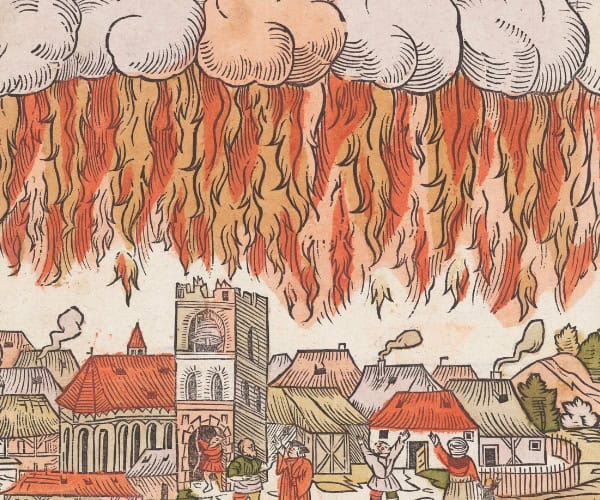
A northern lights phenomenon (“a great broad long flame”) over Eggolsheim near Forchheim (1560) | Georg Merckel / Zentralbibliothek Zürich / Public Domain Mark
Americans have long enjoyed a robust and righteous sense of impunity. No matter how badly our government blundered, we nevertheless clung confidently to the notion that we would always land on our feet.
It has been said (allegedly by Bismarck, but there is little evidence to support the attribution) that “there is a special Providence for children, fools, drunkards, and the United States of America.” This adage, with its implicit analogies, hints at several possible explanations for our blithe and blissful belief in collective invulnerability. Were we protected until now by the innocence of immaturity, or by a national consciousness so blank or so intoxicated by faith in our incorruptible virtue that it could not be suspected of harboring malevolence?
Lately, however, it has become increasingly difficult to evade thoughts of Retribution. I write the ominous substantive with a capital letter in emulation of our President, who litters his tweets with capitalized nouns evocative of his Teutonic heritage. “I am your Retribution,” he has written, addressing, to be sure, not us Elites, who stand accused of battening on a special Providence all our own, but rather the Authentic Salt of the Earth, who allegedly feel hard done by and therefore entitled to their vengeance. Trump, so it is said, was swept into office by masses who, despite having done nothing wrong, felt robbed of their birthright Impunity by self-serving Schemers with Diplomas.
Call this the internal Retribution of the People against the pampered Pretenders. Had it stopped there, one might have been able to accept the indignities and excesses of the reaction as one of those periodic outpourings of envy—the democratic passion par excellence according to Tocqueville—necessary to replenish the exhausted soil of an over-exploited polity, much as the overflowing Mississippi used to replenish the abused bottomland on which so many once depended for sustenance.
So powerful was this latest flood, however, that it brought to power a new class of men that sees Retribution as the only principle of government both internally and externally. And while it still believes in permanent American impunity, this new ruling class has nevertheless arrogated to itself the right to impose punishment on others wherever and whenever it chooses, buoyed by a wholly unjustified confidence that those others will never be powerful enough to exact a retribution of their own.
Curiously, unlike imperial ruling classes of the past, this new one feels no need to justify itself by creating an ideology of civilizational or racial supremacy (at most invoking a technological supremacy that it seems incapable of recognizing as temporary at best). It simply asserts its “ownership” of half the globe—this hemisphere is “ours,” says the Secretary of State—or deploys its military to seize tankers from the high seas, snatch recalcitrant heads of state from their beds, or dispatch alleged drug runners to kingdom come. It develops a sudden “psychological need” to own the territory of another country and expects its whim to prevail over long-settled arrangements. It redefines migration as invasion and arms a force to repel the invader, come what may. And it justifies its high-handedness, yes, as Retribution for a whole litany of asserted wrongs: They’ve “ripped us off,” “stolen our oil,” “raped our women,” taxed and regulated our corporations, and poisoned our minds with subversive thoughts.
What is truly odd, given all this, is that this new ruling class is so steeped in the idea of American impunity that it cannot fathom the bitterness it is provoking, the fears it is stoking, the desires for revenge that it is fostering, even though vengeance is at the heart of its own project and Retribution its one supreme and openly proclaimed principle.
Yet we see everywhere signs of this growing thirst to deliver a well-deserved comeuppance to the global bully we have become. Canadian premier Mark Carney—yes, mild-mannered, soft-spoken, conservative, and Canadian (!) Mark Carney—has gone to Beijing and declared, in his careful, circumspect way, that China has become a “more predictable” trading partner than the United States. Six European countries have sent troops to Greenland, not to ward off a possible US invasion (they’re hardly equipped to do that) but in desperation to bring the Americans to their senses by underscoring dire consequences they are too obtuse to see for themselves. Bewildered and whiplashed Asian Tigers, South American republics, Africans seeking to capitalize on their natural resources, Petrostates wary of Trump’s headlong drive to lower oil prices to compensate for the burdens placed on the US economy by his tariffs, even bankers like Jamie Dimon alarmed by the administration’s attacks on the independence of the Fed—all these Nemeses-in-waiting stand momentarily cowered by the bully’s flexing of his muscles but ready to pounce once the first signs of weakness appear.
Yet despite these unmistakable signs of a thirst for retribution, the US responds as if confident that its immemorial invulnerability will remain permanently imperishable. It sanctions judges at international courts in retaliation for adverse verdicts; it bans EU commissioners from entering the US because they dared to defend Europe’s interests, even while proclaiming self-interest as the one and only principle of US policy and condemning reciprocity as a fatal and indelible sign of weakness; it imposes punitive tariffs on the countries that have dared to defend themselves against American unilateralism, reneging on previous negotiated agreements that temporarily ended the chaos brought on by a prior round of punitive tariffs.
The classics of the “western civilization” that the US, in its recently published National Security Strategy, claims to be defending remind us that Hubris such as that which has recently overtaken America inevitably calls forth Nemesis. It’s hard to witness such a shameless display of arrogance without being reminded that retribution lurks just offstage. And the thought of this retribution fills the mind with adumbrations of impending doom.
When my wife was in medical school, she learned to recognize a patient’s reported “sense of impending doom” as a worrisome symptom of depression. I remember joking with her about this: “But what if doom really is impending?” As Satchel Paige used to say, “Don’t look back, they may be gaining on you.” These days, I’m not sure that a sense of impending doom is a symptom of anything other than a proper perception of reality. Don’t look back, the barbarians are just behind you.
Today, we don’t even need to look back. The barbarians are everywhere: in the newspapers, on TV, in the streets of Minneapolis. We have only to open our eyes, if we dare. Or have we already gouged them out?
This essay was first published in the author’s newsletter, The Sense of an Ending, on January 17, 2026.