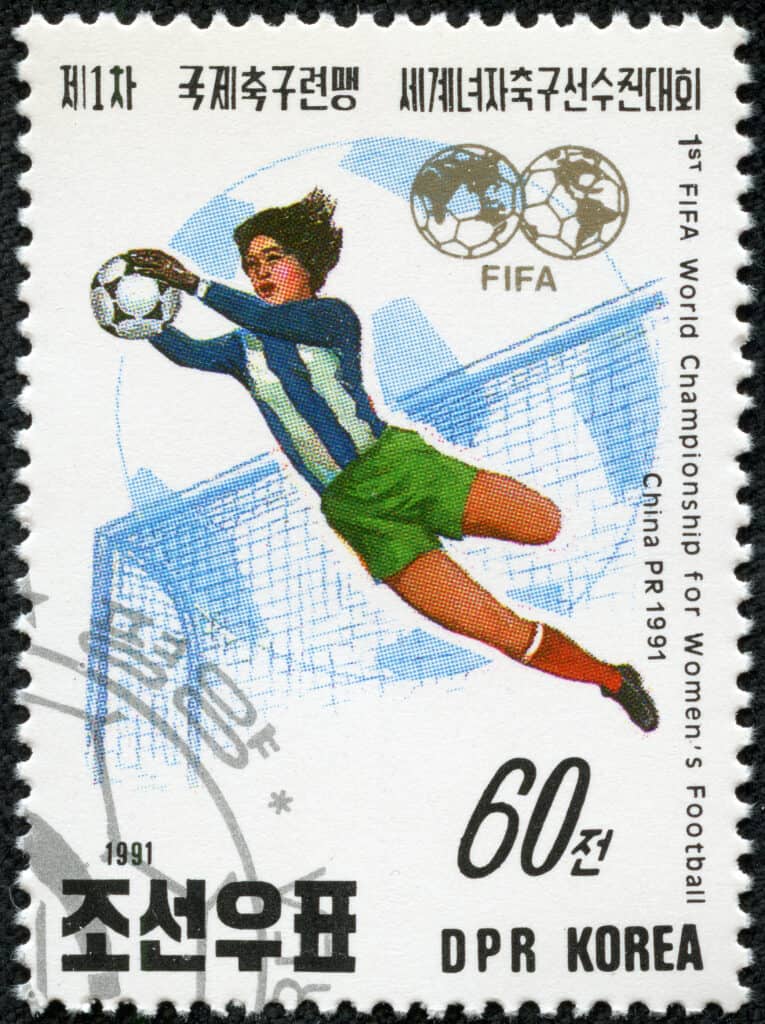
North Korean stamp commemorating “the first FIFA World Championship for Women’s Football, China, 1991″ (ca. 1991) | YANGCHAO / Shutterstock Editorial License
While North Korea’s political doctrine displays a revisionist character that combines nationalism with communism, traditional socialist feminism still influences its gender policy. The key tenet of socialist feminism includes the emancipation of women from economic dependency on their male counterparts and their liberation from confinement to household duties (Mojab 2015). Historically, communist states, at least in theory, attempted to realize the enhancement of women’s status by eradicating their financially and culturally subordinate position in society (Lapidus 1978). Moreover, women under communism were educated to become independent socialist individuals so they could participate in state-led revolutionary projects alongside their male comrades on an equal footing (Shulman 2008). The communist regime in North Korea also embraced this feminist reform from the early stages of state formation. Already in 1945, three years before the founding of the DPRK, Korean communists organized the Socialist Women’s Union of Korea, which encouraged the female population in Korea to take part in industrial and political activities (S. Kim 2023). Women’s labor made significant contributions to North Korea’s staged economic development plan from the 1950s to the 1960s (Hyun 2015). Yet when socialism in North Korea transitioned to despotic communism in the 1970s, the ruling regime encouraged women to be the party’s loyalists in politics, who were under the paternal care of the great leader, while upholding their status as socialist revolutionaries in economic and educational sectors (Jung and Dalton 2006). Since then, this image of politically dependent but industrially and ideologically resolute individuals has gradually become an ideal type of North Korean woman. Hence, although women and men can maintain equal relations at an interpersonal level, the female population as a whole is subordinate to the male political leader at a structural level in communist Korea.
Sports development in North Korea also reflects socialist feminism. It should be noted that female athletes from socialist countries demonstrated remarkable speed and strength at international sporting competitions particularly between the 1950s and the 1970s (Hoberman 1984). Their performance surprised many Western observers, as the women’s muscular athleticism defied the conventional gender norm in the West at that time (Riordan 1991). Such outstanding sporting ability was closely related to their feminist policy to produce a strong female body through sports and physical activities. In comparison with the Soviet Union and the German Democratic Republic (East Germany), North Korean female athletes were less competitive at major international championships during the Cold War. Yet this does not mean that women in North Korea were physically docile and sedentary. In fact, North Korea also encouraged the female population to actively engage with athletic culture in line with socialist feminism and through this effort was able to produce a few notable female athletes (N. Lee 2019). The first North Korean to represent the country at the Olympics was Han Pil-hwa, who won a silver medal in speed skating at the 1964 Olympic Winter Games in Innsbruck (Cha and Andy 2018). Her achievement also marked the first time an Asian woman had ever won a medal at the Winter Olympics. Additionally, the middle-distance runner Sin Kim-dan set an unofficial world record in the 400 m and 800 m races at the Games of the New Emerging Forces (GANEFO) in 1963 (Johnson 2021). Her records were not ratified because the International Association of Athletics Federations refused to recognize the GANEFO as an authorized international competition (Barker 2023). Nevertheless, these episodes were a clear indication that an active sporting culture existed among women in North Korea.
In the late 1980s, sports in North Korea began to carry a highly nationalistic undertone, and since then winning a trophy at an international competition has become an essential political project for the communist regime (Merkel 2012). In the final stage of the Cold War, when a mood of détente emerged between Washington and Moscow, the North Korean regime needed to strengthen its political doctrine amid fluctuating international circumstances (McEachern 2010). As noted earlier, sports offers communist Korea a useful vehicle for projecting a source of collective identity to its people under the banner of autocratic socialism (Lee and Bairner 2009). In this respect, the DPRK started to invest resources in the development of a few strategic sports that present the country with a strong chance of achieving international success (J. W. Lee 2018). Women’s football was one of the chosen disciplines.
In the mid-1980s, FIFA (Fédération Internationale de Football Association) was considering launching a women’s football championship for the first time (Dunn 2016). China organized the inaugural FIFA Women’s Invitation Tournament in 1988, and three years later it also hosted the inaugural Women’s World Cup (Williams 2007). In this nascent period of international women’s football with no ultimate reigning champions, North Korea noticed a window of opportunity for developing a world-class soccer team (Henson 2024). Its gender ideology, based on socialist feminism, constructed a sociocultural space in which footballing women prospered naturally. The fact that China, North Korea’s neighbor and closest ally, fielded a competitive female squad at international tournaments gave communist Korea confidence that it could also produce competent football players (Hong 2012). Subsequently, the DPRK initiated a planned women’s football development program in the late 1980s.
After its international debut in 1989, the DPRK women’s football team gained a series of medals at various competitions. Particularly, North Korea was one of the best footballing nations at the Asian Games and the AFC Asian Cups until 2014 when FIFA suspended it from international football events due to doping allegations (Kirby 2015). Although Team DPRK has mostly been ranked among the top 10 footballing nations in FIFA’s records, its adult women have been unlucky at the World Cup and have never won this championship. It is, instead, junior footballers that have genuinely been exhibiting first-class performances on global stages. North Korea’s U-20 and U-17 teams became the world champions three times each. These youngsters also hold six continental championships. These outcomes prove that the DPRK’s strategic development of women’s football, despite the doping scandal, has been successful. Due to North Korea’s political isolation, women’s football is one of the very few areas in which the country can display excellence to international audiences. Understandably, the footballing triumph offers the North Korean regime an effective means of political propaganda to convey its exclusive nationalism and fortify its authoritarian domination (Lee and Bairner 2009). It also unveils double-layered femininities in North Korea, namely the representation of patriotic socialist individuals and the embodiment of steadfast loyalty to their male leader (J. W. Lee 2018).The incumbent North Korean leader is particularly keen to utilize sports as a propaganda tool, and women’s football aptly serves this political purpose in his country. For instance, in 2011 North Korea produced a television drama series, Our Women’s Football Team, to commemorate its victory at the 2006 U-20 FIFA World Cup, the first major international title Team DPRK had ever held (Kim and Jeon 2018). In 2013 Kim’s regime opened the Pyongyang International Football School to train its football hopefuls, including girls, systematically and scientifically from an early age (Ahn 2015). The ruler also accentuated the strategic development of women’s football as a key policy priority in his announcement of the national sports programs in 2015 (Choson Sinbo 2015). In this respect, 2024 marks a distinctive highpoint in the history of North Korean women’s football because their youth national teams (U-20 and U-17) won four international tournaments that year alone. Seemingly, Kim’s plan is finally bearing fruit.
This essay was first published in Social Research: An International Quarterly, a John Hopkins University Press publication, in its Fall 2025 edition. Reprinted with permission.












Sportswashing. Deplorable. Really.
Surely you DO know that the DDR olympic wins were an artifact of coerced illegal doping?