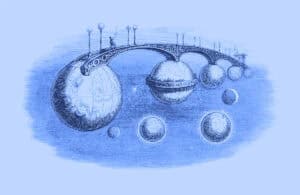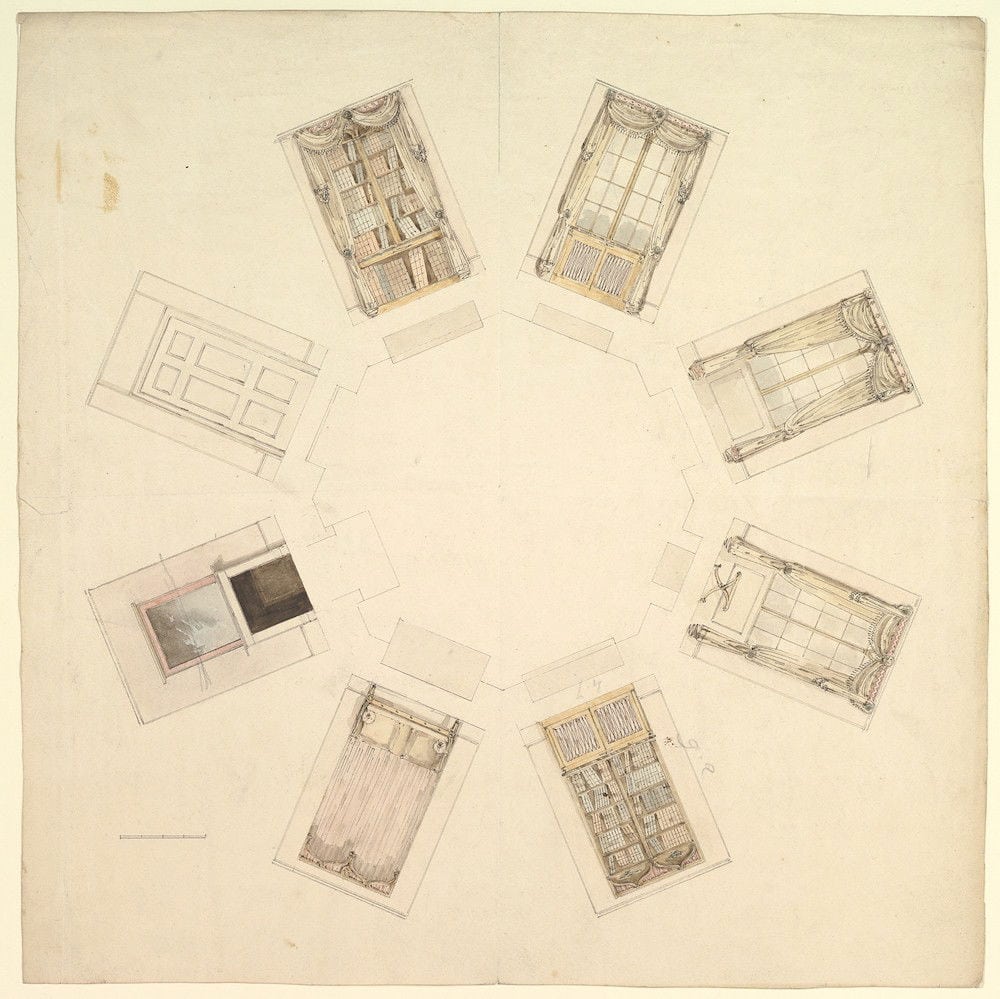
“Octagonal Room With Sectional Views” (1800s) | Anonymous / The Metropolitan Museum / Public Domain
“Who you are and who you think you are: They grind against each other, sand in the frosting,” poet and painter Richard Siken writes in his long-awaited third collection. I Do Know Some Things (Copper Canyon Press, 2025) continues his previous exploration of selfhood, but with a harrowing purpose. In the aftermath of a debilitating stroke that left his right side paralyzed in 2019, Siken attempts to recover his language, body, and memory in an intensely autobiographical book of prose poems that is electrifying and difficult to read. If your mind buckles and your body doesn’t remember, what are the stakes of metaphor? What does poetry have to become to build back a self?
This new collection, which is shortlisted for the National Book Award, is nearly twice the length of Siken’s previous books: Crush (2004), a Yale Series of Younger Poets Prize-winning cult classic on doomed queer desire, and War of the Foxes (2015), a more slow-paced, abstract meditation on the meaning of art and self-expression through his paintings.
This attention to the visual is continued in the design of the new collection, which has a textured cover that feels soft to the touch, with the title scrawled on in a handwritten typeface. The tomato-red and eggshell-colored endpapers of artist Cecil Touchon’s “Typographic Abstractions” paintings are striking against the matte black cover. The painted collages of upside-down, layered lettering are a nod to Siken’s breakdown of language after the stroke.
In contrast to the abstraction and myth-making in his last book, Siken has called I Do Know Some Things a literal “encyclopedia of self.” Its 77 prose poems span childhood memories of dislocation—divorce, deaths, and the placelessness of growing up gay in a dysfunctional family—to his foggy present shifting between hospitals and temporary homes, and shifting sense of body and mind.
There is even a sly reflection on the legacy of Crush, which critic Raquel Gutiérrez calls a “gateway drug” to modern poetry—an apt description not only because of its popularity but because of how Siken captures the visceral, bodily stakes of longing. Images of blood, sweat, hotel rooms, and alleys flash between indented lines at breakneck pace; silences loom in the white space, where no words exist. Perhaps the lasting effects of such drugs have unintended consequences later in life; the carefully constructed poems in Crush have gained a second wind on Instagram and Tumblr posts in the last decade and a half. Lines such as the one from “You Are Jeff” (“You’re in a car with a beautiful boy, and he won’t tell you that he loves you, but he loves you”) are cut and pasted into fanfiction without context. Does Siken want this legacy?
But where the poems of Crush cascade in fragments, I Do Know Some Things arranges itself in square and rectangular blocks of text. As the critic Zach Strait has noted, each poem is like a small room within the house of the collection, four sturdy walls against which Siken braces himself. “I wouldn’t break the line. I was afraid to. Too much was already broken… The sauce breaks. Your heart breaks,” Siken writes, laying each word down like a brick. For a poet trying to retrieve the cognitive capacity of meaning-making, the justified paragraph is a necessity. The sentence becomes a medical device.
As Siken relearns nouns and verbs, the associations his mind makes (calling a waitress a “restaurant nurse,” or a forest a “box of leaves,” or saying “dark tree” instead of night) are not playful rearrangements of language crafted for poetic effect; his words misfire. In the hospital, “dark-struck, slumber-felt, sleep-clogged,” he is angry, lost, and confused by his inability to communicate with the doctors and nurses. Readers, by contrast, can recognize the symbolism of these slippages. When he perceives a doorknob as “a rock for the hand,” something fundamental about his processing of the world remains.
The collection thrums with philosophical questions of authenticity and construction, expression and performance. Can you ever go back to who you were before, and if it were possible, would you want to? Are you an unreliable narrator of your own life?
But even as the poet’s past and present blur, the four walls of text provide him with a steadying element. As the book continues, the sentences take larger leaps, the logic becoming more confident. The room contains more furniture, or its windows are larger. Siken transforms before us.
Take the distance traveled between “Landmark,” from the beginning of the book and ”Dawn,” near the end of the collection. In the earlier poem, Siken writes:
There isn’t a word for it, moonlight, slippery. There isn’t a word for it, moonlight. Through every window at once. I concentrated on the moon. I dug a hole in the sky and called it the moon. A hole in the sky and we call it the moon.
These repetitive syllogisms make the scene feel dream-like; they are also desperate grasps for language.
And from the end of the book, in another room:
The moonlight cast blue shadows on the ground outside the window. Dust on the furniture in the extra bedroom: I sat on the bed. White shag carpet in the living room and a textured ceiling: I lay on my back and raised my legs, pretending to walk on the moon.
The connective tissue of colons marks a change in the poet’s ability to see himself as the playful observer of the particulars of place. The moonlight and the room offer stillness rather than slipperiness. Four walls, as much as they can oppress, hold the potential to heal.