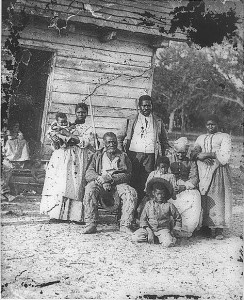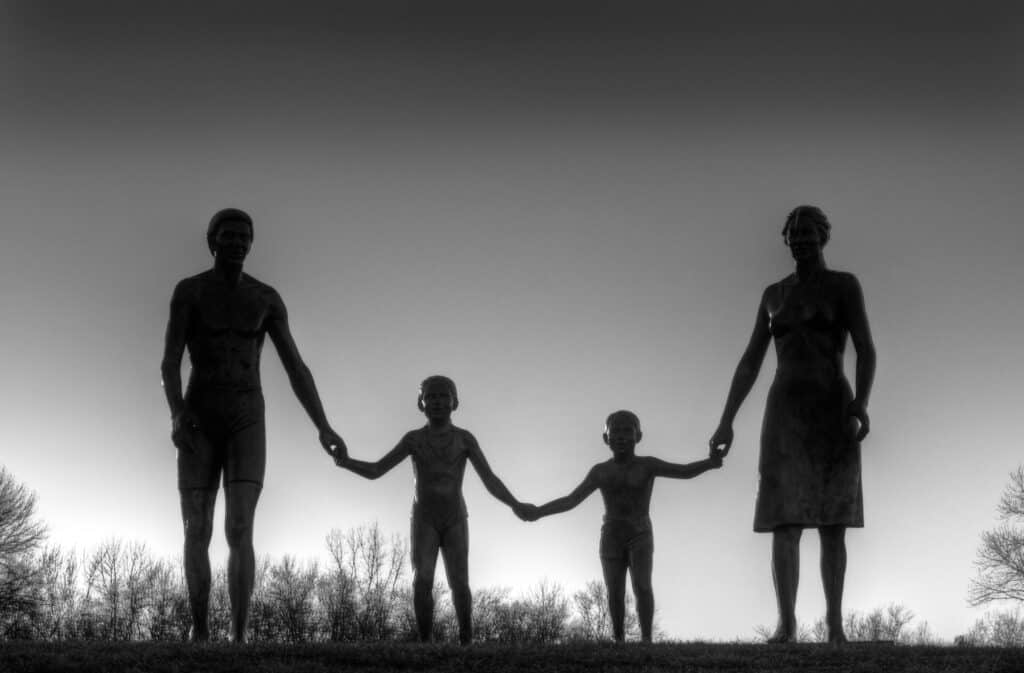
Photograph of “The Family” by James Francis Hopfensperger, Chippawassee Park, Midland, Michigan (2012) | Christian Collins / via Flickr / CC BY-NC-SA
“The Left has largely abandoned questions of the family,” charged the queer and trans Marxists K. D. Griffiths and J. J. Gleeson in 2015. “Tacitly, at least, leftist organizations today have accepted families as a feature of contemporary capitalist society, which they will do nothing to end.” The authors’ timely intervention—presented as “a feminist analysis of the 21st-century family and a communist proposal for its abolition”—slowly but surely inaugurated a resurgence of engagement with the politics of the private nuclear household’s positive supersession within Anglophone anticapitalism. For Karl Marx, the process of positive supersession on all its fronts referred to humanity’s “return” to itself—in other words, the reappropriation of human life—with this horizon of abolition (in German, Aufhebung) combining elements of destruction, transformation, and actualization vis-à-vis the present class-bound state of things (Weikart 1994, 664). Likewise, for twenty-first-century family abolitionists, the task is to make the private nuclear household materially unnecessary and as such socially obsolete, thereby—paradoxically—realizing for the first time the family’s otherwise impossible promise. Momentum in this imaginative revival has been gathering. After broaching the topic in 2015, Gleeson and Griffiths continued to theorize the necessity of moving beyond the family as part of queer and trans liberation (Gleeson 2017), and a plethora of new voices joined the chorus.
In 2018 the Black studies scholar Tiffany Lethabo King revisited US archives of revolutionary Black womanist calls to overthrow the family circa 1970, while simultaneously reflecting on her profound love for her “own extended Black diasporic family” as a source of commitment to the project of “addressing [the family’s] limitations— even its elimination” (2018, 86) in the future. M. E. O’Brien, the communist sociologist and organizer, published her landmark abolitionist periodization of the family, “To Abolish the Family,” the following year (2019b). Alongside others, in my own essays, I had in this time been seeking to reanimate the problem of lifemaking labor’s privatization in the context of birth and the legal manufacture of kinship (Lewis 2015, 2016, 2017, 2018). My academic and short-form efforts ultimately grew into Full Surrogacy Now: Feminism Against Family (2019), my book scrutinizing human gestational labor as a jumping-off point for the positive supersession of capitalist parenthood, which evidently helped raise family abolition’s public profile. Subsequently, amid the lockdowns of the first two years of the COVID-19 pandemic, the urgency of a politics of care-deprivatization became even more widely felt, affording plenty of opportunities to clarify the expansive, care-communizational love-politics at the heart of the terrifying (to many) slogan “abolish the family.” In 2022 a slim crimson-covered volume I playfully refer to as my “little red book”—Abolish the Family: A Manifesto for Care and Liberation—further reduced the terror involved, destigmatizing “abolitionism” in the context of care and vindicating the reproductive principles of “kith” and “comradeliness” in the world, over and above kinship.
Among all the “new wave” family abolitionists, the emphasis on abolitionism’s world-making—not just world-unmaking—character was insistent from the outset. “Rather than orienting toward this question of abolition in negational terms—withdrawing, undoing, subtracting,” the feminist theorist Madeline Lane-McKinley (2018) asked, “how might alternatives to The Family be made imaginable and practicable as a political project of dismantling capitalism’s care crisis?” The radical tenant activist Alva Gotby theorized abolition of the family in terms of “positive abolition” in her PhD thesis (2019) and subsequent monographs (2023, 2025). A number of further contributions by M. E. O’Brien began sketching out what the nascent abolition of the family might look like in magazines such as Commune and Pinko (2019a, 2020), as well as in fiction form (O’Brien and Abdelhadi 2022)—an inquiry crowned by Family Abolition: Capitalism and the Communizing of Care, published in 2023. My Abolish the Family pamphlet published shortly beforehand had aimed to introduce the topic to a wider audience, present a “potted history” of the demand, and poetically mobilize a wish to replace the family with “nothing”—in other words, with the abundance of truly universal nurturance (Lewis 2022a, 87). BothFamily Abolition and Abolish the Family were translated into a wide array of languages, including Spanish, Catalan, French, Greek, German, Czech, Chinese, and Korean.
Meanwhile, in the journal Feminist Theory, the antiwork philosopher Kathi Weeks (2023) elaborated a feminist case for family abolition qua deprivatization of care. Myriad other pro-abolition voices were, at this point, joining the pool. “Family abolition is back,” declared the political economist Alexander Stoffel (2024).
The timing and circumstances of family abolitionism’s comeback are interesting. Western households today are less and less likely to resemble the idealized Fordist male-breadwinner model of the postwar period. (The core capitalist family now is certainly a dual-wage household.) This means that a much greater proportion of reproductive labor than ever before takes waged and commodified forms such as food delivery or cleaning services. Many nations, furthermore, have engineered a dramatic increase in nonfamilial modes of lifemaking among their populations for the management of so-called surplus populations in prisons and detention centers. The left, internalizing the tactical limits of this grim situation, has not only (as Griffiths and Gleeson argued) accepted the family—ever since the global neoliberal counterrevolution of the late 1970s—but actively championed it, not least via the movement for gay marriage rights. Family values during this period have more often been imagined as a bulwark against the White-supremacist cisgender state rather than an extension of it.
It remains the case, for the most part, that contemporary movements dedicated to legitimizing queer kinship in law, protecting migrant kin against state-enforced separation and detention, defending overcriminalized parents—typically mothers—against the court system, or dismantling the state surveillance of proletarian kinship (i.e., abolishing “family policing”) tend to represent family as an unqualified good, especially if equated with “community.” With the recent family-critical turn, however, this has started to shift. To speculate: The realization that the family possesses an antiliberatory structure may currently be spurring a small-scale (re)abandonment of familism on the left, inspired by the display of fascism at the heart of “parental rights” mobilizations around the figure of the transgender child on the global stage (Lewis 2023a). Once one has disidentified from and denaturalized parental domination, it is easier, perhaps, to take a sober look at the family qua system of provision. Does the family per se even provide much, in human lives, at this point?
Ownership, to be blunt, is the main thing, and may well represent the last bastion of the twenty-first-century family form. To have family is to own something; indeed, unwaged labor is not the most salient defining feature of the family anymore, as it was in the heyday of the family abolitionist Wages for Housework and radical welfare rights movements. Thus, the most useful way to grasp familism now—strategically speaking—may be via the lens of private property, which is to say via the possessive relations of nonconsensual hyper-dependency that bind individuals familially, for example, in debt-, education-, and health-related responsibility and in the quasi-prop-ertarian authority of parents vis-à-vis children’s sex. This intuition is why, building on Weeks, I proposed defining the family simply as “the form that the privatization of care takes in a class society” (Lewis 2023c) or “the privatization of care within the home organized around biological kinship” (2023b); similarly, O’Brien stressed that the family is a “system of property ownership” organizing “privatized care” (2023, 90).
The case for family abolition is strengthened, not weakened, by the possibility that the family is a mere bit player in today’s social factory in labor terms. The new family abolitionism responds precisely to the revealed incapacity of the family to provide for humanity’s care-needs, an insufficiency that was exposed amid the crisis of the family (more typically known as the “care crisis” in the discourse under that umbrella that started gaining steam in Europe and the US from 2007 onward [Rosen 2007]). While more family is all too often hazily proposed as the solution to the shortfalls of actually existing family, the concurrent return to a bolder family critique also seems, in hindsight, inevitable. By bitter necessity, to be sure, it was brewing at the same time that the conditions of possibility for the housewife-based family ideal were destroyed, in the sense that capitalism’s protracted crises—since the 1970s—have dramatically shrunk and undermined the functions of the bourgeois private household.
Does it make sense (one might ask) to kick one’s opponent when they are already on the floor? It does, of course. After all, the family remains the locus of most proletarians’ self-reproduction, despite everything. It persists for the majority of people as the simultaneously aspirational, impossible, and austere container for life’s most important activities—namely, the love, care, and sex we depend upon(and live for) yet do not count as “value” for capital. Plausibly, if humanity ever stood a chance of positively superseding it, the time—in this moment when familism’s organized scarcity is most visible—is now. Capitalism has shrunk middle- and working-class family time and parceled up, for monetization, what was previously a lump of unwaged labor called wifehood. But, to borrow Stoffel’s (2024) two-pronged retort to an often-voiced objection to family-critical endeavors: “Does this mean that capitalism is already abolishing the family? No. Does it mean that capitalism is abolishing the bourgeois family? Also no.” On the contrary, capitalism is quite capable of undermining those very features of society on which it most depends. Our task, lest we forget, is to positively supersede, not undermine.
This essay was first published in Social Research: An International Quarterly, a John Hopkins University Press publication, in its Winter 2025 edition. Reprinted with permission.