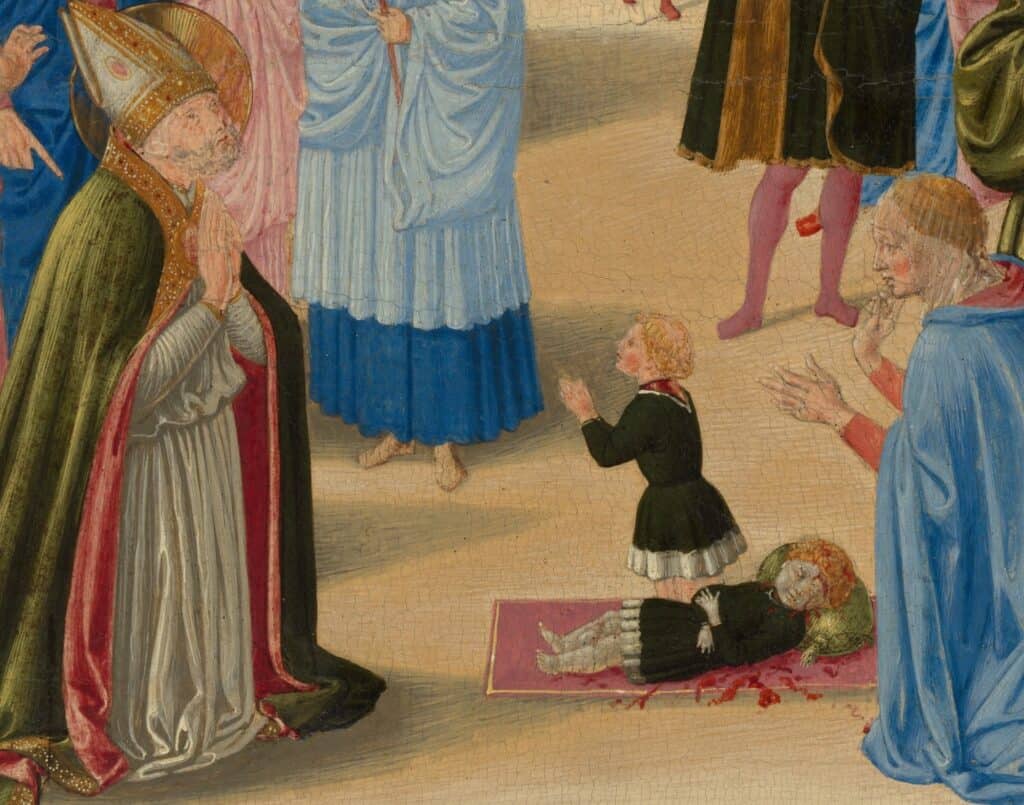
From Saint Zenobius Resuscitating a Dead Child (ca. 1420–97) | Benozzo Gozzoli / The Metropolitan Museum of Art / Public Domain
1.
In my early twenties, I was captivated by the idea that creative processes can return us to the boundless dreamscapes of our childhood. Only back then, I thought, could we afford to experience the world somatically. Not yet captured by social conventions, our bodies had the potential to become everything. Perhaps I was naïve.
In The Poetics of Reverie, Gaston Bachelard writes,
When the human world leaves him in peace, the child feels like the son of the cosmos. And, thus, in his solitudes, from the moment he is master of his reveries, the child knows the happiness of dreaming which will later be the happiness of the poets.
I became caught up in reverie as a radical exposure to the world’s capacity to affect us. With the unscripted curiosity of a child, I thought the poet could tap into the unknowables of our existence.
But how can one sustain this nostalgic infatuation with a child who is nothing but air?
Blissful solitude was rarely an experience accessible to me as a child. This would have entailed a certain kind of abundance, when all we had were endless austerity lines for eggs, bread, and baby formula courtesy of Romanian authoritarianism and IMF debts. Having the luxury of uninterrupted reverie would have also implied a sheltering universe devoid of family conflict, political harm, gendered norms, or institutional abuse.
Bachelard describes a depoliticized child outside of history, power struggles, and cultural life. Reverie, as a kind of transcendence of these conditions, is wishful thinking. I see this child now as an idealized figure flickering beyond the horizon of a world on the brink of collapse, marred by environmental disasters, deep global inequalities, and endless wars.
The innocent child is both a fantasy and a concealment of violence.
2.
To have or not to have a child when the world is falling apart is a question about our political attachments to the possibilities and limitations of the future. Most often, it is also about where we are situated in the vast web of power relations—whether we are close to the eye of the storm or farther away.
Western feminist theory tells us mothers have been persistently subsumed by cultural scripts which fix them within the scope of futurity. Here, birthing becomes a form of depersonalization, a way of sacrificing autonomy to the idealized child for the perpetuation of the patriarchal institution of the family. This is not simply about the uneven burden of care. Jacqueline Rose sees it as a symbolic erasure of the mother:
We expect her to look to the future (what else is she meant to do?), but the seeming innocence of that expectation is an illusion, as if it were the task of mothers to trample over the past and lift us out of historical time—or, in the version that at least has the virtue of its own sentimentality, to secure a new dawn.
This diffuse responsibility, feminist thinkers fear, works as an ethical imperative that nullifies the mother’s sense of self, her ambitions, and her desires. Simone de Beauvoir saw pregnancy as both enrichment and mutilation. The child as a parasite who is possessed by the mother and who possesses her in turn. Here, the child is merely a vessel for patriarchal expectations, a force that annihilates the mother. In its different iterations, including in contemporary debates over bodily autonomy, this foundational liberal feminist critique persists.
I am struck by this reading because it forecloses the relational dynamics between mother and child shaped by intertwined experiences of vulnerability. But I sense there is something far more alarming at play here. Taking for granted the pressures of normative futurity assumes that Western societies expect all mothers to carry their children to term and raise them safely.
How do we account, then, for those mothers whose children are abducted by the state and placed in boarding schools, refugee shelters, and foster care? What of those Indigenous and Roma mothers subjected to forced sterilizations campaigns? Black mothers denied access to adequate reproductive healthcare, who die disproportionately in maternity wards or at international borders? Migrant mothers who witness their children fading from treatable illnesses in detention? And what about Palestinian mothers whose children are killed in their arms by shrapnel or sniper fire? All, we are told, unavoidable losses in the name of a certain notion of civilizational progress.
Mothers and children everywhere are already caught up in the eye of the storm.
3.
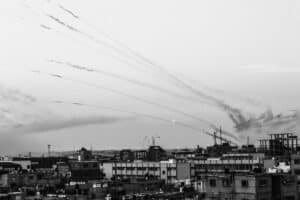
I was four months pregnant when the genocidal Israeli attack on Gaza accelerated in retaliation for October 7. While I took walks around our Cleveland Heights neighborhood and attended prenatal classes, pregnant mothers in Gaza were forced to walk dozens of miles to reach temporary shelter from bombardments in a devastated landscape with no safe zones. As I curated my meals to make sure I ingested enough proteins, iron, vitamins and folic acid to feed my unborn child, pregnant mothers in Gaza subsisted on one meal per day and less than a cup of unclean water. All due to a total Israeli-imposed blockade on food, electricity, and humanitarian supplies. When I delivered my child in a setting complete with high quality medical care, pain medication, birth balls and birthing chairs, countless Palestinian mothers were forced to deliver their babies in makeshift tents, amongst the rubble, without medical assistance. Or they underwent cesarean sections without anesthesia in hospital wards decimated by targeted destruction. Maternity wards and fertility clinics were intentionally destroyed, infant formula confiscated by Israeli soldiers from the pockets of humanitarian doctors at checkpoints, premature babies left to perish in unplugged incubators. This was a concerted attack on the reproductive future of an entire people.
While words like war, conflict, counteroffensive or military campaign were casually thrown around in the US press, they stood in stark contrast with social media reports from Palestinians on the ground in Gaza who livestreamed the methodical obliteration of their entire world. The aim of settler colonialism is the disappearance of the Indigenous population from the land. In Gaza, everything that can support the existence of life has been demolished. Bombings have targeted entire families in their homes, wiping away lineages forever. During the so-called ceasefires, when sheer killing slows down, the Israeli army uses forced starvation, the spread of illnesses, and continuous displacement instead. The destruction has been so systematic that, in two years, a whole society has been reduced to rubble: agricultural lands, water facilities, the healthcare system, universities, most residential buildings, mosques and churches, UNRWA schools, cultural heritage sites. To take Indigenous land, it is not enough to commit massacres or ethnic cleansing. A people’s cultural memory, deeply embedded as it is in the land, must also be razed to the ground—one building, sacred site, and olive tree at a time.
4.
In his lyrical, anticolonial study, Perfect Victims and the Politics of Appeal, Mohammed El-Kurd deplores the fact that Palestinians have been, for such a long time, reduced to women and children in polite, well-meaning Western liberal statements:
One implication here is robbing women and children of their agency and their political or revolutionary contributions. Another is the further demonization of Palestinian men as deserving of death and unworthy of mourning, exiled from their loved one’s embrace.
Despite all this, United Nations representatives, human rights experts, and humanitarian doctors continue to foreground the senseless killing of women and children in their hopeless appeals to a world that has abandoned Palestinians. If one anticipates the essentialist and racist biases of liberal audiences—mothers and children as perfect victims, men as terrorists by default—then, the logic goes, perhaps compassion will turn into action. Perhaps this will finally prove, without a shadow of a doubt, that the Israeli government has violated international law by committing crimes against humanity.
We do not need the reductive distractions of the humanitarian “women and children” framing to understand that settler colonial genocides operate through calculated reproductive violence.
5.
In Gaza, parents moved from temporary shelter to temporary shelter to keep their children safe from bombings. When this failed, they had to collect their children’s limbs from the rubble to give them a proper burial. If their children survived, parents watched them waste away slowly due to engineered starvation. In the summer of 2025, Nada Jouda wrote:
I am terrified of when the morning comes and I start hearing the words “mama, I am hungry.” My daughter is eight and the other day I caught her staring at a wall and smiling. I told her to share the reason behind her smile. She said, “I am excited about going to heaven and eating there. Please mom, when I am there, I want to eat a whole mango by myself. No sharing.”
Mothers Against Genocide amplified voices like Nada’s tirelessly. We organized protests. We raised funds for mutual aid campaigns supporting communities in Gaza with water desalination. We wrote letters, op-eds, poems to whoever would read them. We appealed to our morally bankrupt representatives, hoping against hope that their hearts were not entirely hardened by their hatred for Palestinians, that one more picture of a child starving to death would be the tipping point when empire stops arming a genocidal apartheid state. But empire does what empires know best: it expands and dominates through death and destruction.
None of us deluded ourselves. We knew that our ability to mother as we did, in the heart of empire, was tied to the fact that mothers in Palestine and elsewhere have been prevented from mothering in safety and dignity. The cognitive dissonance between our grief and our complicity altered our moral and political commitments forever. There is the world before and then there is the world after the destruction of Gaza.
6.
The innocent child is contained, vulnerable, and overprotected. From parenting books to state policies to UN resolutions, the child appears as a fragile, passive, unformed human who requires special care and special protections from harm. In these formulations, children are not beings in their own right, but future adults with incomplete cognitive and emotional skills. They are entirely dependent on caregivers, especially as newborns. By law, they are extensions of their parents and of family life. Most often, adults, institutions or states presume to know what is in the best interest of the child, without asking children any questions.
Children are imagined as uncorrupted beings. They exist in an irretrievable state of bliss. They are unblemished mirror images in which we can critique our deformed adult selves. While children harken back to an era of lost innocence, they are also our present and our future. They invariably become the intense focus of institutions, discourses, and policies, and are sent forth as tiny harbingers of our desired futures.
Children are defined through what they are not: autonomous, endowed with reason, in full control of their emotional lives, independent. Only through education, care, civilizational work, can they truly reach their full potential as reasoning adults or sovereign individuals. In this sense, children are shaped by the same exclusions through which colonized subjects have been denied self-determination for centuries.
No wonder the innocent child continues to hold such a powerful symbolic spell over the Western cultural imagination. This mythical child, much beloved and endlessly sentimentalized, is an accumulation of political and economic effects flowing from the entrenched divisions of late liberal capitalist societies shaped by empire. The innocent child is based on a model of childhood that has historically cleansed itself of the signifiers of poverty, otherness, and marginalization. Above all, he gains his distinctive features through the exclusion and negation of non-white childhood.
We only need to read Charles Dickens’s novels to see how the sentimentalization of childhood—at a time when British society became industrialized due to the extraction of wealth and labor from the colonies—helped recast British children from laboring bodies to precious symbols of bourgeois family virtue. In the United States, too, conceptions of childhood innocence took shape within a white, Christian, middle-class worldview built on the assimilation of Indigenous children and the coercion and criminalization of Black children.
The innocent child has become a central figure of our liberal humanist era. A symbol of Western modernity in whose name wars may be waged and foreign lands continuously despoiled. While it is true that children have been granted unprecedented protections like labor safeguards, compulsory schooling, and welfare laws, the illusion of universal care for the innocent child masks the inequalities in the treatment of actual children in our local and global communities.
7.
We live not far from Cudell Commons in Cleveland where 12-year-old Tamir Rice was fatally shot by a police officer more than a decade ago. The child was wielding a toy gun, as children sometimes do. The police officer was wielding the power of the state, which has long proscribed Black children from presumptions of innocence, from conditions that sustain life, from the grammar of the human. Emmett Till, Aiyana Stanley-Jones, Tyre King, Andy Lopez, Trayvon Martin: despite their small child bodies, they too were illegible as children in the eyes of a white supremacist society.
In her book, In the Wake: On Blackness and Being, Christina Sharpe writes about the ways in which representations of Black maternity are tied to condemnations to a life of violence, thus negating the very possibility of Black childhood:
We trace this history back to chattel slavery and the law of partus sequitur ventrem (again, “that which is brought forth follows the womb”), which dictated that the children of a slave woman inherited the mother’s non/status. Black women and children continue to be cast as less-than-human victims and agents of “natural” disasters, whether in the aftermath of the 2010 Haitian earthquake, a boat sinking during a perilous journey, or Hurricane Katrina.
It is when confronting the suppression of Black life in the wake of slavery, colonialism, predatory capital, forced migration, state terror, and border violence that romanticized ideas of maternity and childhood reveal themselves as myths of a certain historical crystallization of whiteness.
But the response of those of us who write as witnesses to this monumental destruction of life cannot be to coerce Black or Brown children back into a colonial calculation of humanity that has already foreclosed their very being. Our obligation is to interrogate and interrupt the logic of this liberal humanism that says only some lives are precious, valuable, and worthy of being mourned, while others remain invisible, ungrievable, and expendable.
8.
When entrenched mechanisms of dehumanization modulate collective empathy, can shared experiences of vulnerability still disrupt racial divisions?
Agnieszka Holland’s film, Green Border, offers an ambivalent answer to this question. The director’s shifting, unstable camera follows Polish border guards as they violently push refugees back over the border with Belarus under the cover of the night. In one of the most painful scenes in the film, they lift an unnamed Black pregnant woman from the back of a van and throw her over the barbed-wire fence. She lands with an unbearably loud thud. Only a few moments before she was lying on the frozen floor of the forest, alongside her husband, as she received an improvised ultrasound from Polish humanitarian workers. As the fetal heartbeat appeared on the screen, the couple exchanged a few glimpses of joy mixed with relief. We never learn what happened to their unborn child but fear the worst.
In November 2021, thousands of refugees from Afghanistan, Syria, Iraq, Eritrea, and the Democratic Republic of Congo were trapped in a zone of exclusion on the border between Poland and Belarus, facing starvation, dehydration, and hypothermia. Lured by the Belarusian president Aleksandr Lukashenko with promises of safe crossings into the European Union, they were detained and summarily expelled from Poland multiple times, their asylum pleas ignored. Holland’s film exposes these violations of international law with a startling focus on how pregnant and nursing mothers are impacted by border violence. By intertwining stories based on the testimonies of refugees, activists, and border guards, Holland looks at how the radical vulnerabilities of pregnancy can become spaces of mutual recognition and the refusal of violence. One border guard in particular, whose wife is expecting their first child, confronts his own role as perpetrator and turns against the system of exclusion he is required to enforce. But this is an isolated case.
Green Border ends with Poland’s warm welcome of Ukrainian refugees fleeing the 2022 Russian invasion. Scenes of humanitarian care stage a jarring contrast to the violence non-European refugees have experienced at the same borders. Holland shows us that EU countries have the capacity and resources to welcome refugees when they want to, but state care and solidarity are ultimately applied selectively according to racialized hierarchies of empathy.
For me, the distressing scenes of Russia’s invasion of Ukraine and the exodus of Ukrainian refugees felt like troubling reenactments of my family’s past encounters with empire. My grandmother was only a few days old when she and the Moldovan and Ukrainian women in her family were forced to abandon their possessions and home in Bessarabia and flee the encroaching Soviet army bent on re-occupying their lands. I heard this story many times—the packed trains, the chaos, the destabilizing sense of uncertainty—but I still cannot imagine what it feels like to be on the run with a newborn clutched to your chest.
When my students and I discuss Holland’s Green Border, I usually suppress these personal and historical resonances. We focus instead on what the double standards in the reception of Ukrainian refugees reveal about the colonial residue lingering in the European Union project. When delving deeper into violent EU border practices on land and in the Mediterranean, the promises of equality and dignity for all that supposedly capture the essence of Europe appear simply as smoke screens for its continuous domination of the Global South. One of my students, also of Moldovan descent, delivers an impassioned condemnation of the racist hierarchies that humanize Ukrainians and disparage non-European refugees. It occurs to me that, when selective empathy idealizes “our” people as perfect victims at the expense of others, the moral responsibility we feel to undo this discourse, to oppose its inevitable consequences, is even more powerful.
9.
When my daughter was born, I did not feel overwhelming joy. It was a more ambiguous feeling, perhaps an unsettling combination of sorrow, awe, and bewilderment. Her intense newborn vulnerability was crushing. I could see in her eyes the possibility that, should a bout of illness or some other calamity strike, she would be taken away from me as swiftly as she was given. Looking at the tiny fragile body of the baby on my chest, it occurred to me that I am now responsible for keeping alive a human being I would likely love more than anyone else. Someone I could not bear to lose. Those early days, far from being oriented towards the promises of the future—first steps, first words, first meals together—were about this poignant sense of mortality I could not fend off.
I recalled Thi Bui’s first thoughts upon becoming a mother: “Family is now something I have created and not just something I was born into.” An immense responsibility.
In her graphic memoir, The Best We Could Do, Bui retells the stories of her parents, Vietnamese refugees who struggled with the emotional consequences of war, loss, and displacement well into her childhood. Above all, she is concerned that the post-traumatic stress her parents passed on to her would also be generationally inherited by her son. But towards the end of her memoir, Bui observes her son swimming joyfully and recognizes that he can be free despite the heavy family history he is unknowingly carrying within. Bui also knows that her son will grow up in a sheltered environment, a middle-class American suburb far removed from the adversities her parents experienced as children.
This resonated with me as one of the main conflicts immigrants or children of immigrants must reconcile: the coexistence of family histories of oppression and dispossession with the safety and comfort that assimilation precariously promises. Many refugee and immigrant narratives highlight this pressure to display gratitude for being embraced by a supposedly benevolent American society. That is, to keep your head down and avoid any inconvenient references to racism, genocide, or empire at the Thanksgiving table that may unsettle the terms of your acceptance into the fold.
When I think of my daughter’s first days in the world, I am overcome by disbelief that my child should have everything she needs and even more. The love and intensive care of an extended family, a comfortable home filled with books and toys and other wondrous baby gadgets, and the calming presence of trees and sunshine and hummingbirds at her window. I know this is partly due to the privileges she has inherited from her American side of the family. And I am relieved she is safe and cared for. But I also think about my grandmother’s first years of life and the immense gap that separates us from her displacement. When she is old enough to think of her responsibility towards others, my daughter will probably have to grapple with this messy embodied knowledge.
10.
When they escape through prison bars, children’s voices can sometimes permeate collective consciousness. They have the power to destabilize liberal societies’ complacent political detachment. They make it hard to look away from the moral obligations we have to all children, not only to those we are primed to feel kinship or selective empathy for.
In June 2018, ProPublica released a recording of the voices of Central American children held in Border Patrol detention after being forcefully separated from their parents by the Trump administration. Declaring anyone who crossed the border an unfit parent allowed the administration to couch its actions in welfare terms by claiming it was merely rescuing children. On the tape, a little boy’s desperate calls for papá puncture the pauses in between bouts of children’s crying and immigration officers jokingly refer to the children as an orchestra without a conductor. A 6-year-old Salvadoran girl, Alison Jimena Valencia Madrid, repeatedly asks to call her aunt. She has memorized her phone number. When she is finally allowed to make the phone call, she promises she will be good if only her aunt can take her out of detention as soon as possible. Children often take the blame for what is done to them. In a moral vacuum, they place onto themselves the ethical failures of the state. They are compelled to see themselves outside of innocence.
The public backlash to the recording forced the Trump administration to rescind its zero-tolerance policy which used separations to deter immigrant families from seeking asylum. Or what human rights groups more accurately called enforced state disappearances and cruel and inhumane treatment rising to the level of torture. But family separations and child abductions will continue as long as the brutal ICE detention and deportation regime continues expanding through unconditional bipartisan funding.
Our critical responses are bound to fail if we see family separations and ICE abductions as isolated incidents during exceptionally cruel moments in US immigration history. Breaking families apart is a tried-and-true imperial method. Today’s detention centers for separated children are yesterday’s boarding schools for abducted Indigenous children. Bipartisan detention and deportation policies focused on criminalizing undocumented communities mirror the removal of Indigenous people from their lands more than a century ago. The terms may have changed, but children’s bodies remain the central terrain onto which the settler mentality defines and expands itself.
11.
Like Indigenous children in the US, Palestinian children have been targeted for erasure as children by the vast machinery of Israeli settler colonialism. Nadera Shalhoub-Kevorkian calls this unchilding. Representing them as potential dangers means that occupation forces are granted full permission to humiliate, imprison, maim, and kill them with impunity. The occupation undermines their presumption of innocence because, once you strip children of innocence, you’ve denied them the rights and protections granted by international law. To sustain the dispossession of children, their manufactured culpability must be amplified on a global scale.
Minors. Underage. Youth. Individuals under the age of 18. Four-year-old “young ladies.” Fragile lives. These are some of the terms Western media outlets have used to unchild Palestinian children.
Human shields. Snakes. Terrorists in the making. Amalekites. Children of darkness. Human animals. These are the genocidal terms Israeli leaders prefer to use instead.
In between these two disparate, but converging discourses, there is nothing but violence.
12.
In the past two years, we have seen how the growing global movement for Palestinian liberation has disrupted this script by foregrounding Palestinian children’s stories. When they rise out of apocalyptic warscapes, children’s voices may ignite fires.
In January 2024, injured 6-year-old Hind Rajab remained stuck in a car in Gaza City for hours, trapped alongside her family members who were killed after Israeli tanks fired 335 rounds of ammunition on their car. She managed to dial the Red Crescent and begged them to come and help her. It was getting dark, and the Israeli tanks were idling nearby. When Hind stopped speaking, the Red Crescent operator asked her if she was alright. Hind shared she could no longer speak because her mouth was bleeding. She did not want to get her shirt dirty and cause more trouble for her mother. In her last moments, Hind too blamed herself. Paramedics dispatched to rescue her were massacred by Israeli forces when they arrived on site.
Soon after, students erecting encampments against the Gaza genocide on the Columbia University campus occupied Hamilton Hall and renamed it Hind Hall. The occupation, inspired by historical anti-war and anti-apartheid actions, was cathartic for many student protesters who had been dismissed, harassed, humiliated, demonized, and infantilized by university administrators, politicians, and bipartisan media outlets. The occupation only lasted a little over a day before university administrators dispatched the NYPD to violently evacuate and arrest students. But the entire infrastructure of the police state could not stifle the contagious spread of resistance across campuses nationwide and worldwide.
In such rare moments in history, the child’s voice does not simply trigger paternalist sympathy. It brings clarity about what is at stake. It animates a lucid determination to oppose dehumanization. It exposes systems of power. It holds perpetrators and their accomplices accountable for their crimes.
13.
In One Day, Everyone Will Have Always Been Against This, Omar El Akkad captures the moment when generalized disenchantment has the potential to turn into collective refusal. Fed up with the liberal establishment’s rhetoric of care as it aids and abets genocide in Gaza, El Akkad calls on us to walk away, that is, to reject “the machinery that would produce, or allow to produce, such horror.” His is not simply an indictment of the hypocrisy of a specific liberal presidential administration sponsoring genocide. It is a rejection of the morally compromised foundations of the Western liberal rules-based order and its militarized, capitalist domination of the Global South.
What would it mean for us, immigrant writers living in the heart of empire, to embrace refusal as an aesthetic and political practice? The responsibility feels urgent, the task enormous.
It would not suffice to disrupt the assimilationist worldview with our hybrid tongues, unruly histories, and messy cultural practices. It does nothing for Palestinians if the empire that entraps and denies them a future is simply more diverse. We would have to dismantle the ways in which our minds have been invaded, distorted, and reshaped in the image of empire. We would have to write against the neoliberal craft conventions of our era that center trivial individual impulses at the expense of political critique, economic analysis, and moral accountability to others. To disrupt the narratives of empire, we would then have to unsettle our sense of self, our relationship to language, the lenses through which we perceive the world. We would have to foreground those voices that have been erased, dehumanized, extinguished by empire. And we would have to put our bodies on the line, connect abstract thought to action, risk our university jobs, and jeopardize whatever small privileges we may have been granted. Only then could we perhaps claim that we are ready to reframe the narrative and reorganize readers’ empathetic attachments. But, at the end of the day, all of this will remain within the realm of symbolism if our refusal doesn’t seriously engage the redistribution of wealth. Freedom of movement across borders, land back or the right to return to your ancestral land are, after all, forms of resistance to dispossession.
14.
Though the innocent child may have been depoliticized beyond recognition, children are far from apolitical beings. They too can erupt in rage and fight their oppressors when they are treated unfairly. We only do them a disservice if we do not recognize their capacity to resist the violence that is often done to them in the name of dispossession.
Soon after Russia’s invasion of Ukraine, a video went viral supposedly showing an 8-year-old Ukrainian girl confronting a Russian soldier with her bare fists. Her blonde hair in a bun, summer clothes clashing with militarized gear, she raises her fists and strikes at the soldier. The video was shared and celebrated as a testimony to Ukrainian resilience in the face of a ruthless oppressor.
But the girl in the video was in fact Ahed Tamimi, then an 11-year-old Palestinian girl from the West Bank village of Nabi Salih. For most of her life, she has been protesting the arrest and killing of her family members and the confiscation of her home and land by Israeli soldiers and settlers. Images of her defiance against soldiers have become iconic, her flaming hair earning her the nickname Lioness. Like many other Palestinian children arrested for throwing stones or joining protests against the occupation, Ahed was also thrown into an Israeli dungeon for several months as a punishment for slapping a soldier. This has not silenced her, nor has it stopped her image from circulating globally as a symbol of resistance.
In her 2023 memoir, written with Dena Takruri, Ahed Tamimi relies on the resilience of her Palestinian community to demand their right to a dignified future after the occupation has collapsed:
Despite all the ugliness and pain I’ve endured in my short time alive, I still love life. That fact alone gives me hope. So does witnessing the unwavering steadfastness, or sumood, of my Palestinian people. I see that steadfastness in the eyes of the young man whose father was martyred when he was a child and who was later imprisoned himself, but who still insists on living in Palestine. I see it in the persistence of every villager who plants a new olive tree immediately after Israeli settlers set fire to their existing ones. I see it in the smiling faces of the children playing outside with such joy despite growing up in a giant cage. I have hope that those children and their children will have a better life than the one I’ve lived.
Ahed’s fists dismantle the innocent child trope. Her dreams exceed the violence of the occupation. She does not need our liberal compassion. And she has little use for our paternalist rescue narratives.