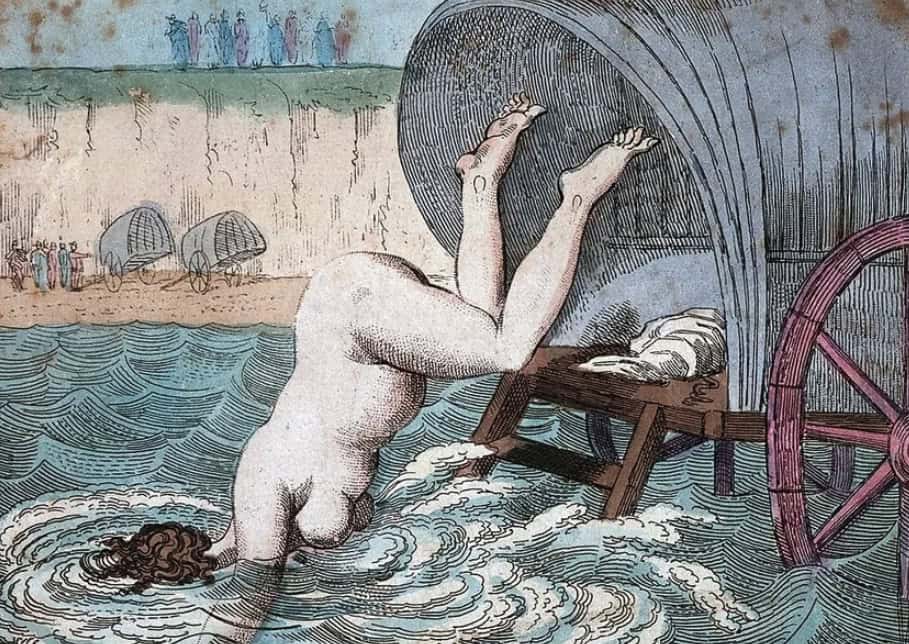
“Venus’s Bathing” (1790) | Thomas Rowlandson / Wellcome Collection / Public Domain Mark
The influencer Vanessa Faga has amassed 1.6 million followers on TikTok, posting a new self-care routine video each day. Her content ranges from a “productive Monday morning” to a “winter self-care night,” to promote a new set of wellness products. She presents a life of curated optimization, where every moment is manicured and aestheticized. Amid the bright pinks and positive affirmations, one of her videos stands out.
A few months ago, the influencer posted her routine for a “Fall everything-shower,” soundtracked to an uncharacteristically melancholic monologue from the show One Tree Hill. As Faga layers on a regimen of scrubs, lotions, and primers, a woman’s voice says, “That’s what I’m afraid of, not being enough.” Responding to this frayed moment of vulnerability in an otherwise polished feed, the video’s top comment reads, “This background sound is my feeling.”
Faga’s weekly afternoon of disciplined self-care is a practice known as an “everything shower,” a one-to-four-hour process of washing, exfoliating, and purifying the entire body. These rituals adopt a range of specialised oils, balms, and tinctures (reliably linked for purchase) to project an image of hygienic optimization to a consumer audience. Influencers caution viewers that this dedicated regimen is “not for the weak” before launching into a rapid-fire succession of product recommendations. From hair masks to face toners, each new tool offers a tailored defense against fine lines, split ends, and oil residue. As the product list grows, so do the praises for exceptional discipline in the comments below. Glowing in natural light and scented oils, the influencer takes on an image of complete self-control, promising viewers a path to salvation through consumption.
The excesses of the “everything shower” make an average skincare regimen look like the bare minimum. Influencers share ten- to thirty-minute instructional videos on YouTube detailing the specific steps to “glow up with me.” Spanning body, hair, skin, and general self care, these ritualized testimonies typically include over 25 “non-negotiable” steps, each requiring a product to be purchased. This rigorous hygienic routine markets itself as a path to self-actualization, with influencers detailing “everyday rituals” that make them feel “put together as a woman.” The act of self-care offers a mechanism for both constructing and enhancing one’s identity, serving as a remedy for a disillusioned self. TikTok influencer Brooke Mason shares how even if her life is “not together whatsoever,” this set of wellness products makes her “feel like [she] has it all figured out.” Hygienic maintenance not only restores one’s body, but also one’s ethereal sense of self, offering the chance to, as influencer Summer McKeen put it, “smell like you have your bills paid, your plants thriving, and your pets well-fed.” The “everything shower” is only a small sliver of a $500 billion wellness industry that continues growing at 4 to 5 percent each year. With 84 percent of US consumers naming wellness as their top priority, an infinite revolving door of brands has emerged to meet this demand. Specific creams, washes, and deodorants are billed as essential components of a true “everything shower.” Beauty editors post listicles naming their “everything shower” must-haves.
To achieve maximum cleanliness (and product placement), influencers will even recommend a “double cleanse,” repeating the same step with two separate products. These prescribed routines will often continue beyond the shower and body, with guidance on preparing your bed, organising your room, or setting your intentions for the day ahead. As influencer Ashley La Marca says in one TikTok post, “Your everything shower begins hours before you even touch the water.” Influencers also stress a regimented standard for what can go on and into one’s body, shunning “toxic” ingredients and promoting a “clean girl” lifestyle. By conducting scrupulous investigations into chemicals and ingredients, users establish a sense of cleanliness, purity, and self-control through their consumption habits.
Routines like the “everything shower” offer a guarded, “do not disturb” space where one can manufacture a sense of self-regulation. For modern wellness followers, these hours offer a moment of respite in a world continuously monitored, dictated, and reinforced by the forces of technocapital. With videos billed as an “anti burnout Sunday reset,” influencers counteract long work hours and endless demands for productivity with “a slow Sunday to prioritize me.” In this sense, these wellness rituals offer a desperate escape from the crushing productivity metrics of the working world, with one influencer sharing, “I personally believe that everything showers save lives.”
Ritualized cleansing, of course, far predates online wellness culture, often functioning as an attempt at control in the face of disempowerment. It was, to point to just one example, a key responsibility for “leading sisters” in the Mormon Church throughout the nineteenth century. Women, isolated from their husbands and forbidden from leadership positions, forged vibrant social networks through healing rituals of washing, laying hands, and anointing with consecrated oils. Limited by a system of patriarchal oppression, Mormon women adopted these purity rituals to reconnect with a sense of personal ownership. While the church dominated marriage, faith, and family life, these healing societies offered a sanctified realm for preserving (or perhaps masquerading) a sense of self-control. This coordinated attempt at autonomy was brought to a halt near the end of the nineteenth century, when the Mormon Church usurped women from their established roles and limited healing rites to the male-dominated priesthood.
Throughout this era, physical purity not only established a definitive hierarchy of religious devotion but also of socioeconomic class. One consequence of the Industrial Revolution in Great Britain was a greater association between hygiene and status. Increased pollution, unsanitary working conditions, and rapid population growth all had a disastrous impact on urban hygiene. Members of the upper class capitalized on their exclusive access to clean homes, nonmanual labor, and bodily care, equating cleanliness with a sense of order or respectability. Throughout the nineteenth century, hygiene signified a privileged withdrawal from the industrialized efficiency of factories, steam engines, and slaughterhouses.
The modern “day spa” first reached the United States in the early twentieth century. Marking a newfound commercialization of ritualized wellness and purposeful “self indulgence,” these locations offered a temporary retreat from the stressors of modern life, with not only showers and baths but manicures, facials, and other specialized treatments. The prevailing culture of opulence throughout the 1980s elevated this to new heights, as spa days became a setting for birthday or bachelorette parties amongst upper-class women. In contrast to the class-straddling bath houses of Japan and Korea, for instance, or the community orientation of Mormon cleansing, American spa memberships came to signify both individual socioeconomic status and moral virtue, suggesting a modern, actualized woman willing to invest time and money into self-preservation.
The “everything shower” represents the infiltration of ritualized wellness in the domestic space. Self-care is no longer limited to the physical or temporal boundaries of a spa; it is now accessible on any given day from one’s own bathroom. Brands market a luxury aesthetic at a relatively accessible price point, offering a vision of obtainable exclusivity to those living in one-bedroom apartments. In the process, a growing population of young women now face the unrealistic self-care expectations traditionally associated with the aristocracy. With unlimited access to a spa of one’s own, the viewer is now presented with an infinite potential for self-enhancement.
Just as the Mormon sisters accessed a short-lived claim to authority within a domineering system, young women seeking self-actualization through wellness are offered only further systems of discipline. The act of washing one’s body now requires rigorous precision, with “me-time” routines demanding the same efficiency as a factory line. By following a routine, avoiding toxins, and consuming high-quality products, young women attempt to reconnect with a disillusioned self. There is always the potential for more steps, more products, and more efficiency, even in an act as mundane as taking a shower. Every inch of the body is double-cleansed, every cabinet is filled with half-used products, and every waking moment is tracked and itemized. Still, a feeling of insufficiency remains.









why is a man writing about women’s purity in this century