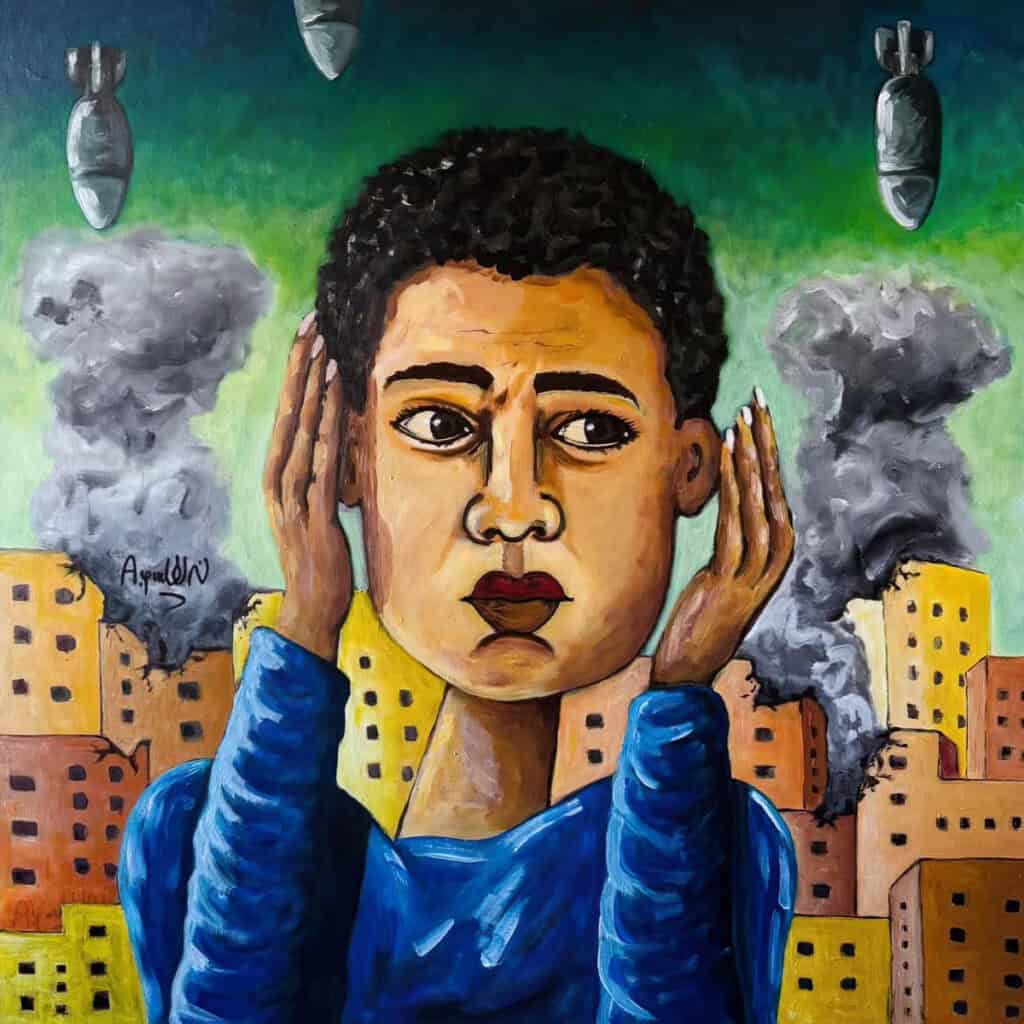
Noise of Death (2025) | Al-Assar / Courtesy of the artist and the Gaza Biennale
The walls of Recess, a quiet Brooklyn studio space, held more than art this winter—they held testimony. The Gaza Biennale is a global exhibition shaped by Palestinian artists working under a genocidal siege that places creative expression at the forefront of collective witnessing. Presented worldwide across decentralized partner sites, last year’s iteration at Recess brought the Biennale’s ethos to New York audiences.
This is no conventional art show but part of a larger, ongoing project that began as a digital and distributed response to the bombardment of Gaza and has grown into a global network of institutional partnerships. This evolution is crucial: The Biennale is not a one-time event, nor is it anchored to a single location; its very form is borderless and collaborative, reflecting the conditions in which Gazan artists themselves create. For those who missed it in Brooklyn, the Biennale will be shown at other sites in the future. There is an open call for institutions to volunteer to host a version of the exhibition.
The Biennale is coordinated by a loose but sustained collaboration between artists in Gaza and a small network of cultural workers in the diaspora who help facilitate communication, translation, and logistics. Rather than operating through a central institution, the project grows through relationships: Artist-led spaces, universities, and independent galleries reach out to the organizers to host exhibitions, agreeing to a shared framework that prioritizes artist testimony, contextual materials, and noncommercial display. In this way, each site becomes both a venue and a partner, adapting the exhibition to local conditions while remaining accountable to the collective vision shaped by the artists themselves.
At Recess, works by 25 Palestinian artists came together in a space designed for active engagement rather than passive observation. These pieces, ranging from acrylic on fabric, drawings on paper, multimedia installations, and short films, were created inside Gaza and sent beyond its borders, even as their makers remain unable to travel. Artists such as Mohammad Alkurd, Yara Zohud, Ghanem Al Den, and Fatima Ali Abu Owda transform their circumstances into acts of defiance and imagination. Their works arrive not as aesthetic commodities asking for sympathy but as dispatches from a reality many institutions have struggled to fully grapple with.
Upon entering the exhibit, visitors received a pamphlet containing the artists’ statements, which included reflections and fragments of dreams written by those who knew their art would be traveling farther than they could. Looped documentary footage accompanied the works, showing hands mixing paint, bodies leaning over canvases, and fingers stitching fabric. Bombed buildings, repurposed corners of homes, improvised workstations: This visual context did not function as spectacle, though at first glance one might assume it could. Instead, it created a framework of sincerity by shifting the focus away from devastation itself and toward the process of creation. The devastation in Gaza is not staged or sensationalized; it is the unavoidable environment in which these artists labor.
This leads to a central tension the exhibition took up: the distinction between consumption and connection. Many contemporary art spaces operate through a logic of consumption, in which artworks are treated as items to collect, classify, or experience in ways that ultimately prioritize the viewer’s satisfaction. In this mode, looking becomes an act of taking: Meaning is extracted without any corresponding sense of responsibility. Within such consumption-driven frameworks, even suffering can be transformed into an aesthetic category, reduced to an image detached from its context and stripped of its immediacy.
The Gaza Biennale counters this not only through rhetoric but through structure, requiring participating institutions to foreground context, process, and artist testimony rather than allowing the works to circulate as detached objects. It refuses to present Palestinian art as material to be pitied or simply digested, and instead asks: What does it mean to build a relationship with the work and its maker? Connection, in this context, demands that viewers remain aware of their position relative to the artist, that the image does not belong to them, that the story is not theirs to appropriate, and that the act of looking carries obligations. If consumption centers the viewer, connection centers the bond between viewer and artwork, and the ethical responsibility that bond creates.
The Biennale makes this distinction tangible by shaping the viewing process itself. The pamphlet writings, the documentary footage, and the careful placement of works throughout Recess formed a layered encounter. Viewers were oriented not toward seamless aesthetic pleasure but toward the friction of the context. The exhibit asserted that to meaningfully see these pieces is to see the people behind them, and to understand that they are not anonymous symbols of crisis, but artists engaged in rigorous craft.
That craft becomes clear in the individual works themselves. For example, Murad Al-Assar’s painting Noise of Death (the image at the top of this article) is one of many featured in the Biennale, and it emphasizes the plight of the children amidst constant bombings and genocide. The viewer is forced to look straight at the faces of solemn children, creating a need to empathize and understand how we have stooped so low to allow this to happen.
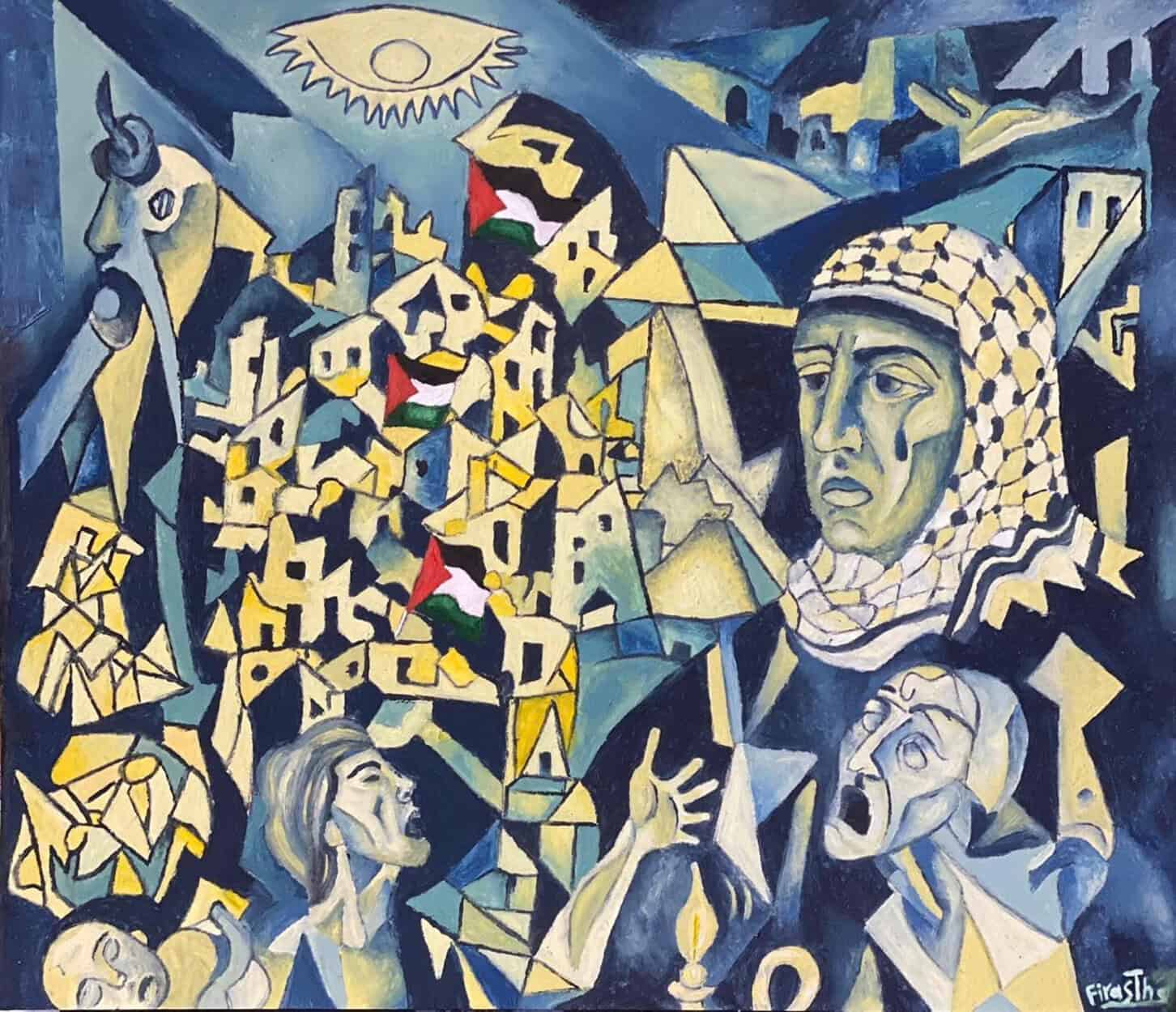
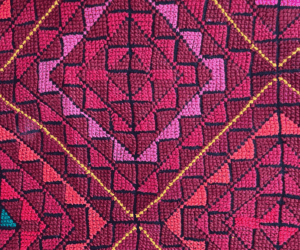
Another piece, Firas Thabet’s Gaznica, shows how its very form counters aestheticization, explaining how it emerges from the environment in which it was created. Created in Gaza in 2025, Gaznica was produced as a tapestry, echoing the way Picasso’s Guernica was also woven into tapestry form. Picasso painted Guernica while living in Paris in response to the devastating bombing of the titular Basque town during the Spanish Civil War, and it has since become an enduring symbol of anti-war resistance. Thabet’s work resonates with that legacy, but with one crucial difference: Unlike Picasso, Thabet produced his piece while living through the very bombardments it responds to.
A third work, perhaps the most striking in the space, was Osama Husein Al Naqqa’s digital drawing The Embrace. Created on a tablet with the tip of the artist’s finger, it speaks to the gravity of the situation—not only because of the lack of tools, but also by emphasizing that through genocide, an artist is able to conjure emotions without the need for tools. By grounding the narrative in specific works, the Biennale avoids abstract moral gestures. Instead, it shows how individual artistic choices of materials, symbols, textures, and compositions carry the imprint of lived experience.
This approach meaningfully confronts the ethics of representation, which challenges what many institutions struggle to confront. Much of the art world’s push toward diversity has been shaped by representational optics, where inclusion becomes a branding exercise rather than a redistributive or relational practice. Museums, galleries, and biennials often incorporate marginalized voices without collaborating with those communities, or worse, without examining the structures that render those communities marginalized in the first place.
The Gaza Biennale offers a different model. Rather than treating exhibition-making as an endpoint, the Biennale uses these small, deliberate shows as platforms for ongoing coordination, education, and solidarity through teach-ins, workshops, and public discussions that extend the work beyond the gallery walls. Cultural care, in this context, looks like shared authorship rather than extraction. It looks like decentralized organizing, where institutions act as hosts rather than owners. It looks like curatorial practices shaped by the needs of the artists rather than the expectations of donors or audiences. It looks like transparency about process, risk, and intention.
The looped documentary footage speaks to these attributes, and why the pamphlets are put into the hands of each viewer upon walking into the exhibit. This is why the works are presented with the explicit acknowledgment that their creators are still enduring conditions of extreme devastation amidst Israeli occupation. These materials are not supplementary but infrastructural, developed collaboratively by artists and organizers to ensure that the work arrives with its political and material conditions intact, regardless of where it is shown.
In London, small community galleries have mounted satellite shows. In Amman, artist-led spaces have organized workshops and screening nights. In North America, universities have incorporated Biennale works into teach-ins and public lectures. Recess is one node in this expanding network, not the sole site of meaning. Across locations, exhibitions remain in dialogue through shared materials, parallel programming, and ongoing communication between organizers, allowing each site to respond to local conditions while remaining accountable to the collective project.
Institutions that participate in the Gaza Biennale must commit to its solidaristic ethos; they do not simply host but join in a process of witnessing, amplifying, and being accountable to atrocities committed with impunity. Taken together, these practices demonstrate how a decentralized exhibition model can sustain collective responsibility across distance, allowing artists and organizers to remain in communication even as the work circulates internationally.
The key question of whether it’s really possible to witness without also being a consumer is not easily answered—the Biennale does not assume the answer is clear or self-evident. Instead, the exhibition structure encourages viewers to ask this question of themselves. What does it mean to look at art not as a product but as part of a relationship? How does the viewer’s role change when the artwork is not for sale, not for personal branding, not for Instagrammable moments, but for communally held remembrance?
Standing before these works, the viewer feels the duality the Biennale holds: the weight of grief and the persistence of beauty. The exhibit asks its audience not to reconcile those forces but to carry them simultaneously, to understand that creation does not cease in the face of genocide. In this way, the Biennale fulfills art’s oldest purpose, to affirm life even when life is under threat.






Incredibly thoughtful piece 🕊️
So very Brilliant. While reading , I felt a part of the experience that the artists portrayed. Thank you Nate for this amazing insight.
The weight of grief & persistence of beauty.. This is what we have to hold on to and this is what we learn from these artists