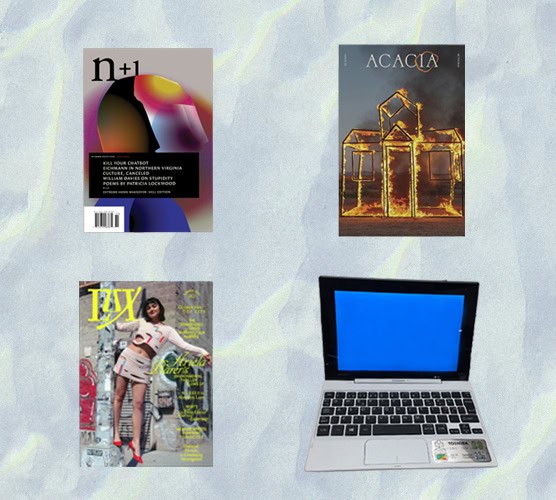
Covers of Lux magazine, Acacia, n+1, and Norsk Blåskjerm Windows 10 | Courtesy of the publishers / Public Domain
Friday the thirteenth felt like a fitting day to gather a group of independent writers and editors for a discussion on the current state of political publishing. On February 13, Natasha Lennard, Intercept columnist and Associate Director for the New School for Social Research’s Creative Publishing and Critical Journalism (CPCJ) MA program joined Matt Peterson, filmmaker and director of Woodbine, an experimental arts hub, to host the second edition of an event that originated at The New School in 2024.
The panel included Nick Pinto, founder and journalist at the worker-owned local NYC news site Hell Gate, Hira Ahmed, founder and editor of Acacia, a political and cultural magazine for the Muslim left, Colin Vanderburg, senior editor at n+1, a literary, cultural, and political magazine founded partially in response to the Iraq War, Natalie Adler, founder and editor at the feminist-socialist Lux magazine, and Edward Ongweso Jr, cohost of the podcast, This Machine Kills, author of The Tech Bubble newsletter, and senior researcher at Security in Context.
The following transcript has been ended for clarity and length.
Natasha Lennard: The point of this event is to engage explicitly with what it means to do political journalistic editorial work: what it is to understand that as politics in a moment of escalated fascism, both in terms of the actual content produced and how it’s circulated, and in terms of how we think of ourselves in relation to social movements and struggles.
Matt Peterson: In 2024, we hosted a very similar kind of gathering. Since we’ve known each other, there’s been this sense that there are these institutions, like universities and mainstream media outlets, and then some of us consciously decide to operate outside of them. But there was always a sense that you could take for granted that those other institutions would continue to exist. And I think now we’re saying that’s very much not the case, and if we do this in two years, it might have to be at Woodbine [rather than the New School].
Lennard: To start, I would love for you each tell us about your project: what does it do and how does it see its relation to politics today and its imagined publics?
Colin Vanderburg: n+1 is a magazine of literature, culture and politics published in print three times a year. But we also publish pieces online several times a week on average. The magazine was founded in 2004, I think very much in another moment of crumbling institutions. It was a moment of great political conformity around the invasion of Iraq and Afghanistan, and a sense of sort of stagnation among literary institutions; it was a time where literary magazines didn’t include politics and political magazines didn’t care about literature.
It’s also a magazine that was both born out of and continues to thrive in the margins of both academia and publishing, even as we’ve come closer to the center of publishing in some ways. There’s always a sense that it’s a space for experimentation, both formally and politically. We’ve never had any kind of party line, but we’ve always been a magazine committed to the left and to anti-capitalist politics. Our editors and writers have always included social democrats and socialists and communists and anarchists of every stripe, and we very much seek to foster that kind of ecumenical dialogue within the left.
Natalie Adler: Lux was founded in 2001. It’s a socialist feminist/feminist socialist magazine. A lot of us who founded the magazine knew each other from the Democratic Socialists of America, but although we say that the magazine is socialist feminist, I would also say, similar to n+1, that we publish all stripes of the left as long as they are unified around a feminist principle, which we would share with bell hooks’s definition of feminism, which is that it is the “struggle against sexist oppression.”
We talk about anti-fascism, we talk about abortion, we talk about queer and trans rights, we talk about Palestine, we talk about unions and workers organizing. And we also have an international focus. We come out three times a year and we are scrappy and a labor of love, but we wanted to create a glossy magazine of the likes of when Teen Vogue existed in print.
Nick Pinto: Hell Gate is a news site covering New York City. We were founded in 2022 by a bunch of unemployed and underemployed journalists. All of us as founders had been through the ringer of different sorts of media ownership. I did two stints at the Village Voice, the second of which was under a billionaire owner who shuttered the publication shortly after a difficult union contract negotiation. Some of my colleagues came from Gothamist, which got absorbed by WNYC and struggled under a nonprofit management structure that was not conducive to journalism. Another founder came out of the former Gawker Empire (RIP), which had its own tangle with private equity. All of us were thinking about what it meant to do journalism on our own terms without the interference of ownership or management, so we decided to try to do it on our own. And that is a political thing, I suppose, because we are seeing the financial underpinnings of journalism collapsing all around us at a very alarming rate.
In terms of our editorial and political project, I think we are less explicitly political than other publications represented on this panel. We are covering the news of New York City on a daily basis. Hell Gate‘s editorial intervention, I think, is to be the people at the press conference or writing about what happened, who are prepared to be aggressively skeptical of power.
Hira Ahmed: I started Acacia in 2023. Put simply, it’s a magazine of politics and culture for the Muslim left. The main impetus was to create a forum for taking our thinkers seriously and critically engaging with them and challenging them. When you don’t have a space that is for Muslims, by Muslims, there’s this trap where you sort of have to pander to non-Muslims [in mainstream media]. And so non-Muslims end up deciding what is newsworthy vis-a-vis your community. There is often pressure to positively represent your community and none of those things really serve us. We wanted to get rid of the non-Muslim gaze and be honest about our own problems.
We also have poetry and literature in our journal because I think those mediums are historically, in every culture and tradition, really important in challenging dominant narratives and communicating politics and building imaginaries that we can then actualize. Poetry, especially, has been such an important part of Muslim history, so it was important to highlight that. We think of our audience as anyone who identifies as or with Muslims, so that includes anyone who is interested in understanding issues that affect the Muslim community, alongside Muslims and not as an interloper.
Edward Ongweso Jr: Most of my work is concerned with providing critical analysis of technology, specifically asking: why do we have the technology that we have? What are the financial incentives in developing or innovating certain types, what technological designs are given up and what are the political forces or the coalitions behind choosing a particular type of technology and the way that we have to use it? I think today, one example is why, when it comes to artificial intelligence, are the major products being offered to the public sycophantic chat bots, instead of almost anything else that could be integrated into your life? What kind of technologies can you expect to emerge in a system where the only priority is not whether something is going to improve the social good, but if it’s going to maximize the ability of a corporation to develop a product that will yield some consistent revenue stream out of you? It’s very hard independently or even with a group of people to make sense of what actually works, what to be concerned about, what not to be concerned about. And the hope is with my work and work with others who are focused on this tech is to give people a little bit of a roadmap.
Lennard: I think of this as an extraordinary golden age of little magazines and new publications, but on a shoestring budget and in a lot of terror, and also with a lot of passion and commitment. So it’s sort of beautiful and terrible. But Nick, Hell Gate has a worker-owned model, is this where we should all be going? Why was that important for Hell Gate? What does that really mean?
Pinto: There are two pieces to this. There’s the ownership stake and horizontal self-governance of the operation, and then there’s the revenue model, which is related, but distinct. The through line there is we didn’t want anyone to tell us what to fucking do, be that investors or philanthropists or a board. We have gotten some extremely helpful money from individuals and a handful of foundations. Our experience has been that the foundations for the most part don’t really know what to make of us because the trend in the philanthropy world campaign to rescue journalism is very much in the nonprofit model. I sometimes go to a dark place where I think that there is a malevolent conspiracy among the people who broke journalism in the first place and who are now trying to rebuild it in a way where it’s really dependent on their largess. So for that reason, what could be more natural than to be directly funded by the people who are reading your work?
As to whether we should all be doing that, you’re catching us at a great time. The line continues to go straight up. It looks really promising, but that line is going to start to flatten out. There is some natural limit of how many people want to read New York City news of this particular inflection. And while this is great and I want to see it get as big as it can, I have no expectation that this model scales in a way that comes close to making up the deficit in the kind of journalism that was underwritten by advertising 50 years ago. So this is another thing that we should all be experimenting with, and maybe it gets us somewhere, but I don’t think this is the thing that’s going to save us.
Peterson: I think now for the last five or 10 years we have internet, social media platforms, algorithms kind of dictating in many ways how we think, how we write, how we understand the news. And just thinking about for you guys as writers or editors, how do you resist that or how do you feel or play within that paradigm?
Ahmed: We launched in print for a lot of reasons, but one of the big ones was wanting to resist the reactivity of the internet, and I think that we have managed to do that. I’m very proud of our rigorous fact-checking and deeply thought-out arguments that are well-researched and consult both academics and lawyers and all sorts of subject matter experts so that you’re getting a well-rounded story. But there has been a lot of pressure to digitize, and everyone’s always asking us, ‘When are you going to do TikTok? Why aren’t you on Substack? You need to turn all of your articles into ten second reels because nobody reads anymore and that’s the only way to get your message out.’ We’re trying to figure out how to be online in a way that aligns with our values, but also recognizing that that’s where most of the eyeballs are.
Vanderburg: So as I mentioned, the print magazine does appear three times a year at pretty regular intervals. And I think that kind of timescale does offer a certain balance or medium between the desire and the obligation to intervene in a timely way in the pressing crisis of our moment, but without feeling the obligation to respond immediately or reflexively to the news. The political pieces in particular are a venue for that kind of mid-range thinking, trying to understand the broader conjuncture while remaining grounded in the day-to-day specifics of the moment.
But I think in our online section, often we try to harness that cycle of continual rage and reaction towards something more considered and more critical. One of our most widely read pieces recently was an on-the-ground dispatch from Minneapolis by Aaron West. He wrote this sharply observed moment-by-moment diaristic report of rapid response organizing against ICE in Minneapolis. It wasn’t a quick take or a packaged response, but it was an immediate engagement with news that everyone was consuming.
Lennard: This particular moment is so horrifying. Nothing is heading in a liberatory direction, but we are seeing such extraordinary sites of resistance. I always tell my students that anyone who tells you that journalism changes the world is not understanding a theory of change, for which good journalism is necessary whilst being insufficient. How do you feel about the kind of work you are doing and its role in the various political struggles that make up this conjuncture?
Vanderburg: In some ways this is the animating question of the entire n+1 project. As Trotsky said, the place of art is in the rear of historical advance. So we want to be clear-eyed about the ability of any literary or journalistic culture to directly advance political struggle in any leading capacity. But at the same time, we don’t want to let our pessimism of the intellect outrun our optimism of the will. We have a commitment at n+1 to publishing the first-person, reported experience of organizers or activists. I’m thinking, for example, of Alyssa Battistoni’s wonderful essay “Spadework” about labor organizing among graduate student workers from 2019. Also “Not One Tree,” which is about the Stop Cop City movement in Georgia by Sasha Tycko and Grace Glass. These pieces merge closely argued, deeply historicized political thought with literary flair and polished prose, and that doesn’t feel like an added luxury to me. I think the quality of writing and the quality of thinking are closely connected, and at a textual level, I think that’s one way that we negotiate this question.
My last thought is that it’s endlessly fraught with contradictions and paradoxes. We at n+1 are very much embedded in and dependent on these institutions of cultural production that are themselves deeply unequal and hierarchical. While I genuinely believe that we protect our editorial autonomy and our political principles, there’s a constant negotiation and uncertainty about, what are we really doing? What are we really achieving? Whose minds are we changing?
Adler: I think that the role of magazines like Lux is to bring people left, to radicalize people, and to nourish and edify people who are already there on the left. I really believe that we have a lot of power already; we have power in each other and we have righteousness on our side. I do believe that if Lux can get into anybody’s hands, that it could get them to move maybe past a sort of more basic sense of feminism or socialism—or leftism, for that matter.
When we started in the late 2010s, it was the post-Hillary, post-Girl Boss post-the immediate years of Me Too, and we were in this moment of feminism where we were reeling from the most terrible and basic and barely even liberal conceptions of what feminism could be. So we wanted to have a magazine that would help people with a burgeoning sense of feminism be able to define feminism as a site of struggle, one that is historic and international. We hope that somebody who’s reading this magazine is able to say, ‘Okay, other people have been doing this work for a long time. Other people are doing it right now and they’re doing it all over the world. Our struggles are not only linked, they’re also not new.’ I think that’s what our role is: to fortify those of us who are already battle-weary on the left, and to move people still. Even if I feel like I should be more boots on the ground sometimes, I do think this work matters. It has to, right?
Pinto: I don’t think we expected when we started Hell Gate how much of it was going to be cultivating and nurturing a community of readers. That’s especially clear for us because we have a local focus, and so it’s sort of part of our business model, but we’re hanging out with these people. We hold events and we bring ’em together. To the extent that that is reassuring people who love the city and who are consequently enraged at everyone who’s fucking it up, if we can bring those people together, I comfort myself that that is a thing we’re doing.
Ahmed: I came to this work from housing court, where I defended tenants from eviction. When I went into it, I thought, ‘This is a way to use your practical skills to help the most vulnerable in a direct way.’ And I left that to come do this. So that’s just to say that I think anywhere you try to plug in and be the most effective, you’re going to come up against the limitations of that space and the ways that the institutions and the laws that govern that space design it so that you cannot be effective. I experienced that in the legal world, and I’m not surprised that it exists in the world of journalism as well.
I agree with Nick that I’ve been surprised at how much community matters to people in this moment. We have these launch parties, which at first I thought were kind of silly and superficial, but really, they’re a place for people who feel very lonely right now to come together. And I think that alone is affirming. I hope that the magazine is making an important intervention, but even on my most cynical days, I think at the very least it is serving as a record for the archive that there were people who resisted and this is how they did it. The New York Times is not telling their stories, but Acacia is.
Lennard: I’m particularly interested in Eddie’s answer to this. In this moment of AI almost determinism, how do you feel like your interventions can help?
Ongweso Jr: I first got into journalism in 2019 because I had been a labor organizer for Uber and Lyft drivers, and it was an incredibly soul-draining and depressing gig. There was an unimaginable chasm between the reality you see organizing the drivers, and the reporting at that time, which consisted largely of, ‘I drove through Uber for a few times and it’s hard work, but if you really hustle, you can make it work.’ I quickly realized that even though people are open to learning about on-demand labor and the gig economy, nothing really changed. This happened in part because digital technologies are treated a bit differently. People think of them as ahistorical objects, guided by different laws of nature or reality, and so we have to let them work their magic. I saw that with gig economy and then I saw that again with crypto, and we’re doing the same exact thing with artificial intelligence.
But a lot of this also overlooks the reason why these things are being pushed onto us. It’s very hard, for example, to step back and have this comprehensive analysis that talks about how surveillance is integral to how we’ve supported capitalism over the past 60, 70 years. So do you want to write an incredibly long analysis about why most of our consumer products are focused on gleaning as much insight from consumers as possible to figure out what new activities we can sell to them? Or can we talk about the more potentially exciting frontiers of the abilities that they have, whether it’s to mimic human speech or whether it’s to spontaneously create databases that allow people to do better research? So, I think it is hard because there’s a lot of technical advancements that are genuine, and there is a lot of bullshit that’s being advanced by companies who need to figure out a way to say, ‘We are worth $380 billion.’
In my darkest days, I feel like tech criticism has its limits because on a fundamental level with technological innovation, there’s really no grappling hook that the public can do unless there’s other political reforms that are made, which are hard to do because this is a wealth engine for some of the wealthiest, most powerful people who are on the cusp of getting enough wealth and power to make even more changes to politics. I think tech criticism helps give people tools to understand technology, but what good is that analysis if we’re so far removed from the basic political arrangement that we’d need to affect any change? And I don’t know how we get there, but I think part of it is organizing and political pressure, but I don’t know, whether through the journalism route or through the tech criticism route, how to exactly get there.