Inverted tulips, Siasard area, Borujen (2023) | hmd2011 / Wikimedia Commons / CC BY-SA 3.0
In search of a flower, I spent one day in early March going to plant shops and market stalls in central Malmö, Sweden. I was looking for something in particular: the laleh-ye vazhgoon, the inverted tulip. A reddish mountain flower that grows in the Zagros, the ancestral lands of the Bakhtiari. It is a flower of grief and mourning.
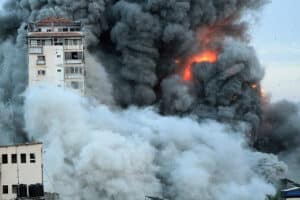
I didn’t realise that I’d spent the better part of the day in this makeshift mission until I sat on a bench on Södra Förstadsgatan and felt the pulsating ache in my feet. I wasn’t dressed for the weather. This wasn’t the plan. I’d only meant to pop out for a minute and now here I was, almost four hours later. When you’re far away, and you watch, in horror, as your country is relentlessly bombed, you don’t know what to do with yourself. Maybe that’s why I fixated on this flower. As if I were doing something.
But March in Sweden isn’t the season. I ended up settling for ordinary red tulips. Defeated, on my way back to the apartment that is spotless from obsessive cleaning, I ran into a small group of Iranians. I could tell from afar as they were draped in the Lion and Sun flag that has become the banner of monarchist fervor. One of the group, a man in his early thirties, recognized me and asked if I wanted to tag along. I shook my head. In the lead-up to war, the diaspora splintered, with a loud group of monarchists rallying in support of the bombing campaign, brandishing “Make Iran Great Again” signs and waving the ancien régime flag alongside those of the USA and Israel. You see them dancing in the streets as people are slaughtered and Iranian schools, hospitals, and cultural landmarks are reduced to rubble.
But no, it’s wrong to call this a splintering; the outbreak of war has exposed, and exacerbated, preexisting faultlines. For years, you ignored your cousin’s displaced nationalism and imperial nostalgia to maintain peace in a group chat. Then you couldn’t hold your tongue when your friends started ventriloquizing the people cut down in the streets in January. There are no voiceless people, you said, only those silenced or ignored, and besides, sovereignty resides in people, not kings. You were accused of having Iranian blood on your hands for the effort.
We half-heartedly play the taroof game: He repeatedly insists I join them, and I repeatedly decline, explaining that I’m too tired. I didn’t have it in me for yet another argument about kings and sovereignty and speaking on behalf of others. And I was exhausted, it’s true, but not because of the day spent traversing the city on foot; rather, because the accumulation of days and nights of barely sleeping or eating was taking its toll. I had been glued to the computer screen, staring at undelivered messages on my phone. I tell him that I was looking for inverted tulips but ended up with ordinary ones. Why? As a remembrance for the at least 175 people, most of them children, murdered in the American bombing of the Shajareh Tayyebeh elementary school in Minab. A middle-aged woman standing beside him interjects. She asks which side I am on. I exhale and say I am on the side of the children. “What about all the children the regime has killed?” Before I can reply, she has snatched the flowers out of my hand and thrown them into the street. “This is a time for celebration,” she says, bouncing her shoulders to imaginary music. A man who appears to be her husband seems ashamed and ushers her away while she keeps asking him what he thinks he’s doing.
I relay this incident to others and catch myself at a loss for words. I struggle to explain my reaction, or lack thereof, and reach for language that seems incongruous to the moment: there was something violent about the encounter, but it’s somehow obscene to talk about the violence of throwing flowers during a war. How to explain the abyss separating celebration and mourning?
A few days later at a Möllan café, an acquaintance visiting from London asks why I was looking for inverted tulips, and I explain the Bakhtiari custom by showing photos of Koohrang on my phone. I give a snapshot of the history of the place I was born. He has never heard of the Bakhtiari before. I don’t blame him. As part of a modernization project, then-ruler Reza Shah suppressed the Bakhtiari in various ways, I explain, not least since Bakhtiari ancestral lands were the site of the burgeoning oil industry, the profits of which were siphoned off to English banks. But the Bakhtiari weren’t alone in being targeted. To build the modern Iranian state, Reza Shah promoted a single language, a single history, a single identity. The systematic targeting of diverse peoples wasn’t incidental but foundational to this project.
My English acquaintance says that I haven’t answered the question. Who are the Bakhtiari? Maybe this constitutional lawyer was looking for something neat and categorizable. The easy answer: we are the indigenous peoples of the Zagros mountains in southwestern Iran. He did not know at the time but soon came to know that he wasn’t asking an innocent question.
“A people without a history, a literature, or even a tradition, presents a phenomenon in the face of which science stands abashed, ” wrote British politician George Nathanial Curzon of the Bakhtiari in his 1892 volume, Persia and the Persian Question. Lord Curzon, who later became Viceroy of India, traveled throughout the region and argued for the strategic importance of Iran as part of The Great Game against Russia. Henry Creswicke Rawlinson, British army officer and agent of the British East India Company, described the Bakhtiari as the “most dexterous and notorious thieves” and “the most wild and barbarous of all the inhabitants of Persia.”
There are two others with us at the café, two young scholars from Copenhagen who crossed the Öresund Bridge for this meeting, which we had planned months ago. We were meant to be discussing a joint seminar series on decolonial legalities. Given the nature of our meeting, I assumed that my brief historical interlude would have elicited some interest, maybe a follow-up question. Instead my colleagues merely offered a few nods about my efforts scavenging in archives for a book I am writing. One of them suggests that now is a bad time to be doing this kind of research. The current US-Israeli-led neocolonial strategy for Iran, insofar as there is one, appears to be to splinter the country: to support separatists, even with weaponry, as a way of driving sectarianism. Khuzestan is centrally important in this endeavour given its natural resources. For strategic purposes, then, it’s best to keep quiet about the Bakhtiari, at least for now. I marvel at the ways in which there always seems to be a reason for invisibilizing indigenous peoples.
To break the tension with a half-aborted joke, one of the Danes says I wouldn’t want to be mistaken for a secret American agent. To write about the Bakhtiari is akin to working for the CIA, evidently. That’s twice within a week that I’ve been accused of such a thing. The first time I was accused of being an agent of the Islamic Republic because I condemned the illegal war, and it wasn’t a joke, or at any rate, wasn’t intended as one.
Caught between Iranian monarchists and Western anti-imperialists, I close the door and pull the drapes. I keep my phone notifications on, though, in case the internet blackout ceases. It ends up keeping me awake at all hours as messages pour in from everywhere other than the one place I want to hear from. Every vibration gives a false hope. One such message arrives from an Inuit actor I met during the Suialaa Arts Festival. Before I open it, I recall the genuine questions she asked during that week: about Luri, about Bakhtiari customs and rituals, about the realities of displacement. Her message is a captionless photo of a bucket of red paint and we both know what it means. Last October, talking about the Hans Egede statue in Nuuk, I felt an urge to deface it, but obviously didn’t as it wasn’t my statue to deface. The next day she sends a voice note musing about how European countries rushed to the defense of Denmark’s sovereignty over Kalaallit Nunaat in the midst of American threats and how she was expected to choose between masters.
A week of sleepless nights gives way to another WhatsApp message that breaks through the mental fog. This one’s from my sister in New York. My 4-year-old niece has asked if their house is going to be bombed. She has no sense of territoriality. She hears the adults talking in the kitchen about a school being bombed, and she doesn’t understand that it’s in another country, halfway around the world. None of that matters. To a 4-year-old, a school is a school, a child is a child, a bomb is a bomb. What to say to a little girl with such fears? No, you are not going to be killed. I was going to say something else but caught myself, because it wouldn’t have been true. I was going to say nobody wants to kill you.