The Reign of One’s Own Desire

An interview with Sheldon George on his book Trauma and Race: A Lacanian Study of African American Racial Identity

Daniel Gaztambide (DG): Would you mind unpacking some of the Lacanian concepts you draw on to understand racism and Black identity, such as jouissance and object a, for a general audience? Sheldon George (SG): Jouissance is often translated from the French as pleasure or enjoyment, but it is most properly an excessive pleasure, a destructive ...
Read More
The Reign of One’s Own Desire

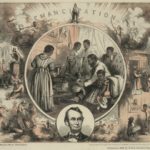
Reparations, Atonement, or Both

Why Atonement is a Necessary Step for National Healing

When the first Africans arrived at Point Comfort, VA, they did not suffer the unmitigated brutality of chattel slavery that their progeny would endure; that hadn’t been invented. Some of these first Africans who arrived in 1619 were freed, some intermarried with white indentured servants, and some escaped. For the ...
Read More
Reparations, Atonement, or Both

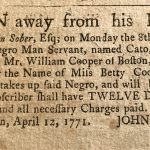
“Well Known as Miss Betty Cooper”

Gender Expression in 18th-Century Boston

In the years before the American Revolution, Boston newspapers routinely advertised the sale and recapture of enslaved people alongside news of Massachusetts’ resistance to British rule. In these ads, enslavers provided descriptions of fugitives in order to assist slave catchers in returning them to bondage. One 1771 advertisement sought the recapture ...
Read More
“Well Known as Miss Betty Cooper”

Monuments to Men

An Interview and Epilogue to Birthright Citizens: A History of Race and Rights in Antebellum America

Martha S. Jones (MSJ): My first inspiration was the years I spent as a public interest lawyer. I represented poor people of color in lower Manhattan’s trial courts and rarely did those cases reach high courts or turn on constitutional questions. Still, I knew that my clients were fighting for fundamental ...
Read More
Monuments to Men

This is Your America

Why Frederick Douglass Still Matters

I’m worried. Very worried. But don’t mistake my worrying for pessimism or, worse, nihilism. Rather, I worry because I see a nation, with its connection to a wider world, unraveling right in front of us. Daily attempts to shatter what constitutes citizenship contribute to this entropy. There’s no immediate solution ...
Read More
This is Your America

Memory, Justice, History, and the “Right” to be Forgotten

Reflections on Georgetown’s Slave Legacy

For the past two years, since the publication of a front-page New York Times story on Georgetown University’s sale of 272 slaves, I’ve been following the saga how the university has dealt with this information. By way of context, Georgetown is one of 28 Jesuit colleges and universities in the United States. When the Society of Jesus ...
Read More
Memory, Justice, History, and the “Right” to be Forgotten

Who Is Allowed to Speak For North Koreans?

Narratives of Captivity and Freedom

The Southern Slavocracy’s obsession with people escaping slavery helped create anti-slavery feeling in the rest of the United States. The Slavocracy viewed these escapes as threats to the viability of the South’s Peculiar Institution. But until the Civil War, very few of the black people held in slavery did escape. ...
Read More
Who Is Allowed to Speak For North Koreans?

Presidential Visits to Yad Vashem

Misrepresentation and Misrecognition, yet again (Part One)

You will by now have seen one report or another contrasting the responses of Presidents Obama (who visited as a senator and presidential candidate) and Trump to Yad Vashem, the Israeli national museum and memorial dedicated to the victims of the Nazi Genocide, the survivors of that crime, and the ...
Read More
Presidential Visits to Yad Vashem

Against Exceptionalism, Beyond Triumphalism

A Review of the Smithsonian’s National Museum of African American History and Culture

On 13 April 1943, on the 200th anniversary of Thomas Jefferson’s birth, President Franklin Delano Roosevelt dedicated the Jefferson Memorial to the nation’s third president. Facing a sharp wind blowing in from the Potomac, the president admired the heroic statue and read the famous words that grace the interior walls of ...

Read More
Against Exceptionalism, Beyond Triumphalism

Slaves: The Capital that Made Capitalism

A re-post

This post, adapted from a lecture in the team-taught course "Rethinking Capitalism" at The New School for Social Research and first published last year, is being reposted today to provide critical insight into today's headlines. Slavery was central to the development of the American political economy. Ott reviews the recent ...

Read More
Placeholder

Actually Essential Reading About the Confederacy

Understanding the historical context of the massacre in Charleston and the debate about the Confederate battle flag

The massacre at the Emanuel AME Church in Charleston and the subsequent debate about the Confederate battle flag have sent Americans scrambling for historical context. The shortlist of introductory readings on the Confederacy recommended by John Williams in the New York Times ArtsBeat, however, is an embarrassing ...

Read More
Placeholder