Poet Paisley Rekdal Summons the Lost Voices of Chinese Railroad Workers

Poetry on the landscape of race, past and present

The transcontinental railroad—one of the great engineering feats of US history—was laid thanks to the labor of Chinese immigrants: between 1865 and 1869, some 12,000 Chinese workers constructed the western line. Yet very little evidence remains in the words of the workers themselves. “This is not to say there are ...
Read More
Poet Paisley Rekdal Summons the Lost Voices of Chinese Railroad Workers

What Are We Defending When We Defend Democracy?

The unruly role of modern social movements in testing the limits of political freedom

I realized, as I wrote to Bill, “that it's quite unclear precisely what form of the American regime we are all ostensibly defending, at this juncture in history. Is it the current form as you describe it, which is so peculiarly open to popular pressure from the bottom up? What if ...
Read More
What Are We Defending When We Defend Democracy?

Women’s History, An Origin Story

In 1975, Carroll Smith-Rosenberg published “The Female World of Love and Ritual, and changed how my generation of feminists understood the practice of history

I first encountered Carroll Smith-Rosenberg’s “The Female World of Love and Ritual” in 1978. I was twenty and a junior at Yale. A teaching assistant passed it on to me when I met with her after class: a paper was due and my mind was empty. She said that there ...
Read More
Women’s History, An Origin Story

Georgia On My Mind

The Democratic Party in Georgia has come a long way since the 1965 Voting Rights Act

“The concept of political equality...can mean only one thing—one person, one vote." ...

Read More
Georgia On My Mind

Why We Shouldn’t Try to Erase America’s Racist Past

Twitter’s misguided attempts at censorship

Some Denny’s restaurants once bore the name “Sambo’s.” Sambo is a character featured in the children’s story Little Black Sambo, set in India, written by Helen Bannerman, a Scottish author, and first published in England in 1898. After it appeared in America a year later, the book inspired an outpouring of ...
Read More
Why We Shouldn’t Try to Erase America’s Racist Past

Let’s Build a Monument to Anastácia

An enslaved woman’s image that has traveled around the hemisphere can help us rethink slavery and memorialization

In May 2020, as the social movement to remove racist monuments grew and the COVID-19 pandemic spiraled out of control, two white women protesting against social distancing and masks were photographed with a sign. It read: “Muzzles are for dogs and slaves. I am a free human being.” It featured ...
Read More
Let’s Build a Monument to Anastácia

Trojan Horse

Misusing Greek mythology on a college campus sneaks white supremacy in the back door

These cultural forms act as “Trojan horses,” sneaking offensive, even racist and sexist ideas into the fabric of the university where they lie in wait to do harm. In our case, one has to begin, of course, with the hyper-masculine bronze statue of Tommy Trojan (erected in 1930) at the center ...
Read More
Trojan Horse

A Monument to Dis-Union

The West Virginia Coal Miner statue ignores race, class, and history

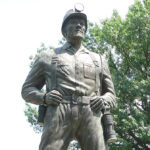
During our present twilight of the statues, when citizens across the country force the removal of effigies that represent racism and colonialism, Jackson is an obvious target for removal. Yet I’ve been thinking of another statue just a few yards away from Jackson: The West Virginia Coal Miner, a monument ...
Read More
A Monument to Dis-Union

Saying Goodbye to Aunt Jemima Is Not Enough

What we really need to do to address the economic impact of systemic racism in the United States

When Dinah Washington recorded “What a Diff’rence a Day Makes” in 1959, the blues diva managed to imbue the Tin Pan Alley lyrics with a kind of haunted hopefulness, the same kind of soulful yearning that would reappear a few years later in Sam Cooke’s monumental ode to the civil ...
Read More
Saying Goodbye to Aunt Jemima Is Not Enough

Trump’s Story of America

Whistling “Dixie” through the graveyards

By the time of Trump’s Mount Rushmore speech on July 3 of this year, his targets had shifted, slightly but significantly. Now America faced threats from “angry mobs” trying to “tear down statues of our Founders” and “unleash a wave of violent crime” in the service of a “new far-left ...
Read More
Trump’s Story of America