Class, Hegemony, and the Will to End a Neighborhood

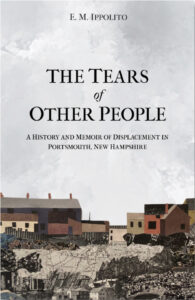
An excerpt from The Tears of Other People: A history and memoir of displacement in Portsmouth, New Hampshire

Why is it important to interpret Portsmouth's history of urban renewal as a history of class? So far, historians who have published work on the subject have chosen not to take this angle. All contemporary writing on Puddle Dock and the North End—the city's two neighborhoods destroyed by urban renewal—notes ...
Read More
Class, Hegemony, and the Will to End a Neighborhood

Portsmouth, Displacement, and Belonging in The Tears of Other People

A conversation with author E. M. Ippolito about the settler colonialist roots of modern displacement and urban renewal

E. M. Ippolito’s relationship to her hometown of Portsmouth, New Hampshire, is a complicated one. While Ippolito’s exploration of Portsmouth’s working-class history began when she was a college student, it was her own displacement from Portsmouth that personalized her research. Learning the story of Portsmouth’s 1960s urban renewal—a federally funded ...
Read More
Portsmouth, Displacement, and Belonging in <em>The Tears of Other People</em>

The Words We Learn to Fear

How authoritarianism begins with the policing of language

The Polish poet Czesław Miłosz once wrote, “Language is the only homeland.” I didn’t understand that line until my own country broke apart. Now I see what he meant—when people learn to fear their own words, it is its own form of exile. Two of my uncles learned this early: ...
Read More
The Words We Learn to Fear

Honest Truths From Wrongful Deaths

In an excerpt from Our Grief Is Not a Cry for War: The Movement to Stop the War on Terror, the author surveys how left-wing intellectuals responded to 9/11

The first war the United States fought following 9/11, I argue, was a “war of interpretation” over the root causes and deep meaning of the attacks themselves. Below is a section from the first chapter of Our Grief Is Not a Cry for War (University of Chicago Press, 2025), in ...
Read More
Honest Truths From Wrongful Deaths

Goldbugs

An excerpt from Hayek’s Bastards: Race, Gold, IQ, and the Capitalism of the Far Right

People make bad money, and that money makes bad people.— Peter Boehringer Monetary issues have long divided neoliberals. Can you trust a central bank to manage currency? Can the growth of the money supply be made automatic? Should fixed or floating rates reign in global currency markets? Must money be backed ...
Read More
Goldbugs

Judah Magnes: Binationalism as Political Theology

A reminder of a sacred myth

Judah Magnes, rabbi, orator, pacifist, and founding Chancellor of the Hebrew University, has long haunted the political margins of Israeli and Palestinian history. Too Zionist for the anti-statist left, too pacifist for the militarizing Yishuv, and too binational for a nation determined to consolidate, Magnes occupies a strange position in ...
Read More
Judah Magnes: Binationalism as Political Theology

A Lost Utopia

A review of Göran Rosenberg’s Israel: A Personal History

In a speech delivered to the United States Congress on July 25, 2024, Benjamin Netanyahu issued a sharp retort to protestors against Israel’s genocide in Gaza:  They call Israel a colonialist state. Don’t they know that the Land of Israel is where Abraham, Isaac and Jacob prayed, where Isaiah and Jeremiah ...
Read More
A Lost Utopia

The Politics of Music and Motorcycles in Indonesia

Elections have empowered a strongman government—and police and military are back to banning music

Sukatani, a punk band from Central Java, are known for critiquing the interconnected violence of police, military, and religious institutions. I like to play their music in my Minneapolis house—and share it on my Instagram—to protest the return of fascism in Indonesia and globally. So early this year, I was ...
Read More
The Politics of Music and Motorcycles in Indonesia

The Vision of Hegemony Driving Israel’s Regional Policy

From “periphery doctrine” to open domination

Over a long twentieth century of regional tussles, Israel’s local foreign policy focus has shifted from preventing the emergence of a regional hegemon toward a campaign for outright domination. The strategy has shattered the Middle East’s fragile and imperfect status quo, the stability of which was closely connected to the ...
Read More
The Vision of Hegemony Driving Israel’s Regional Policy

Black Children, White Schools

Episode 71: A conversation with historian Noliwe Rooks about democracy, education, and her new book Integrated: How American Schools Failed Black Children

On November 14, 1960, 6-year-old Tessie Prevost woke up and put on one of her prettiest dresses. Like Leona Tate, Gail Etienne, and Ruby Bridges, Tessie was a very special little girl. Along with hundreds of other Black children, the New Orleans Four, as they would forever be known, had taken ...
Read More
Black Children, White Schools