“If You Wish to Know Who a Man Truly Is, Give Him Power”

By eroding the values of inclusivity and fairness, Trump’s rhetoric cultivates instead an exclusionary ethos, one deliberately designed to undermine the idea that all citizens possess equal moral worth and deserve equal opportunities to participate in public life

Reflecting on Abraham Lincoln in 1894, the American orator and lawyer Robert Green Ingersoll observed that “nothing discloses real character like the use of power. It is easy for the weak to be gentle. Most people can bear adversity. But if you wish to know what a man really is, ...
Read More

“If You Wish to Know Who a Man Truly Is, Give Him Power”

Why Does a Powerful Nation Form an Alliance with a Minor Power?

The India-Armenia arms deal opens a window on the value of asymmetrical alliances

India-Armenia relations have been actively developing in recent years. In a series of consultations and meetings, India and Armenia have signed defense deals, a significant development in the global arms trade. For India, a great power, this was the first export deal of its weapons, while Armenia, a minor power, ...
Read More
Why Does a Powerful Nation Form an Alliance with a Minor Power?

The Problem Is Not Harvard, the Problem Is Graduate School

Sexual harassment is a normal feature of the current power arrangement. What will you do about it?

This is because the system is built to protect, enable, and encourage harassers. Graduate students, whose cheap labor is used by the university to buttress the outrageous salaries of star faculty and senior administrators, are often broke, disempowered, terrified, and exhausted, even prior to being sexually harassed....

Read More
The Problem Is Not Harvard, the Problem Is Graduate School

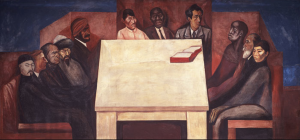
A Pencil For Your Land

Ngũgĩ and Achebe on colonial public school

_____ Oppressed people who retaliate are up against the privileged and powerful. Fighting back often places them outside the system. But what happens when the suppressors’ tools are turned on themselves? Can a colonial education—the underhand offer of ‘a pencil for land’—be turned into an emancipatory counter movement? ‘Colonial mimicry’ describes a ...
Read More
A Pencil For Your Land

A Political Paradox

Power, fallibility, and the Twenty-Fifth Amendment

The Twenty-Fifth Amendment was ratified on February 10, 1967, in the wake of the Kennedy assassination and a period of great anxiety about nuclear weapons. The first section deals with a vacancy in the presidency, the second section with a vacancy in the vice presidency. But it is Sections 3 ...
Read More
A Political Paradox

Why the Harper’s Letter Got It Wrong

The most serious threats to protest and open debate come not from the left or the right but from the state and powerful political institutions

So I took a new job in a new city and began again. I have been thinking about my decision to speak up, and its costs, in light of The Letter. You know the one: the open letter in Harper’s magazine that praises the “needed reckoning” of the past few months ...
Read More
Why the <em>Harper’s </em>Letter Got It Wrong

The Formal Ethics of Metony#metoo

Poetics, Power, Primal Scene

Last year the journal Studies in Gender and Sexuality published a panel called "The ontology of the rape joke," organized around a performance by Vanessa Place of her piece, "Rape joke." The panel included responses from Jamieson Webster, Jeff Dolven, Gayle Salamon, Kyoo Lee, Katie Gentile, and Virginia Goldner, and ended with ...
Read More
The Formal Ethics of Metony#metoo

Revisiting Bartky on Foucault

The production and discipline of femininity

In “Femininity and Domination,” Sandra Lee Bartky examines the underlying causes and effects of women’s subjugation in contemporary society. Though women are generally understood to have equal rights, oppression, she argues, does not have to involve “physical deprivation, legal inequality, nor economic exploitation” in order to have a systemic and ...
Read More
Revisiting Bartky on Foucault

Philosophers on Fake News

Arendt and Foucault on power and truth in media politics

Despite their irrefutable and continued presence in the world today, for some time the practices of banning and censorship have struck me as antiquated, almost quaint, like a desperate but not wholly effective grasp for control by a declining State. My admission of this admittedly unsubstantiated and impressionistic outlook—although not ...
Read More
Philosophers on Fake News