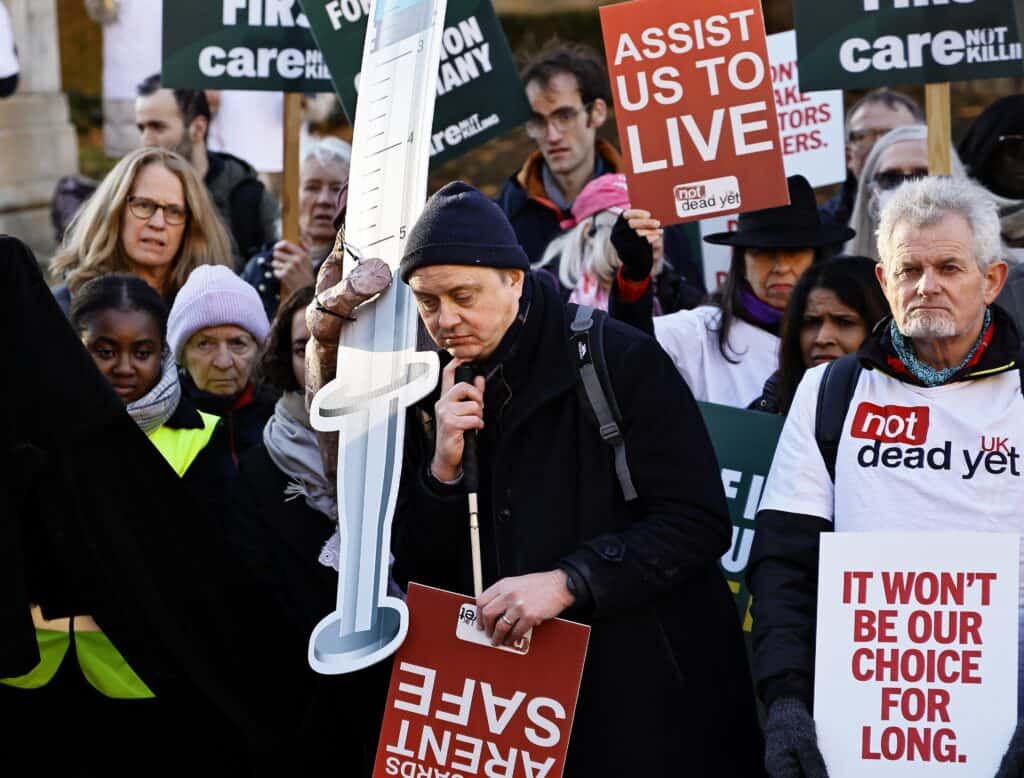
How do we support patient autonomy? Outside London’s House of Commons, activists gathered to protest the introduction of Britain’s own assisted dying bill (2024) | Sean Aidan Calderbank / Shutterstock Editorial License
New York Gov. Kathy Hochul signed the Medical Aid in Dying Act (MAiD) into state law in early February, months after the legislation passed the state Senate in June 2025. The bill’s passing prompted an extended period of debate, advocacy, and amending, centered on whether mentally competent, terminally ill New Yorkers with less than six months to live have the right to self-administer medication to end their lives.
Framed as a victory for autonomy and “death with dignity,” laws enabling MAiD are currently on the books in 12 states and the District of Columbia. Oregon was the first state to legalize medically assisted dying with its Death with Dignity Act in 1997; other states including Washington, California, and New Jersey have adopted similar laws in the decades since.
Supporters of MAiD frame the law as an extension of patient autonomy through the end of life, arguing that decisions about how to die belong solely to those facing their own mortality. MAiD allows for death brought about by a lethal combination of drugs—including an anesthetic to induce unconsciousness, a paralytic agent to stop respiration, and an anti-anxiety medication—which are designed to lead to a peaceful and painless death. With MAiD, advocates say that patients can decide when and how they die, plan a departure surrounded by family and friends, and avoid weeks or months of prolonged suffering.
The testimonies of patients who have used MAiD are moving. Brittany Maynard was 29 when she opted for a medically assisted death in Oregon in 2014. She was recently married and planning to have children before being diagnosed with an incurable brain cancer. She described her “sense of relief” after receiving her fatal prescription, which she saved to use when she was ready. She was able to choose a death surrounded by her family, husband, and best friend, after spending her final months travelling around the world to “outdoor wonders of nature” with the people she loves, living her final months and moments in a way that reflected her values in life.
The ability to plan for death, and reduce pain and suffering, can undoubtedly be comforting to patients and their families. However, the language around self-determined death as a “right,” and the insistence on autonomy in dying—that part of life notoriously resistant to control—is where some critics of MAiD find the framework ethically troubling. Alongside longstanding religious objections to euthanasia, secular concerns focus on the potential that a “right to die” could interfere with the right to be supported in life.
One of the strongest arguments against MAiD is that it risks becoming a response to systemic failures that should instead be addressed through greater investment in healthcare and social support. Canada is often cited as a cautionary tale in this regard.
In Canada, where assisted dying has been legal for a decade, MAiD accounted for 5 percent of all deaths in 2024. While qualifying medical conditions remain the legal basis for eligibility, some recipients report social suffering—such as isolation or loneliness—alongside physical and psychological anguish related to serious illness or disability, as part of the circumstances surrounding a MAiD request. A Canadian patient must have a chronic condition to qualify, but it need not be terminal.
Tina, a Christian end-of-life doula from Canada, said she has seen firsthand how MAiD evolved from requiring strict eligibility criteria to something offered in response to social issues, including homelessness. She noted during a recent online meeting for end-of-life doulas that patients “can feel isolated, worthless, like a burden,” and that these feelings—produced by inadequate social and caregiving systems—can underlie a MAiD decision.
Harold Braswell, a healthcare ethics and disability studies researcher at Saint Louis University, told me that while he does not object in principle to a “right to die” for terminally ill people, he views the implementation of MAiD in Canada as something closer to the state’s “right to kill,” and worries that the U.S. could follow in Canada’s footsteps by liberalizing MAiD laws. In a country like the U.S., where health care costs are crippling and the social safety net is threadbare, concerns over expanding the option to die are all the more heightened.
Braswell noted that “we actually have far greater tools than ever before to ameliorate human suffering, including the suffering of very sick and disabled people,” but that “once a gun is on the table, all other possible solutions leave the room.”
At present, MAiD laws on the books in the U.S. are strict. In Oregon, for example, eligibility formally requires a terminal prognosis. But curable diseases can become terminal when left untreated in a broken medical system.
Gov. Hochul made explicitly clear that she wanted New York to have stricter eligibility criteria than many other states. “I ultimately determined that with the additional guardrails agreed upon with the legislature, this bill would allow New Yorkers to suffer less—to shorten not their lives, but their deaths,” she said when signing MAiD into law.
The legislation does indeed impose highly specific requirements to qualify for MAiD. Unlike in Canada, where patients can be eligible even without a terminal diagnosis, MAiD in New York, as in other states, will only be available to mentally competent adults with a terminal diagnosis and a prognosis of six months or less. New York will also have additional guardrails, including mandatory waiting periods between a prescription being written and filled, a mandatory mental health evaluation, and limiting eligibility to New York residents. Physicians must also provide patients with information about other end-of-life options, including palliative care and hospice. The legislation does not, however, include mention of additional steps to ensure a patient’s access to care and other support systems.
Critics of MAiD argue that it could become a band-aid solution to suffering, which could be otherwise mitigated by a greater investment in healthcare. For Braswell, even investing in basic efforts around something like fall prevention could meaningfully alleviate pain and injury in a way that could reduce the need for MAiD in the first place. He also argues for wealth redistribution on the same grounds. But, he said, because “such radical change is both difficult, and, for many, almost unthinkable, we default to killing as a more amenable solution.”
Dr. Virginia Chang, an end-of-life doula working in New York City and author of Preparing For End of Life For Dummies, takes a more nuanced approach, noting that no one takes dying “lightly.”
“I don’t see that people want to die,” she told me, “but what drives them to choose MAiD can be a multitude of factors. It’s not just one thing, like being depressed or being lonely, or not having proper care. I think it’s a much bigger societal question of how we approach death and dying.”
Chang argues that investing in systemic solutions to suffering and offering patients access to MAiD are not mutually exclusive. We can, and should, have both at once. We should try. She notes that the availability of MAiD can reduce suffering by providing a sense of reassurance, even when patients ultimately choose not to use it. Data from multiple jurisdictions show that one in three MAiD prescriptions are never taken, suggesting that for some people, having the option matters as much as exercising control over the outcome.
“I believe that we could create a lot more space for the death wishes of sick and dying people, but that by exploring them and taking them seriously, in all their complexity, we could find a lot more there than a desire to die,” said Braswell. “Perhaps that very desire might, in its own way, cloak a desire to live in a way that is difficult to access but possible and worthwhile to achieve. I believe that it’s worth trying.”