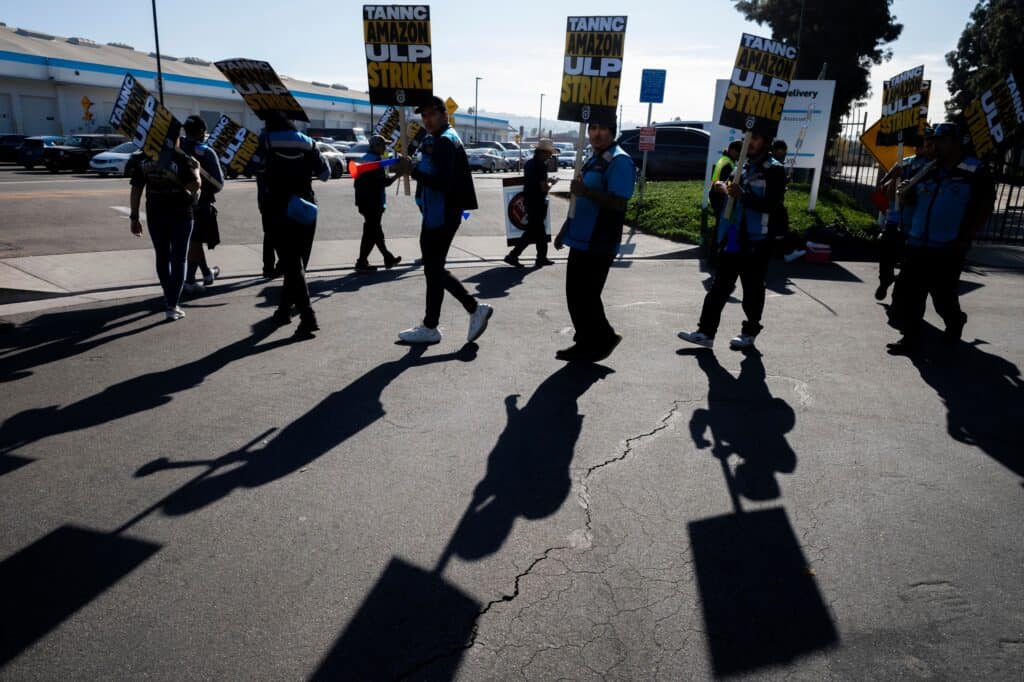
Amazon workers picket outside the gates of an Amazon fulfillment center, City of Industry, California (2024) | Ringo Chiu / Shutterstock
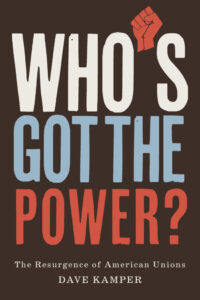
In his new book Who’s Got the Power? The Resurgence of American Unions (The New Press, 2025), labor writer and organizer Dave Kamper delivers a bit of good news in a dark time. “Much of the last half century has, for the labor movement, sucked beyond the telling,” he writes. But a number of factors—lessons learned during the pandemic, the revitalization of some of the country’s largest labor unions, and, especially, young organizers’ commitment and creativity—offer reasons to be hopeful. In an interview with Shea Dean, Kamper talks about how we got here and where it might lead.
Shea Dean: So tell me about your decision to write an intentionally optimistic book about the labor movement.
Dave Kamper: It reflects my own personal journey from being a curmudgeon and a cynic who called himself a realist to realizing I had hope in ways I didn’t have before. And I can date it very precisely, to the [2022] Amazon Labor Union election on Staten Island. I was at work the week of that election and colleagues were like, “So there’s this election of the Amazon workers in Staten Island.” I said, “Yep, they’re going to lose.” And everyone’s like, “Are you sure?” I’m like, “Oh yeah, they’re going to lose big.” And of course I was entirely and completely wrong. They won that election. And as that kept happening, with Starbucks workers and with the UAW and with all these other things, it triggered in me a long train of thinking and reconsideration where I realized that things I thought were impossible 10 years ago are no longer impossible.
Dean: What does your optimism for the labor movement look like now that Trump is in office?
Kamper: Well, there’s no denying that we’re in for rough sailing for at least the next three years. And the federal workers have taken the brunt of it so far. But what they’re also finding is that all of those unions are seeing thousands of people stream through the doors as members and they’re having competitive elections for officer positions that they’ve never had competitive elections for. Now, it’s going to be really hard to win the things they want to win. But you can build the power so that you can use it when it will pay off.
Dean: But isn’t it troubling that even if we do have another prolabor administration, we’re going to be stuck with a conservative anti-union Supreme Court, potentially for decades?
Kamper: Because I wrote an optimistic book, I’m going to give an optimistic take on a very difficult situation. I took over a building with four other people in the spring of 2000 to try to win union rights for folks at the University of Illinois. And we expected to get arrested. We thought we’d get beat upside the head. But the reason we were engaging in this action is we needed the courts and the legislature to listen to us. And we had this great labor lawyer, and this is what he said to us: “Organize and the law will follow.” So we went on a massive civil disobedience action, and a few months later, the state Supreme Court that had been sitting on a case relevant to our organizing rights for months—for years—ruled in our favor. And they actually wrote in the decision, “One of the things we’re here to do is try to preserve labor harmony. There clearly is not labor harmony, so we’re going to act in a way to preserve it.”
I don’t think the John Roberts court is going to be that amenable, but there are these things called facts on the ground. They’re not going to respond to pleasant words or cute memes. They’re going to respond to action. American history is full of occasions of very anti-union legislatures, very anti-union courts who backed down when faced with real action by workers.
Dean: One of the heroes in this book—one of my heroes generally—is Sara Nelson, president of the Association of Flight Attendants. You tell this great story about how she drafted the Payroll Support Program in the first weekend of the Covid shutdown, stipulating that government money earmarked for the airline industry be spent on paying airline workers’ salaries and benefits, not on executive bonuses and stock buybacks. Of course executives hated the idea, but they ultimately accepted it. So even as other industry CEOs fired their workers and stuffed their pockets with Payroll Protection Plan funds, two million airline workers kept their jobs and benefits thanks to Sara Nelson, and the industry came out stronger than anyone expected.
Kamper: I was really honored that Sara wrote the foreword for the book. In the labor movement, we tend to judge people by how passionate they are and how they believe in the cause, but it also matters if you’re good at what you do. And the thing about Sara Nelson is that she is the smartest person in the room as well as the most inspiring. I say this with all sincerity that there is nobody in the country who I would rather see elected president in 2028 than Sara Nelson.
Dean: The last time I heard her speak, I thought the exact same thing. She is fabulous. In another section of the book, you report on the UAW’s recent success organizing academic workers and staff. Are you optimistic on that front as well, despite the Trump administration’s attacks on higher ed?
Kamper: Well, my hope is that organized labor will start asking itself, “What kind of higher education system do we want? Let’s start pushing for that,” and that they’ll do this not just by trying to elect people but by doing things like going on strikes and educating people in the workplace and bargaining for the common good the way K-12 teachers have done. Faculty unions are still pretty risk averse. They’ve got to be willing to take more risks. It’ll pay off in the long run if they’re willing to do it.
Dean: It’s hard because at The New School, as with so many other universities, we have this two-tier system with 20 percent of the professors being full-time and tenured and 80 percent being part-time and nontenured—essentially gig workers. How do you build solidarity across this gaping divide?
Kamper: The way you frame it is really important because people in higher education don’t use the term “two-tier system.” They don’t want to call it that. I think the autoworkers have an advantage in that they’re willing to name exactly what it is. Yep, it’s a two-tier system. And the more you dress it up in other terms, the harder it is to embrace that fact. There’s a lot of status tied up in not acknowledging that that’s what this is. It’s not about money. It’s about power. And one of the prime ways that people in power exercise power is by pretending it doesn’t exist.
Dean: I think a lot of people—both the powerful and the powerless—pretend that power doesn’t exist because it makes them feel bad.
Kamper: Yes. You worry you’ll become a bad person if you have power. And I think that’s a reasonable worry to have because all power tends to corrupt, as [Lord] Acton said. There’s also the flip side of it, which is that you worry that if you acknowledge power too much, it’ll be too depressing because the powerful have so much power. But it’s not a fixed pie. You can create power where none exists, and you can add to your power. And we’ve seen this happen again and again and again: people who had no power suddenly building and creating power for themselves and then taking it and using it.
Dean: You write about how well Starbucks workers are doing exactly that.
Kamper: What’s supposed to happen is that you win a union election and then the boss drags it out and you all lose hope and you all fade away. That’s what happens most of the time. It’s not happening with these Starbucks workers. They are continuing to grow, to be strengthened, to find energy in themselves. They are building relationships with people around the country who they’ll never see in person, which again, people like me said was impossible: “You have to do it face to face. Digital’s never going to be as good.” Well, maybe it is as good for people who are raised in a digital world.
When I was growing up in the Left, in the nineties, the cool thing to do was to go live in the woods like the Unabomber but just not make bombs. Instead, these folks for the past 15 years—starting, I think, with Occupy—really what they’re seeking is solidarity. They’re seeking connection, they’re seeking to build meaning and connection with each other, and they’re finding the union movement as a way to do that. I love that. I want to be the observer of that. I really think a big part of my job now is to encourage and support this next generation, to be open to what they want to bring to the table, the priorities they want to carry. To see what they’re doing is really exciting and the thing that makes me feel safest going forward in these terrible, terrible times.
Click here to read an excerpt from Who’s Got the Power? The Resurgence of American Unions, in which David Kamper discusses the different meanings of solidarity.











One thought on “Fresh Hope for Labor”