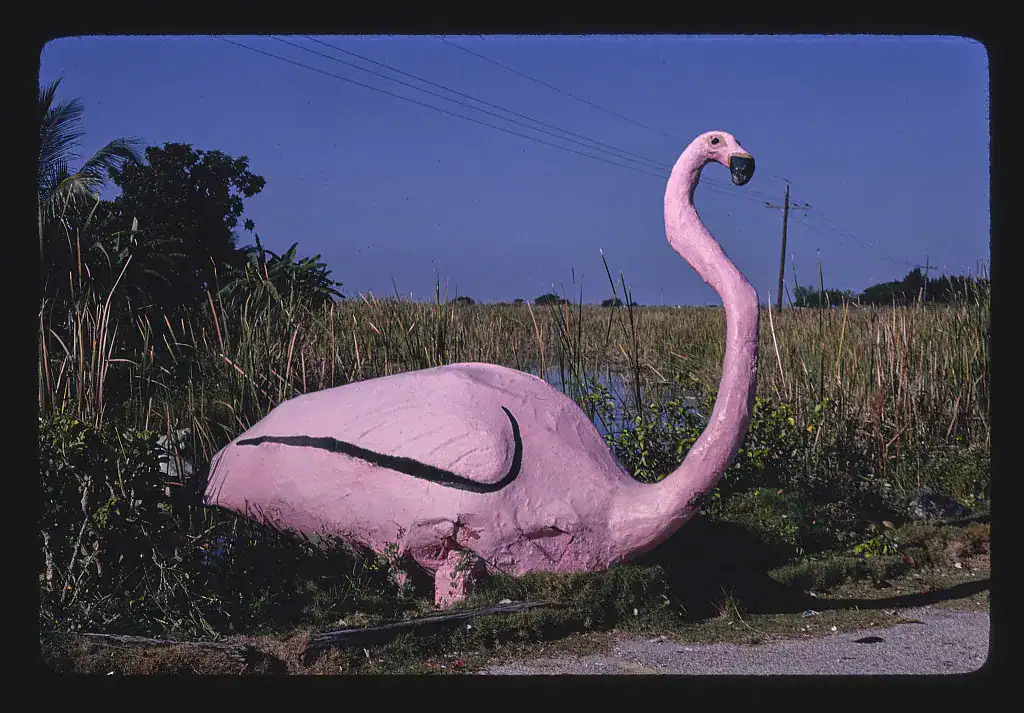
Roadside flamingo statue, Frog City, Route 41, Florida (1980) | John Margolies / No known restrictions
“I kept wondering why it felt like we were all living in the United States of Florida,” says Robert W. Fieseler. In his new book, American Scare: Florida’s Hidden Cold War on Black and Queer Lives (Penguin Random House, 2025), Fieseler examines the forces shaping the fastest-growing state in the nation—one that draws between 900 and 1,000 new residents each day. For Fieseler, that growth is not incidental—it reflects how central Florida has become to the nation’s political imagination.
The book traces the history of the Johns Committee, a body founded and funded by the Florida Legislature in 1956, which exploited anti-communist anxieties to persecute Black and queer citizens. “Some stories are repressed, censored, or buried,” Fieseler notes, “but they’re usually not buried very well.” Drawing on primary records—many long sealed, partially redacted, or buried in state archives—Fieseler reconstructs the full scope of the committee’s inquisitorial campaign. He spoke with Kateyn Kimberlin about how McCarthy-esque movements can be brought down.
Katelyn Kimberlin: Did you intend on the book being this timely when you published it?
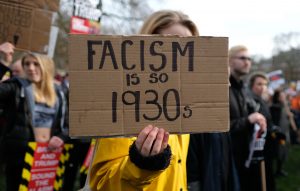
Robert Fieseler: I’m not wholly interested in a timeliness angle—although I am journalistically trained, so maybe I do seek that out unconsciously. What I really was looking for was for some orientation in our current sociopolitical climate. I was wondering: Why does it feel like McCarthyism is on the rise again? Why does it feel like it’s not federal McCarthyism but a different version of McCarthyism that most people don’t hear a lot about, which is Southern McCarthyism? I had an instinct that maybe McCarthyism would have some sort of dotted line relationship to our current sociopolitical dilemma. I was hoping to gain insight and knowledge of it. Any history well told exists in dialogue with the present. But when I sold this book, DeSantis was just getting started with his anti-Disney campaign, January 6 hadn’t happened yet, a lot of turns in the march towards fascism really hadn’t transpired. It was still Trump 1.0.
That all happened while I was researching and writing the book, and I was just constantly having my mind blown, being like, Oh my God, every DeSantis play feels like it’s just out of the playbook of the Florida Legislative Investigation Committee—I wonder if he realizes that? And then I realized—I don’t think he knows that. Because Charley Johns [head of the Committee, which came to be known also as “the Johns Committee”] sealed his own records and gained a reputation as the guy who got away with it. And, in doing so, he firmly entrenched this tradition of Tallahassee, where the rule is: If you get power in Florida, you can use it to pick on anyone.
So I just kept feeling this buzz every time people would ask me, as I was writing the book, What’s the book you’re writing? and I’d explain to them about this Florida Johns committee, and they’d be like, It sounds like that history is coming straight out of the news headlines. I was trying to avoid that, to be honest. The news is so toxic, and it feels like now every headline chases the next, and you could read the news all day long and be less informed. You’re just chasing your tail and feeling sick. But then, I’d peek over and I’d be like, Oh my God, yes. Because, it turns out, so much of today’s political climate, if you drew it back, goes straight through Florida—and then it’s a straight line to Charley Johns, a guy no one’s ever even heard of. And so that added urgency for me to get this book out. It always feels good when reportorial or scholarly instincts pay off, and you find that clue that helps explain what seems unexplainable.
Kimberlin: What was your intention with uncovering these documents? What do you want people to take away from this point in history, as well as your publication of this book?
Fieseler: That McCarthy-esque movements can be brought down, and they have been brought down in the past by ordinary citizens. And I saw how that worked in Florida with the Florida Johns Committee. How a Black father [Theodore Gibson] that was suing for the integration of Miami schools on behalf of his son was hounded by Charley Johns, held in contempt of the John’s Committee, threatened with jail time, harassed all the way to the steps of the Supreme Court, won in the Supreme Court in a five-four decision, and ended up shutting down the anti-NAACP, anti-Black campaign.
A lot of my work is about that capital “R” return of voices that were quashed. Not only do they refuse to die, but they return with a sort of vengeance in the South. They demand to be rewoven into the tapestries of the communities and lands that they loved. So my work is in service of that. And I felt like there were so many voices that were harmed and sagas that were suppressed over the course of the Johns Committee atrocities from 1956 to 1965. I knew I wanted to write a book in service of returning those stories to the public discourse.
Kimberlin: What do you want a reader to take away from the rebuilding of this history? Maybe even one not from the South?
Fieseler: Well, the bicoastal queer narrative of history—centering on the Stonewall uprising—totally misses the plot because social justice battles waged in the 1960s South were fundamentally more pivotal than any of those waged on the coasts. Many of the alliance tactics of the LGBTQIA+ movement drew directly from the successes and the hard lessons of the racial Civil Rights and Black Freedom Movements that transpired in the South in this era. There’s still so much we don’t know about the turns of the most important social movement of the twentieth century, which was the nonviolent movement that brought down racial apartheid in the South. And we learn even less about it, whether as students of American history or as queer folk, because we live in a society governed by powers that specifically divide us and conquer so effectively. When we are busted up into these tiny movements with agendas that don’t overlap, the remnants of a very powerful political order driven by white supremacy and male dominance is able to trounce all of us.
Kimberlin: You sprinkle cautious optimism in some parts of the book. What ignited your optimism about our country?
Fieseler: My last little epilogue was probably one of the most hopeful things I’ve ever written. And it came from thinking about the fact that we live in a society where the truth is under attack, and yet truth survives—and oftentimes emerges victorious over attempts to kill it.
One of the lines in my prologue was: “You can’t half kill the truth; not in America, where it’ll only play dead, go dormant for years, and resurface to tell its story of being buried,” which never fails to embarrass those involved in the cover-up. Journalism, in theory, is supposed to be a form of nonfiction writing that has a very strong relationship to the truth. And when you are in a position like me—where you’ve become a public historian, and now straddle the public/academic sphere—you end up doing the same thing I’ve always done: spelunking into the past and fishing out at first seemingly out-of-left-field histories that, it turns out, have 100 percent to do with what we’re facing now.
The incredibly exciting thing is that we exist in a country built on self-evident, capital “T” truths. That helps me keep in perspective that truth still matters in America. I know that’s still very confusing for some. It may take education to learn sleuthing skill sets, or to understand the difference between fact and opinion. But that process is thrilling, and it’s almost sort of spiritually redemptive.
The last line of my book says, “And a bracing new knowledge rolled toward me on waves.”
That’s the physical sensation that I have when I figure something out or when I discover something. Queer art and also queer history can offer you the kind of soul nourishment that invites you to very profoundly check back into your own existence, so that you feel powerful in your sense of self and in your own story—even when your own story runs counter to whatever propaganda is out there. That was why I wrote the way I wrote.