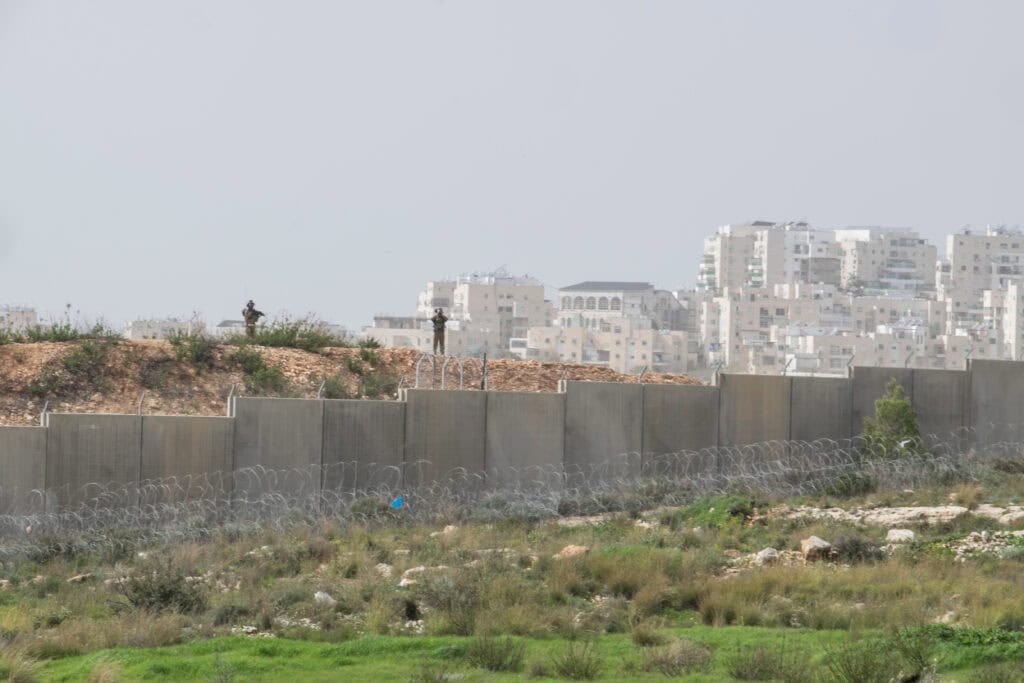
Israeli soldiers patrol along the West Bank barrier in Bilin, West Bank, Palestine (2019) Edward Crawford / Shutterstock
I spent the summer of 2025 in a state of rage about events in Israel. Every day, I read in the liberal daily Haaretz of settler attacks in the West Bank on Palestinians and the Israeli activists who were defending them. Rage has long been my normal state, but I had recently decided that impotent anger was no longer morally or politically sufficient: I had to do something. Feeling that writing checks was not enough, in the summer and fall, I went door to door campaigning for Zohran Mamdani.
In August, Haaretz published an opinion piece by the human rights activist Avner Gvaryahu in which he encouraged foreign Jews to come to Israel to engage in what is called “protective presence.” If we came, Gvaryahu wrote, we would join Israeli activists like himself in accompanying Palestinians in the West Bank in their daily work and activities in the hope of preventing attacks by Jewish settlers intent on driving them from their land.
Despite the many perfectly legitimate excuses I could have made to myself—my advanced age, my legal blindness, a defective heart—what also echoed in me was a line from the Phil Ochs song “When I’m Gone,” a sorrowful reminder that there will be “no righting of the wrongs when I’m gone, so I guess I better do it while I’m here.”
And so, inspired by the essay in Haaretz, and moved by the same impulse that had me pounding the pavement for Zohran, I contacted three Israeli organizations that engage in protective presence. They all reassured me that my age would not be a factor, that almost all their activists were in their 60s, 70s, and even 80s. These activists are the last remnant of a period when Israel had a real Left, groups like the radical anti-Zionists of Matzpen and SIACH.
A comment one often hears in protective presence circles is that you’d better hurry and help, since there soon won’t be any Palestinian presence to protect. The danger to the Palestinian landowners who remain was visible in the terrain: Palestinian farms and small villages sit in valleys, while above them on a hill is often little more than a single house or double wide, with huge Israeli flags flying. These are the settlements from which the Jewish attackers descend, unhindered and encouraged by the Israeli government. And so, in mid-December, I found myself on the West Bank working with members of the Jordan Valley Activists (JVA).
While doing so, I experienced the most terrifying moments of my life, minutes after beginning a drive through a Palestinian farmer’s fields, accompanied by the landowner, Mohammed. He was driving us through his land so we could see how hostile Jewish settlers had been methodically destroying his crops by repeatedly raiding the farm and ravaging his fields.
Within minutes, we were ambushed. The road before us through the Palestinian’s land was blocked by a young settler on a motorcycle, who took out his cellphone and called for reinforcements. We were soon surrounded by young Jewish settlers. One of them had a pistol whose outline we could see jammed into the back of his fatigue pants.
They berated us, filmed us while we filmed them, and menaced Mohammed. They insisted on the right of Jews to the land that was legally owned by Mohammed. When Mohammed and members of our group made this claim, a settler waved it away: “Read the Torah, the land is ours.”
The settlers are not shy about killing and beating Palestinians, but up until now, Jewish activists only suffer occasional beatings. Even so, the violence that hung in the air was electric. Any time one of the settlers approached me I feared for my safety, since I knew of the aggression against activists and had been warned that settlers sometimes destroy their cell phones that hold incriminating videos. But why? The settlers act with impunity and the support of the army; in fact, of the whole government. Though the videos show up on the social media of activist groups, they have clearly had no deterrent effect.
In due time, some members of the IsraeI Defense Forces arrived. They spoke briefly and angrily to Mohammed, conferred with the settlers, and accused us of threatening the attackers.
After twenty minutes or so of palaver, the soldiers told us all to get lost, not without some final insults aimed at me, my age, and the fact of my accompanying a Palestinian. In their eyes we were what they called “Tel Aviv anarchists,” a form of life they have learned—been taught—to detest. Settlers called me that every day I was on the West Bank.
By now, I was rattled: I had survived one of the scariest moments in my life. It’s true that Mohammed had been left unharmed, but I realized that, in fact, he was only in danger because we were there and he had shown us around. Had we not been there he would have escaped any threat, on that day at least. I later had conversations with members of JVA, and some spoke of how soldiers told them that we made matters worse, our presence a red flag waved before a bull. Jews who support the Palestinians are considered traitors—essentially race traitors—a word thrown around freely by the right in everyday Israeli political discourse. In fact, for many Israelis, “leftist” and “traitor” are synonyms, with a third synonym, “terrorist,” often thrown in for good measure.
Palestinians don’t feel this way. Far from scorning or fearing the impact of our presence, earlier in that visit Mohammed had asked if JVA could have volunteers present round the clock, seven days a week. I went to the West Bank four times in six days, a killing pace given the danger, the long days, and the lengthy voyage to get there. We were greeted warmly by the Palestinians everywhere we went. That our groups can more easily speak to the army and police when attacks occur was welcome. Our presence and the solidarity we represent does make a difference and obviously mattered to them.
Protective presence can be effective, and yet, I’ve come to think it very much resembles the Dutch Boy sticking his finger in the dike. If activists are here, the settlers simply move there. Or, knowing they won’t be stopped, if we’re here, so are they, with sticks and rocks and firearms, while we have cellphones and righteousness on our side.
I complained to friends that we were showing up with nail clippers for a knife fight. To be sure, to meet violence with violence would have been suicidal for us, and the Palestinians would have paid even more dearly. But it’s foolhardy to think moral suasion alone will work with people intent on ethnic cleansing and who don’t view Arabs as sharing genus and species with them. To borrow from Roger Taney’s Dred Scott decision: “The Palestinian has no rights that a Jew is bound to respect.”
Of the many videos from activist groups that are posted online, one I particularly enjoyed was of Elie Avidor, a member of JVA, tearing off the shirt a settler had wrapped around his face to hide his identity and then giving the attacker a solid kick. Just watching Elie deliver that blow was, for me, a cathartic experience.
Still, no more than efforts at moral suasion have spectacular images of direct action been able to stop the ongoing attacks by Jewish settlers on the West Bank’s Palestinian landowners.
Recently, the Bedouins of Ras Ain al-Auja, in the Jordan Valley, abandoned their homes en masse. Israel’s Supreme Court has ordered the government to allow them to return, but the Bedouins are reluctant to do so, since the army and police have proved unable to protect them. In 2025 alone, the settlers and their militias razed 1,500 structures in the West Bank. Killings and beatings are skyrocketing. The settlers are every bit as dedicated as the activists who attempt to ward them off, but “quantity has a quality of its own,” as the maxim goes: The settlers vastly outnumber those engaged in protective presence.
The situation is hopeless.
Netanyahu’s government has now decided to all but annex most of the West Bank. No two-state solution is possible, given the extent of Israeli settlement; the one-state solution, the only legitimate alternative, will never happen, since it will deprive Israeli Jews of their political superiority. Israel, which suffers no consequences for its violations of international law, has no reason to change tack. They know they have no reason to fear war with their weakened neighbors, nor will the West ever really carry out any threats against it economically or diplomatically.
The last night of my stay in Israel, I attended one of the regular large Saturday night demonstrations against Netanyahu’s regime in Tel Aviv, a few blocks from the flat in which I was staying. I hadn’t wanted to, but Matan, my closest Israeli friend, told me that I would find it interesting from an anthropological and sociological point of view. A veteran but disabused left-wing militant, Matan had stopped attending these demos, because the participants never protested the plight of the Palestinians being massacred in Gaza or being attacked in the West Bank. He, like many of the leftists I met, preferred to attend smaller demos against the regime where they felt free to hold up photos of Palestinian children killed in Gaza.
The crowd gathered in Habima Square that night, outside the national theater, was largely Ashkenazi and prosperous looking. Had I been told I was in Park Slope or Cobble Hill, I would have believed it.
Reminded again of Phil Ochs, I found myself humming “Love Me, I’m a Liberal,” his memorably sarcastic put down of moderate sympathizers of the civil rights and antiwar movements of the sixties who nevertheless happily attacked, and tried to marginalize, the radical left proponents of direct action and militant forms of protest.
At the demo I attended, the only placards demanding an end to the accelerating occupation of Palestinian land in the West Bank were held by a small group on the outskirts of the gathering. Instead, in an effort to attract as broad a crowd as possible, those in attendance wrap themselves in the Israeli flag—some literally, by wearing it as a cape. Haaretz reported on February 15 that “thousands of antigovernment protesters gathered around the country, including a demonstration outside the Prime Minister’s residence in Jerusalem after months of no protests.” That there were no protests for months in a time of increased settler violence and annexation speaks volumes about the demonstrators’ unwillingness to confront their nation’s crimes.
In Israel, which once presented itself as the standard-bearer of a different form of socialism, I felt estranged from everyone in the square. To be a leftist in Israel today is to live outside society. One of my companions in protective presence told me that the only people to whom she speaks are those with whom she travels to the West Bank every week.
I left Israel with the rage I’d felt over the previous summer heightened. I was filled with fresh despair, but I was also convinced that even in hopeless cases, what matters is doing the right thing. If it’s nothing else, protective presence is the right thing.
A few days into my time in the West Bank, two of us had accompanied a Palestinian shepherd who was taking his flock out, but who had been hesitant about doing so without protective accompaniment. We joined him, and all was well.
A week later, back home in Brooklyn, I learned that the same shepherd had been attacked and part of his flock stolen by settlers.











The courage it takes to do this work at any age, let alone in your 70s, is remarkable. Thank you for bearing witness.
This is such a powerful and honest account. The ambush you describe is terrifying, and I appreciate your willingness to grapple with the difficult questions about whether protective presence actually helps or inadvertently puts Palestinians at greater risk. The comparison to the Dutch boy and the dike feels apt – individual acts of solidarity matter to the people you’re standing with, even when the larger structural forces seem unstoppable. Your observation about the Tel Aviv demonstrations avoiding any mention of Gaza or the West Bank is particularly striking. It reminds me of how easy it is for protest movements to focus on what’s politically palatable rather than what’s morally necessary. The loneliness you describe among Israeli leftists is heartbreaking. Stay safe if you go back.