Combine harvesting wheat, Eastern Washington” (2012) | Charles Knowles / CC BY 2.0
When I think about farming, I imagine the simple farming my Filipino great-grandfather did, and that students at my alma mater, Amherst College, still do at the Book & Plow Farm, an organic operation that employs students part time and supplies the college dining hall. Many consider this an ideal form of agriculture, prizing food that is grown locally in small, non-corporate farms.
Like many people, I prefer to eat food grown near home, in part because food from local, organic small farms often tastes better than alternatives, even if it isn’t always more nutritious. However, a closer examination proves that this idealized version of farming is rare, and certainly won’t meet our present needs.
Rafael Gonzalez, the great-grandfather for whom I am named, farmed under the hot, Philippine sun without modern fertilizers, pesticides, or crop varieties (either genetically modified or selectively bred). He was never educated and died young by modern standards. His experience was typical of the farmers he worked alongside, and I don’t think it would have occurred to him that he was living the agricultural ideal of future generations.
However, since my great-grandfather’s time, the world has changed in ways that have turned localized agriculture into a luxury good that can be enjoyed only by a small percentage of the world’s wealthiest inhabitants. Global population has quadrupled since then, and increasing temperatures, a decreasing water supply, and adverse climate events all make farming harder. Feeding 10 billion humans by the end of the century and decarbonizing our food system to help mitigate climate change are Goliath goals.
Organic farming maintains soil health and biodiversity and can shield consumers from harmful pesticides. However, it is also inefficient. Organic farms need 22% more land to produce the equivalent of conventional farms. Converting all farming to an organic model would mean millions of acres of deforestation.
Organic farming advocates claim that lower per-acre greenhouse gas (GHG) emissions compensate for this difference. However, studies indicate that organic farming produces as many GHGs as conventional agriculture because natural fertilizer (manure) emits GHGs at similar levels to synthetic fertilizer.
Given these factors, it is no surprise that organic farming occupies less than 1 percent of US agricultural land. At least one attempt to do otherwise serves as a cautionary tale: In 2021, Sri Lanka showed the perils of trying to scale these practices when the government mandated organic farming but was forced to abandon the scheme when rice output fell 20 percent and food shortages set in.
Organic farming may result in the best produce, but small farms all require intensive labor and don’t benefit from the economies of scale that make bigger farms more efficient. Amazingly, the median farm in America loses $900 each year. Aside from struggling to be profitable, small farms produce less than big farms when adjusted for use of machinery, fertilizer, and energy in contexts as diverse as the United States and developing countries. Big farms don’t have the charm of independent farmers, but they produce more food on less land, meaning more food security and fewer GHGs.
Critics often say that globalization makes food more carbon-intensive, but in fact, transportation constitutes only 5 percent of food-related emissions, and of that 5 percent, only 7 percent comes from ocean transportation. Most food transportation emissions come from road transport, which is needed for local agriculture as well. The low carbon cost of shipping food reflects the fact that it is generally cheap. For example, soybeans can be shipped from Brazil to Europe for just 3 cents a kilogram. The cost of trucking on either end is double that, amounting to 7 cents a kilogram, but trucking costs like emissions apply to locally produced agriculture as well. The low carbon and financial cost of food transportation means that once food enters the transportation network, it doesn’t make a big difference if it is going 100 km or 10,000 km.
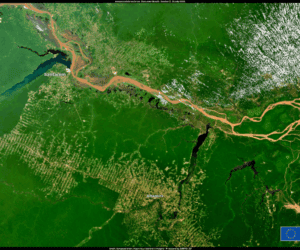
Instead of transportation, the vast majority of the food system’s GHG emissions come from deforestation and farming itself. That means that to reduce emissions from food we need to stop converting forests to farms and change agricultural practices. Localization by itself helps neither cause.
Industrial agriculture is better at implementing resource efficiency innovations than localized agriculture: When an industrial farm adopts an innovation, it is implemented across thousands of acres instead of just a few hundred. Big farms are also twice as likely to consider adopting new technologies than small farms. Among these promising technologies is precision agriculture, which uses instruments to determine the precise required doses of water and fertilizer; this prevents overuse, saving water and preventing harmful fertilizer runoff. Another such innovation is advanced, hyperlocal weather forecasts, which allow farmers to optimize planting and harvesting schedules.
Global food systems also distribute risk more effectively than local ones because when crops fail, food can be brought from elsewhere, decreasing famine risk and increasing price stability. Food commodity prices still change with adverse climate events, but distributed risk limits price volatility and prevents shortages. Without the ability to distribute risk across the globe, countries would need to grow excess food in case of crop failure. In other words, they would need to emit more GHGs to prevent shortages.
The rise of adverse climate events increases the need for risk distribution via globalized agriculture. To instead respond by localizing agriculture would be like spotting a leak in the hull and pouring water into the boat.
This isn’t to say that there aren’t any problems with our industrial agriculture system. Big agriculture relies on low-wage workers and often exploits immigrant labor. The dominance of agricultural giants like Bayer AG, Cargill, DowDuPont, and John Deere concentrates economic gains in the hands of shareholders while squeezing the farmers on whom our food system depends.
However, these problems are not inherent to industrial agriculture and can be addressed without localizing farming. Governments must enact stronger labor protections for agricultural workers and more vigilantly regulate agribusiness giants.
To grow food more efficiently with less resources, we should develop crop varietals resistant to climate change and adapted to underserved regions. Examples of the former include sun-repellent cauliflower and drought-resistant avocados, while examples of the latter include high-yield cassava varieties with the potential to double yields, a massive gain for subsistence cassava farmers. Another important goal: Reduce food loss in supply chains and food waste in households, which together are responsible for 10 percent of global GHG emissions. Large farms can also integrate regenerative agricultural practices such as mix-cropping and shade-cropping, boosting efficiency and reducing GHG emissions.
Many of my Amherst classmates enjoyed their part-time jobs at the college’s Book & Plow farm. It’s the kind of place we like to imagine our food coming from; the kind of place I like to imagine my farmer great-grandparents working; and the kind of place that inspires people like my grandfather to keep family farmland, even as they work office jobs. And it didn’t hurt that in season, the farm’s rows of colorful flowers made for lovely Instagram photos.
There is nothing wrong with buying local and organic if you can afford it, but to make food more widely available for everyone—and to help meet the challenges of climate change—the world also needs industrial agriculture at a global scale.