
Pushball match during a freshman-sophomore competition at Miami University, Ohio (1910) | Frank R. Snyder / Miami University Libraries / Public Domain
Matt Walsh: The definition of conservatism … It has no definition, I think. We talk about the words that don’t mean anything anymore, words that used to be useful and maybe used to mean something and they just don’t anymore because of how they’ve been used and abused and overused. And I just think conservatism is one of those words. When you tell me now that someone is conservative, that doesn’t tell me a lot about them. I don’t know what you mean.
Tucker Carlson: It generally means I’m not going to like them. They’re going to be some kind of fraud on the internet … That’s my gut reaction, so discredited has that word become.
—Tucker Carlson podcast, April 2025
The conventional political vocabulary most commentators have inherited from the French Revolution assumes that politics is fundamentally a contest between Left and Right, radicals and conservatives.
Yet contemporary events increasingly suggest that this scheme obscures more than it reveals.
As analysts such as Branko Milanović and Adam Tooze have recently argued in different ways, the defining tensions of the twenty-first century may be less between Left and Right than between competing forms of capitalism and governance.
The epochal contrast between the United States and China, for example, cannot be captured adequately by the traditional distinction of Left and Right.
After all, both the US and China are avowedly capitalist societies, yet they embody radically different relationships between markets, the administrative state, and emergent transnational institutions such as the United Nations and World Bank.
The relevant question is perhaps not whether one system is more “left-wing” and the other “right-wing” but whether complex networks of exchange—of both goods and ideas—are organized primarily through national or transnational institutions, and to what extent the results are determined by administrative commands rather than unregulated, and potentially more chaotic, interactions at the level of local networks of exchange.
It’s important to recall that in the modern world, anarchy has long had its advocates: not just Godwin and Proudhon and Bakunin in the nineteenth century but also, on one interpretation, Karl Marx and his championing of “real democracy” in place of a stifling “bureaucracy” (Hegel’s preferred solution to limiting through regulation the conflicts inevitably generated by an entirely free and frank exchanges of goods and ideas).
At the same time, some of the most powerful statesmen in both China and America have episodically resorted, deliberately, to unleashing the most brutally Hobbesian kind of de facto anarchy—one thinks of the armed conflicts that raged at the explicit direction of Chairman Mao during China’s Cultural Revolution and President Lincoln during America’s Civil War.
From this perspective, liberal constitutionalism appears less a natural, evolutionary endpoint of incremental political change than a historically contingent and obviously fragile achievement, forged or fortified in a crucible of coercion, fear, and violence.
At the same time, in our world one independent check on the tyrannical tendencies of powerful political leaders remains the unfathomable, wayward, and increasingly global networks of intellectual, commercial, scientific, and cultural exchange—augmented by a growing flow of people and peoples from the countryside to cities, from the peripheries of the world system to its centers. These networks bind together societies in ever more complicated relationships of interdependence. They generate a surplus overflow of information, facilitating the rise of decentralized, and alternative, centers of authority that limit the autonomy even of ostensibly sovereign central rulers.
Ever since the French Revolution, “conservatism” has derived much of its political meaning from its position within a left-right spectrum, defining itself in relation to novel projects of social transformation. But what matters in the current conjuncture is not whether a regime or a movement labels itself “conservative” or “radical,” liberal or progressive.
The central political divide of our era instead lies in the struggle between political tendencies and movements that aim to amplify the tangled institutional, intellectual, and moral interrelationships that nourish a globalizing civil society and those hegemonic empires and national regimes—whether avowedly revolutionary or counterrevolutionary, cosmopolitan or nativist, democratic or dictatorial—that instead aim to place those tangled interrelationships under the effective direction of a single sovereign power.
At the moment, Donald Trump is an agent of chaos and destruction, while Xi is an institutionalist with a preference for centralized command and control.
Both men are pursuing great transformations in their respective societies, under conditions of profound existential and epistemological uncertainty (since nobody can predict the results of global climate change, or the moral as well as economic consequences of the latest forms of artificial intelligence that may finally and fatally undercut any labor theory of value).
Trump and Xi obviously inhabit—as do we all—a world where all that is solid (in more ways than one) is melting into air.
And in this world of ever-expanding, ever more complicated networks of exchange, it’s not clear what role, if any, an avowed political “conservative” might play—surely not standing athwart history, and yelling, “Stop!”




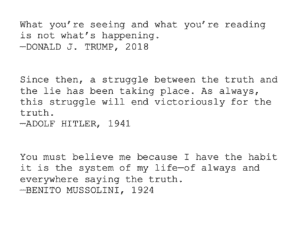









Food for thought Jim! I’ll keep chewing. My initial reaction is that conservatism remains rhetorically legible as a rejection of Progress, with its internationalism and multiculturalism. A conservation of the nation state, its racial identity, its gendered organization, its traditional values. An angry shout to “Stop!” immigration, feminism, queerness, and, it should not be left out, globalization. A desire to conserve the white Christian male breadwinner with reshored factory jobs, to repopularize the submissive child-bearing wife, to re-relegate minorities to second-class citizens (or deportees if possible). The American Right sure continues to take pride in the label. I think the American Left’s success lies in parsing it to identify points of strategic leverage — how to win at least some conservatives over economically. That this is even a possibility, let alone an actuality, speaks to your point that Left and Right have become less meaningful. Just look at MAGA for Mamdani.