Sinai and Palestine (1860s) | Francis Fifth / Metropolitan Museum of Art / Public Domain
When NAZA, the new documentary on the genocide in Gaza directed by Israeli filmmakers Yuval Abraham and Rachel Szor, had its world premiere at the Venice Film Festival it was reported that it set a festival record for the longest standing ovation ever at 24.5 minutes. When I saw the film at its first US screening at a press preview at Lincoln Center’s Walter Reade Theater, the reaction in the packed house of 268 critics and industry insiders was, I felt, the only proper response: stunned silence. It took almost 15 minutes for us to empty the theater and not a word was spoken. Certainly, no hands clapped. We had viewed 80-minutes of testimony from 24 unrepentant, anonymous young members of Israel’s elite military intelligence explaining how they went about participating in war crimes and killing thousands of Gazans.
The Israeli government and most of the public has launched their attack on the film since the day of its Venice premiere, claiming that it is full of falsehoods, antisemitic, and a “blood libel.” Israeli authorities have called those who made this film and those who appeared in it, treasonous. Israel’s minister of culture has even called to strip the directors of their citizenship. When I texted my impressions of the film to a filmmaker friend in Tel Aviv, he texted back that, at that very moment, crowds were demonstrating in front of director Szor’s parents’ house, threatening their and the director’s lives.
NAZA puts paid to the idea that the bulk of the deaths in Gaza were unintended, unforeseeable collateral damage. Instead, we learn that Israeli Artificial Intelligence technology tracks cell phone data in Gaza at a mass scale. For example, the Israeli military knew which phones belonged to alleged Hamas fighters, and that it was killing thousands of civilians, including children, when it decided to obliterate whole apartment buildings to take out one purported target. NAZA is an acronym for nezek agavi, meaning “collateral damage.” Targets were designated by their number of “naza.” We learn that the baseline for acceptable Naza was 20 people per alleged Hamas target. One soldier in the film speaks of once reaching Naza 500 in one strike. Unlimited collateral killings were permitted, even if it resulted in the death of only one Hamas fighter. One AI phone tracking protocol monitored for when the children of alleged Hamas fighters said words along the lines of “Daddy” and “is home.” Upon hearing this, the Israeli soldiers moved to bomb entire buildings. These decisions were made by humans, not algorithms.
Israel’s access to Gaza’s phones is practically limitless. One interviewed soldier recounts viewing the selfie of a reported Hamas fighter and his kids just before killing them. He admits feeling a certain sadness at the death of the children, but shrugs it off.
At another point, the film’s interviewees detail the killing of starving people who ran to get food when it was finally made available. There were, they explain, three groups of snipers set up to shoot and kill anyone who ran into a forbidden zone — although no one had told them it was forbidden.
Throughout the film, the soldiers offer all the usual excuses: if I didn’t do it someone else would have, I was only the technician, I was following orders, this is what my country wanted done.
Israel has long claimed that civilian casualties were primarily caused by Hamas living and fighting in civilian neighborhoods. NAZA reminds us of the obvious hypocrisy, as interviewees reflect on conducting war crimes from bases in central Tel Aviv. One soldier speaks of going out into the city for lunch in the middle of his shift, planning and implementing mass murder.
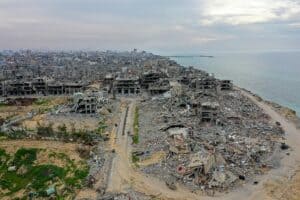
That Israel has killed tens of thousands of Gazans is a mystery to no one; it is well established that at least 73,000 Palestinians have been slaughtered, including at least 20,000 children. That these killings were carried out with total inhumanity is not news either. As Palestinian writer Hanin Majadli, among others, asked in his response to the film in Haaretz: Why didn’t we just listen to the Palestinians who have told the central part of this story of mass murder from the beginning? Why is it, Majadi’s column questioned, that “Palestinian suffering must pass through an Israeli voice to be heard?” Israel’s murderous callousness was there to be seen, livestreamed and described by the Palestinians suffering from it. NAZA simply certifies the truth of the genocide, one that had already been spoken but all too widely dismissed because the revelations came from the wrong source: the victims.
Cinematically, NAZA is the simplest of films. We see Yuval Abraham interview his informants on the roof of a Tel Aviv building, the soldiers’ faces obscured and voices disguised. Interspersed are shots of the windows of neighboring buildings, their residents going about their lives as the speakers recount their experiences.
Attacks against the filmmakers for insulting and defaming the Israeli military are all the more striking, given the fact that Abraham never makes a single onscreen accusation or claim. Every incriminating tale is told by one of the war criminals. It is an Israeli soldier himself who likens the actions of Israeli forces to that of the German military in WWII. He had always wondered how German soldiers could have carried out acts of pure evil, he says, until he found himself doing it. But the young man expresses no regret, no repentance. We hear no such sentiments from the whistleblowers. One soldier explains the process of drone killings. Sitting in their offices the soldiers would view the drone’s images and decide when and where to fire. Abraham asks what was done with the dead bodies. The soldier calmly explains they were eaten by dogs. He adds that he was unable to watch the scenes of dogs eating dead Palestinians. Others could; he couldn’t.
Israeli Prime Minister Benjamin Netanyahu said in the immediate wake of the October 7 attacks, “You must remember what Amalek has done to you, says our Holy Bible. And we do remember.” He was recalling the genocidal episode from the Torah in which the Israelites obliterated their enemies, the Amalekites. “Do not spare them; put to death men and women, children and infants, cattle and sheep, camels and donkeys,” was God’s word, a biblical justification for collateral damage. NAZA’s interviewees make clear their commitment to these barbarous orders.