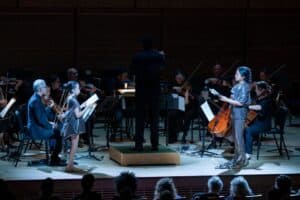
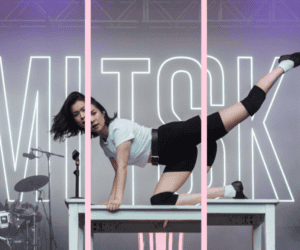
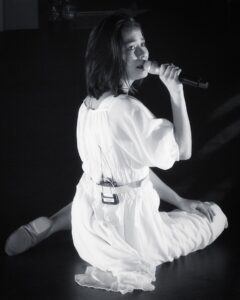
Rock Werchter Festival Werchter, Belgium. Concert of Rosalía (2023) Ben Houdijk / Shutterstock
Rosalía released her fourth studio album, Lux, in November 2025. Inspired by “feminine mystique,” according to its press release, the album narrates the lives of several female mystics and saints.
Rosalía worked with collaborators including Björk, Yves Tumor, and producer Noah Goldstein (from Kanye West’s Yeezus, another acclaimed God concept album), with the London Symphony Orchestra performing throughout. She reportedly spent a year studying theology and mysticism, followed by another writing lyrics in 13 languages associated with the mystics invoked on the album.
Lux was critically praised for blending classical music with contemporary pop, with The New York Times calling Rosalía “pop’s leading avant-gardist,” and Rolling Stone stating that Lux sounds “like nothing else in music.” Though I came to the album knowing little about Rosalía, I was curious to listen to a pop and classical synthesis devoted entirely to God.
I listened to the album as Rosalía instructs listeners to do, in a dark room with headphones on and my eyes closed. Rosalía has a beautiful voice. Two tracks in particular stood out: “Berghain,” a dynamic collaboration with Yves Tumor and Björk, and “Mio Cristo Piangi Diamanti,” which Rosalía has described as her “version of an aria” and where she most commits to the conventions of classical music and her operatic training.
I appreciate Rosalía’s ambition and dedication to praise God and blend classical and pop music. But because pop music has incorporated classical composition for decades, often to far more interesting and innovative effect, I think Lux was overhyped
Rosalía said in her Popcast interview that she wants Lux to succeed as a pop album. Though she doesn’t define what she means by pop, I take it to mean commercially viable, accessible, and fun to listen to. Lux has been commercially successful, breaking Spotify’s record for the most streams in a single day. Any Rosalía release is likely to succeed commercially at this point: She is an established global star, and the rollout for Lux was framed as a major event with artistic listening parties and great PR. But I don’t think it succeeds as a pop album.
A “pop album” could be defined as something most people like. Classical music, by contrast, refers to the Western music tradition—distinct from folk and popular music—built around complex compositions and orchestral performance, most often associated with European composers writing before the twentieth century.
Classical music isn’t typically described as accessible because it doesn’t rely on hooks, choruses, or a four-on-the-floor bass drum, and given its association with European aristocracy, it is perhaps an odd medium through which to celebrate global feminine mysticism.
Take “La Perla,” for example, the album’s second single. It is a Disney-like waltz, the kind of unmemorable musical number that isn’t really anyone’s favorite. Yet it’s somehow become the album’s most recognizable pop hit.
Waltzes were born in the eighteenth century from European folk dance music and were once considered scandalous, even avant-garde, because they were among the first social dances where partners held each other closely. Over time, they moved from popular dance floors into aristocratic society and eventually the classical repertoire. In that sense, Rosalía’s choice seems slightly odd. Lux attempts to bring classical music into pop, yet it does so through a form that historically travelled in the opposite direction.
The appeal of the waltz likely lies in it’s association with both popular and classical traditions. But that association is no longer relevant when they sound dated. Especially when they take on the sweeping Viennese, Beauty and the Beast variety heard in “La Perla,” in which Rosalía’s vocals cast the mental image of a pretty cartoon mouse.
The problem, however, isn’t the waltz itself. Waltzes can sound modern. Take “Golden Brown” by the Stranglers or “Norwegian Wood” by the Beatles, both commercially successful waltzes that don’t sound like they’re sung by dancing pots and pans. A waltz doesn’t have to feel like musical theater. Unfortunately, “La Perla” leans into the waltz in its most familiar style, which makes it an unusual vehicle through which to channel global feminine mysticism.
Elsewhere on the album, many songs lean more recognizably into standard pop conventions. “Sauvignon Blanc” is a pop ballad in which Rosalía considers throwing away her Jimmy Choos and finding peace in God alone. “Magnolias” is also a ballad. Though there is some interesting orchestral instrumentation, both follow predictable pop structures, which likely explains why they sit comfortably within mainstream expectations.
Yet the album’s use of 13 languages runs counter to pop’s promise of accessibility. If the music doesn’t move me, the lyrics might, but with thirteen languages, no one knows what’s being said.
Though Rosalía fans say good music demands work from its audience, I’m not convinced this is necessarily true, nor that the effort is especially rewarding. If the lyrics are meant to evoke specific saints, the correspondences are rarely clear. It requires considerable digging to trace possible references, and even then the connections feel tenuous. I don’t think any album, pop or otherwise, should require this much work to be conceptually legible.
Rosalía has said that she had to amend lyrics to fit different languages, and I think this leads to lyrics that are quite vague at best and sometimes read like a bad poem. On “Reliquia,” Rosalía sings, “We are dolphins jumping, going in and out / Of the scarlet and shining hoop of time.”
Despite its linguistic maximalism, the album engages with fairly narrow themes: our relationship to material things, the longing for something beyond ourselves, and our shitty boyfriends. The project’s aim to narrate mysticism rarely comes across. At times, it feels as though the lyrics were sacrificed to accommodate the polyglottic flex. The album might have been stronger had Rosalía sung in fewer languages and written more considered lyrics, avoiding moments like the dolphin debacle.
An exception comes in the last two minutes of “La Yugular,” where her lyrics are at their most telling across the whole album: “I fit in the world / And the world fits in me.” I admire this sentiment. But ultimately, the attempt to fit so much into compositions that remain musically familiar is where the album falls short both as an experiment in genre fusion and as a pop album.
Pop music should encompass experimentation and genre fusion, historically sustaining itself through absorbing other genres. Rosalía herself is a prime example, her superstardom a testament to the way pop music has, in recent years, cannibalized Latin music, repackaging reggaeton as the familiar rhythm sitting underneath countless mainstream pop songs and a Justin Bieber hook. Pop music did the same with hip-hop before that. It sustains its cultural ubiquity by absorbing other genres into itself.
Rosalía is now trying to fit classical music into pop, but she’s underestimating both what pop music is capable of producing and what its listeners are capable of digesting. She seems to want to take the lushness of orchestral instrumentation and fit it into arrangements and compositions that lean into the most predictable formats we’re accustomed to hearing—from the Disney musical waltz of “La Perla” to the to the classic pop ballad of “Sauvignon Blanc”—which make it neither experimental nor that interesting.
The best pop music incorporates other genres in ways that push beyond their boundaries. There are commercially successful records that expand what popular music can sound like, from Joni Mitchell’s Mingus, a collaboration with jazz composer and bassist Charles Mingus, to Beyoncé’s country eulogy Cowboy Carter, which still registers as pop while experimenting with genre fusion. We can think of artists like Nina Simone, whose classical piano training carried directly into the way she composed popular music.
We can also think of artists who defined the “fusion” genre itself, like Weather Report and Frank Zappa, who earned the title of “avant-garde” for his fusion of rock, blues, jazz, and classical music. Zappa even composed a classical album, Yellow Shark, recorded with Ensemble Modern. These were complex compositions written specifically for orchestral instrumentation. Rosalía, by contrast, seems to be writing conventional pop music and paying a lot of money to have it performed by a symphony orchestra which at times feels a little gratuitous.
Weather Report, the 1970s jazz fusion band, wrote the song “A Remark You Made” for their chart-topping album Heavy Weather. Composed by Joe Zawinul, its harmonic language recalls twentieth-century classical impressionism, blending jazz improvisation with classical composition. It doesn’t sound “orchestral” in a theatrical way, nor does it announce itself as a fusion record. It’s simply a beautiful song with orchestral voicing that achieved widespread commercial success and helped shape what both rock and jazz could sound like for years to come.
A great pop album should expand what pop music can sound like without requiring work to decode it. Lux isn’t truly innovative or experimental in the way we should expect of a critically heralded album. Setting experimentation aside, I’m not sure it works even as a predictable, feel-good pop album. It’s not really an album to sing in your car or dance to. It may be an album to listen to with the lights off and your eyes closed, or to feature as a jumping-off point to delve into hagiographic research, but I don’t think a pop album should only work in such a narrow context.
It may seem arbitrary to compare Rosalía to Frank Zappa, Nina Simone, and Weather Report, but they’re all popular artists who have used classical training to their advantage. If you’re going to create a pop album inspired by classical music, it’s worth remembering that classical music has influenced some of the most innovative—and still popular—records of the past decades.
It’s fallen out of fashion to criticize at all anymore, with a kind of democratic taste-making—“let people like what they like”—prevailing instead. But I do think we should remember what pop music has been and is capable of. This is important in order to define what titles like “avant-garde” and “fusion” mean at all. And if you like Lux, that’s okay! We can enjoy things for what they are. It’s the attitude of institutional critics—the Rolling Stone and New York Times writers of the world—that is most disappointing, especially when words like “avant-garde” are used casually and the history of pop music quickly forgotten.
To forget that legacy of experimentation is insulting both pop music and its listeners, and ignores what pop music has always been and is still capable of achieving.