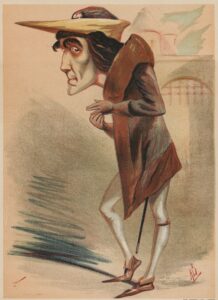
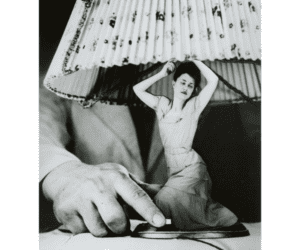
Rudolf von Laban and his Labanotation signs (1929) | Unknown photographer / Public Domain
Have you ever watched a video of yourself and wondered, “Why do my hands look so stiff when I gesture?” or “Geez, my walk is really galumphing!” And then, inevitably, “Would my life be different if I only knew how to move?” To this last question, the adherents of the movement visualization system Labanotation, had a definitive answer: “Yes!” As Whitney E. Laemmli shows in her new study, Making Movement Modern: Science, Politics, and the Body in Motion (University of Chicago Press, 2026), Labanotation promised that the very key to self-understanding, cultural vitality, and living authentically was making legible the codes of body movement that, to most of us klutzes, is invisible.
Making Movement Modern, the first book by Laemmli, a professor of Social Science and Cultural Studies at Pratt Institute, is a provocative study of a movement notation system known as “Labanotation.” Tracing the development of Labanotation—from its early iterations in Nazi Germany to its role in UK and US manufacturing, the CIA, Broadway musicals, and movement therapy for polio patients—Laemmli argues that Laban’s system for visualizing the body “not only aimed at preserving a vanishing past but at the literal choreographing of modern life.”
Labanotation is a series of darkened rectangles, chevrons, and squiggles meant to represent the positions of the feet, legs, trunks, shoulders, arms, and hands of people in motion. Its progenitor, Rudolph von Laban, born Rudolf Jean-Baptiste Atilla Marquis de Laban de Varjala in 1879, in modern-day Bratislava, was a Weimar Expressionist choreographer and, later, Hitler’s de facto minister of dance. During the late 1920s and early 1930s, Laban developed Kinetographie, a notation system that was meant to capture the movements of dancers so that performances could be repeated and recorded for posterity. Kinetographie looked like a cross between ancient Sumerian script and if Piet Mondrian came up with a language. The system would attract industrial and military consultants, dance therapists treating Holocaust survivors, Broadway and ballet choreographers (including George Balanchine), and folklorist Alan Lomax.
Laban’s big break was 1929’s Pageant of the Trades, a parade that Viennese city officials asked him to choreograph in an attempt to unify the city’s workers during a politically volatile time. Laban conceived of “traditional” movements that each group of workers would perform en masse. Laban’s commitment to ethnographic naturalism made him unusual among dance choreographers. In researching his dances, he developed a notation system to record the “traditional” movement elements in the labor of the modern workers he observed: confectioners, furriers, carriage decorators, barbers, blacksmiths, meat smokers, newspapermen, gamekeepers, bakers, and gunsmiths. He would then use his notation (which he named “Kinetographie”) to choreograph, for example, a “blacksmith’s dance” according to “blacksmith rhythms,” and a “stamping dance” in the style of the street-pavers—all with elaborate costumes. One paper was impressed by Laban’s “profound and painstaking study” of craft culture, while another noted that some guild heads resisted direction and simply walked, “solemnly robed and perspiring, ahead of their products.”
In the 1930s, Laban’s “movement choirs” became highly sought after. Laban found that he and Hitler shared similar opinions about the “alien” influences of swing dance. Charmed by the “lovely family feeling” and the Führer’s flower arrangements during a dinner Laban attended at Hitler’s house (other guests included Goebbels, Goering, and their wives), Laban accepted Hitler’s offer of the director of the German Master Studio for Dance position in 1934. But Goebbels, unimpressed by a rehearsal of his 1,000-person dance Of the Warm Wind and Joy, planned for the 1936 Berlin Olympics, fired Laban. (He likely knew Hitler preferred Leni Riefenstahl’s light, strong, athletic bodies; past attempts to introduce Hitler to darker, more experimental avant-garde work had gone poorly.)
A year after Laban’s fall from grace, a former student, Kurt Jooss, found him wasting away in a hovel, with a collaborator and lover Dussia Bereska, “who passed the majority of her days in an alcohol-induced stupor.” Jooss, an Expressionist choreographer who had fled Germany for England rather than fire his Jewish composer and collaborator Fritz Cohen, made connections with some key financiers and encouraged Laban to accept an offer of employment from them. Those financiers were Leonard Elmhirst, a British economist, and Dorothy Payne Whitney, financial backer of The New Republic and the New School for Social Research.
Duly smuggled into Devon, England, as a “Czech refugee,” Laban became the dance instructor at Dartington Hall, an experimental utopian school in a fourteenth-century castle funded by Dorothy Payne Whitney’s family fortune. Notable members of the progressive intelligentsia⏤Aldous Huxley, Ernst Freud, Bertrand Russell, and Robert Flaherty⏤sent their children there. That Laban should move from the embrace of the Third Reich to teaching at Dartington Hall is shocking until one considers that both proposed to counter the alienating effect of industrial mechanization through choreographing an “authentic” way of living.
When his emigration status came under question and his position at Dartington turned tenuous, Laban also dabbled in consultancy for UK companies like Mars Confectioners. To patch the gaps in the despondent, mostly untrained and female wartime workforce, he was hired to energize them, thereby increasing efficiency; his firm, Industrial Rhythm, promised that they would rediscover the ancient rhythms of industry, working joyfully like the unalienated threshers and sowers of old. Industrial Rhythm’s slogan was “To Bring That Swing and Lilt in Labour, Which Makes Efficiency a Pleasure.” Laban’s company claimed to not only increase productivity as Frank and Lillian Gilbreths’ Time and Motion Studies did, but also to reverse the corrupting effects of mechanized labor on the body, producing a happier, less union-hungry workforce, all using his notation system, Kinetographie. A cascade of interest in Kinetographie, channeled by Laban’s former students at Dartington Hall—dancers, industry experts, and ethnographers—followed.
In the 1940s, Laban’s code of dots, dashes, and squiggles came under widespread use by the New York dance community, when his former Dartington student Ann Hutchinson Guest founded the Dance Notation Bureau (DNB), which she ran out of a two-story elevator shaft in her Greenwich Village apartment building. George Balanchine and other choreographers had their work notated and archived, while Kiss Me Kate became the first production to copyright its dance material using what was now referred to as “Labanotation.” The idiosyncratic originator of the idea, Laban, much like the dancers captured by his code, faded into the background, and more impersonal, uniform systems took over.
In 1952, Warren Lamb, another Laban protégé, reworked Kinetographie into a more flexible notation system called Effort/Shape for his business peddling employee aptitude assessments. Like his teacher, Lamb was convinced that the authentic self could be divined through the systematic study of body movement. Lamb consulted on hiring for major corporations navigating this “puppet age” of the “cheese-like grin which does not express joyousness” and the “routine shake of the hands that does not express welcome.” His business, Aptitude Assessment (renamed Action Profiles International in 1981), would boast Colgate-Palmolive, Hewlett-Packard, Kodak, Hoover, Mars Confectioners (again!), and Bank of America as clients. Later, the Department of Defense’s Office of Net Assessment—an internal Pentagon Think Tank founded in 1973—hired a certified Aptitude Assessment analyst who had received the “Warren Lamb Trust, Creativity, Leadership, and Innovation Award” to conduct “Body Leads.” She profiled Saddam Hussein and Osama bin Laden’s decision-making styles based on their body language; Lamb himself consulted on another “Body Lead” in 2011: for Vladimir Putin, presumably on horseback.
Lamb’s Effort/Shape was also integral to dance therapy pioneered in the 1950s through 1970s by Irmgard Bertenieff, another Dartington graduate, who founded the Laban/Bartenieff Institute of Movement Studies in New York City. Bartenieff’s systematic study of trauma responses, first with polio patients and later in Holocaust survivors and veterans returning from Vietnam, realized the therapeutic potential of Laban’s approach: dance therapy was a means to coax authentic, joyful physical responses from traumatically damaged, maladaptive ones. One of the first members of the Laban/Bartenieff Institute of Movement Studies was the anthropologist Margaret Mead, who introduced the system to ethnomusicologist Alan Lomax; he would go on to use Effort/Shape notation for his influential “Choreometrics” film project, in which he sought to salvage and celebrate the movement styles of peripheral communities who did not display the “head-back, chest-out, erect posture of the North European elite.” Encountering heterogeneity of movement, Lomax thought, could inspire perceptual sensitivity to movement differences and provide a bulwark against the mass culture of the television age.
Laemmli unwinds a dizzying tangle of influences that sets Margaret Mead in conversation with Mars Confectioners and places Bertrand Russell one degree of separation from Joseph Goebbels. But was making movement modern anything more than the effort of a collection of people who, despite their radically different political affiliations and economic interests, were united by a grand idea of an authentic self or community that movement, if regulated or decoded properly, might “foster” or “express”? Laemmli only hints that these approaches might be bound by a shared shortcoming as well:
Taking movement seriously also means recognizing the ways in which it can be used for both good and ill—how ecstatic forms of embodiment have also functioned as tools of social control … It is too much to ask that individual forms of bodily practice remedy the larger structural problems that plague the world in which we live. As we look to the future, therefore, we should remain wary of those who refuse to recognize this nuance and complexity, and who promise that in the act of recording the moving body, everything will be gained and nothing will be lost.
The problem with movement studies is also the problem with books: So much escapes notation.