Remembering the Civil Rights Movement

An interview with poet Cheryl Clarke about the 1963 March on Washington

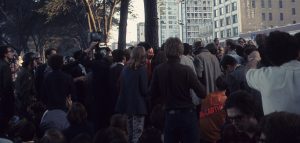
In August 2013, the fiftieth anniversary of the March on Washington, I had the opportunity to interview African-American feminist and lesbian Cheryl Clarke about her participation in the March on Washington. A poet, essayist and literary critic, Cheryl has been an activist, a teacher and an artist for her entire ...
Read More
Remembering the Civil Rights Movement

Feminism and the Intersectional Politics of Anger

Soraya Chemaly’s Rage Becomes Her: The Power of Women’s Anger

I began reading Soraya Chemaly’s Rage Becomes Her: The Power of Women’s Anger the week of Brett Kavanaugh’s second appearance before the Senate Judiciary Committee. Like so many other feminists, I found Kavanaugh’s bellicose and evasive performance utterly infuriating, and I was incensed by Republicans’ sputtering indignation that he had to address the accusations ...
Read More
Feminism and the Intersectional Politics of Anger

Can There Be Dignity In A Vast Majority?

Democrats have the votes. Now we need to listen to each other.

What if the Democratic Party now has the support of the majority of American citizens? Certainly Democrats did well in the 2018 elections. More revealing than the tally of races won is the fact that Democrats received majorities of the overall votes cast for Senate candidates, for House candidates, and for gubernatorial candidates. In the House elections, Democrats ...
Read More
Can There Be Dignity In A Vast Majority?

A History of Innovation

The first history of The New School for Social Research recalls its originality

My friend replied, “The New School I know was the creation of American progressive reformers.” We quickly realized that we each knew only parts of two different versions of the New School’s history and that this subject was perfect for collaboration based on our very different perspectives. What kind of school is the New ...
Read More
A History of Innovation

Mahatma Gandhi: What Jesus Means to Me

A greeting to our readers from Public Seminar

In December, 1931, when Mohandas K. Gandhi was voyaging back to India after attending the Second Round Table Conference in London, Christian passengers asked him to give a talk on Christmas Day. We at Public Seminar are consciously non-sectarian in our approach to all things religious and political; we also ...
Read More
Mahatma Gandhi: What Jesus Means to Me

Should “Child’s Play” Include a Little Danger?

The Progressive-era roots of the ‘adventure playground’ movement

Adventure playgrounds are built on the idea that kids need to play in danger-possible environments, free from rigid schedules and restrictions of modern parenting. These playscapes throw kids into industrial-like settings where hammers, saws, and drain pipes replace the see saw, slide, and swing structures of the post-World War II ...
Read More
Should “Child’s Play” Include a Little Danger?

Interview and Excerpt: Robert Coover’s New Book, The Enchanted Prince

An innovative author continues to test the limits of genre

Robert Coover, author of innovative fiction such as Pricksongs & Descants, The Public Burning, and The Adventures of Lucky Pierre: Directors’ Cut, has had a long and influential career in avant-garde literature. His latest book, The Enchanted Prince (Foxrock Books/The Evergreen Review, 2018), continues to expand the genre. In 62 pages of mischievous parody, flamboyant image-making, ...
Read More
Interview and Excerpt: Robert Coover’s New Book, The Enchanted Prince

Tiny Animals

Season one of ‘My Brilliant Friend’

I think they are cockroaches, streaming out of the sewer by the thousands, but they might be rats -- we see them from a distance, and because it is dark and there are no people in the shot, just the empty street and the dirty white cement of the housing ...
Read More
Tiny Animals

Antisemitism after Pittsburgh

Wayne Koestenbaum’s Poetic Ethics 

About a month after the murder of eleven at the Tree of Life Synagogue in Pittsburgh -- the worst attack on Jews in the history of this country -- we might pause to reflect on the nature of the continuing threat. The attack itself has only elevated anxiety that Jews ...
Read More

Antisemitism after Pittsburgh

My Arrest in Poland

Reflections on the significance of an apparently trivial event

“At the time the circumstances of my arrest in Poland seemed trivial. I hardly thought about them afterward. But now, when I consider the fall of 1989, and the fall of communism, my little run in with the Polish authorities seems highly suggestive of how things were then and what ...
Read More
My Arrest in Poland

The Moral Reader and the Moral Life

Exploring Timothy Aubry’s essay, ‘Should studying literature be fun?’

Earlier this month, English professor Timothy Aubry published an essay in the Chronicle of Higher Education Review with the rather querulous title “Should Studying Literature Be Fun?” The essay was a kind of précis (as far as I can tell) of his new book Guilty Aesthetic Pleasures. I have not been able to read the ...
Read More
The Moral Reader and the Moral Life

“Well Known as Miss Betty Cooper”

Gender Expression in 18th-Century Boston

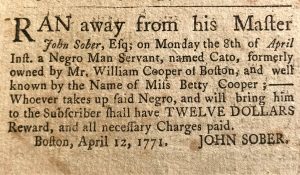
In the years before the American Revolution, Boston newspapers routinely advertised the sale and recapture of enslaved people alongside news of Massachusetts’ resistance to British rule. In these ads, enslavers provided descriptions of fugitives in order to assist slave catchers in returning them to bondage. One 1771 advertisement sought the recapture ...
Read More
“Well Known as Miss Betty Cooper”