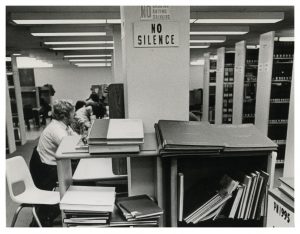
New School staff seated beneath José Clemente Orozco’s mural cycle (ca. 1940s) / Photographer Unknown / Permission of The New School
The New School for Social Research will keep indefinitely a yellow cotton curtain over the “Revolutionary Violence” section of a mural in the school’s cafeteria by the late Mexican artist José Clemente Orozco, because the painting “does not express the philosophy of the faculty,” Dr. Hans Simons, president of the school, declared yesterday.
—The New York Times, Friday, May 22, 1953
Be on time. No. Be early. Be there at five minutes to one.
It’s in the room for special occasions: a luncheon, for her, for her decades of service. A luncheon. She pronounces it “lunch-on” when she sees the word printed on the invitation, and again now on a sign outside of the room where the celebration will take place. Lunch-on-me, she thinks, they will all lunch on me. My final turn. How do I taste? Aged? Tired? A stinging zest at the end? But I’m not paying. Happy retirement. What a special occasion.
The curtains in the cafeteria hang on the eastern wall of the room, from the ceiling to the top of the wainscoting, like there is a window behind the draped fabric. Windows are the eyes to the soul, she thinks. But we are in a room looking out. Yellow curtains like eyelids, or like lining for the inside of the skull. Yellow sinuses. A backdrop to the round tables dressed in linen and silverware, a reminder of just how long she’s worked at this university. The year she began: 4 BC (Before Curtains).
Before Curtains: the room bustling, students and faculty and staff members, smoking cigarettes, drinking coffee, ideating in the company of the frescoes. She had always liked them—the frescoes. Vivid frescoes, painted by a renowned Mexican muralist, one scene for each wall of the room. Frescoes the color of earth and herbs and blood and spearmint mouthwash. Frescoes of people marching, starving, winning, reaching, and discovering. Some familiar faces. Some imagined. Table of men (only men!) and so many eyes.
Something about those frescoes. Something gruesome, insulting, making important people uncomfortable. Something that required curtaining. Hiding away. Out of sight, out of mind, out of spite. She knows it was the faces and the ideas. But now, staring at the wall where there’s nothing but yellow curtain, she thinks it might have been the colors. The colors they did not like: blue, for instance. Purple. Green. Brown. Red.
“You’re first to arrive. Something to drink?”
She doesn’t bother to acknowledge the voice. Waves his words off like a fly and shuffles her sturdy black loafers (polished so well that, except for the worn heels, thrice resoled, they look almost brand new) to sit beside the east-facing wall. She can get a good look at the curtain there. What’s behind it? A saucer touches her hand, the aroma slips up to her age-hooked nose, and it comes back to her. She is here, 4 BC, a not-young secretary, someone reliable and cheap, sipping coffee, transfixed by the angles of the marching soldiers of the fresco. How they stand aslant on the wall. Flat menaces, ready to strike.
Later, she asked questions when the curtains went up—for how long? Why that color? That awful color? And isn’t it art? And who is it for? There were few answers given, and no point in digging. But that was then. This is now. And that awful yellow curtain is still hanging limp from a brass rod, mocking her. It remembers, and she does not.
Hold a buttercup under your chin, if you see yellow, it means something. But what? She tries to remember as colleagues line up to shake her hand. The closer they stand to the curtain, the more clearly she sees the putrid hue each one emits. Yellow is supposed to mean happiness and cheer. Sunshine and lemon drops and goldfinches. But this is not happiness yellow, here in this room. It is not quite butter, not quite citrine. So wholly dull, so neutral, it feels like an offense. An offense, yes! Imagine peeling a banana to find nothing inside. Happy retirement.
Why not red, to make the room feel like a theater? Or why not blue? Something regal. Something, a portrait, could be hung in front of the curtains. Yellow, she wants to tell the next person who embraces her, is the color worn by medieval prostitutes.
Someone stands at the table to her right, clinking on their coffee mug, clinking everyone to a hush. He speaks of her years of service, but she can only hear the stifled laughter of those red-starred soldiers on the other side of the curtain. She can recall them now; thrilled, those soldiers, to never have to look at the crowd of people in the room. These people who hang yellow curtains.
“Would you like to say a few words?”
A hand extends to help her from her seat. A slow roll of applause helps her find her footing. She passes round bodies, sliding against the eastern wall. Close enough so the downward curve of her nose touches the curtain. She smells sand. Smells gold. Smells something akin to a wheatfield. Yellow warming her back.
Turn to the audience now. Ask them. Tell them. Go on.
This essay is part of a series of interdisciplinary responses to Mexican artist José Clemente Orozco’s 1931 mural cycle A Call to Revolution and Table of Universal Brotherhood. The mural, one of The New School’s earliest commissioned artworks and the only surviving permanently installed public example of classic Mexican fresco painting in New York City, is currently the subject of a multi-year conservation project that will see its surface restored and environmental conditions stabilized for years to come. While conservators prepare to gently treat the efflorescence clouding Orozco’s imagery, Public Seminar has invited scholars from across The New School to look at the artwork with fresh eyes.
The preservation effort has been made possible by funding from the Mellon Foundation, Frankenthaler Climate Initiative, and the Terra Foundation for American Art.