Simulacra of Democracy

Between erasure and reactivation

The following lecture was first presented as part of the Memory Study Network conference “Routes and Roots: Migration, Memory, Transnationality” at the New School for Social Research Festival of Ideas, on April 16, 2026. Let me begin with a proposition that may sound unsettling. Democracy does not disappear only when it is ...
Read More
Simulacra of Democracy

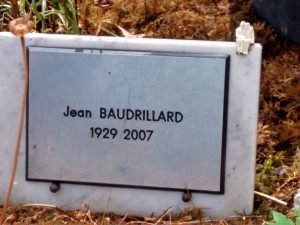
Remember Baudrillard

On the Ecstasies of Posthumous Communication

The last thing I expected was a reply. After all, he was dead. I emailed Jean Baudrillard one intoxicated evening, when the world was feeling too much for me. The idea came to me as a dark whim; somewhere between a compulsion and a negative epiphany. We had exchanged a couple ...
Read More
Remember Baudrillard

Is Alex Israel for Real?

Sun, sincerity and simulacra in SPF-18

The campy, nostalgic, Hollywood-inspired works of young(ish) artist Alex Israel would not be out of place as the scenery for a nineties-California-themed party, yet they regularly sell for hundreds of thousands of dollars – sometimes more – and he has had solo exhibitions in prestigious galleries globally. Israel’s first major ...
Read More
Is Alex Israel for Real?

Franco ‘Bifo’ Berardi

Where Mario Tronti and Antonio Negri were born in the 30s, Berardi (1948) belongs with Paolo Virno (1952) and Silvia Federici (1942) to a second wave of Italian Marxist thinkers who grew out of the workerist current that struck out on its own path, diverging from the official Gramscian postures of the ...
Read More

#Theory21c (part 2)

It is quite scandalous how much theory-talk still retails metaphors based on 19th century worldviews. As if what we can know about the world had not undergone several revolutions since. Hence if one were to look for a #Theory21c it would have to start with people who at least engage with ...

Read More

Virno and History

He could have been talking about something that goes by many names in Paolo Virno’s Déjà Vu and the End of History, (Verso Futures, 2015). Sometimes Virno calls it potential, or the virtual, or memory, or faculty, or disposition, or even labor-power. This unquenchable fire is for Virno the source ...
Read More

Cognitive Capitalism

The second is able to think more historically. For example the regulation school came up with a convincing portrait of what it called the Fordist regime of regulation. In this version capitalism has stages, each of which are qualitatively different. But it tends to be troubled by the current stage, ...
Read More

#Theory21c (part 1)

That agenda seems to me to have at least three major features. The first is the anthropocene. One can no longer bracket off nature from the social, and construct a theory exclusively on the terrain of the social. The second is the role of information in both production and reproduction. ...
Read More

The Drone of Minerva

The one kind of speculative thought that might be of service in the Anthropocene is surely some kind of philosophy of history, and yet within the academy itself it seems the one nobody wants to actually attempt. It is as if the debates at the end of the last century ...
Read More
The Drone of Minerva

Utopian Realism

I once asked Jean Baudrillard for his impressions of his tour of the colleges of America. “Boring,” he said, “like any realized utopia.” This was a provocation on several levels. In the cold war, realized utopia mean Soviet terror, not American prosperity. And of course Baudrillard was as aware as Jameson ...
Read More
Utopian Realism

Extrapolation, not Acceleration

We hoped; we waited for the day The state would wither clean away, Expecting the Millennium That theory promised us would come: It didn’t… W. H. Auden, New Year Letter, 1941 It would appear that in the twenty-first century, we should probably relinquish a faith in a force external to capital, even if generated by it, ...
Read More
Extrapolation, not Acceleration