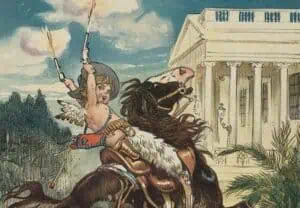
Cowboys on a Texas Roundup (1901) | William Henry Jackson / Library of Congress Prints and Photographs Division / Public Domain
For the past 50 years, Texas has been a GOP stronghold. Despite the good efforts of figures such as Beto O’Rourke, Barbara Jordan, and Ann Richards, the state has remained firmly in the grip of big business, big oil, and a conservative legislature. But as David Griscom observes in his new book, The Myth of Red Texas: Cowboys, Populism and Class War in the Radical South (Nation Books / OR Books, 2026), Texas once had the third-largest socialist party in the US.
What happened?
Griscom lays out a timely challenge: How might the region’s voters come to know their own historic antecedents for revolutionary change? It’s a question freshly relevant given the upstart Democratic candidacy of James Talarico, the eighth-generation Texan, seminarian, and former middle-school teacher who is currently vying for the US Senate seat of the departing John Cornyn against the state’s scandal-plagued attorney general, Ken Paxton. Talarico has stirred considerable national enthusiasm for his modest Christian eloquence, his call for economic justice, his determined assault on corruption, and his outspokenness against his opponent’s legal and ethical lapses.
Griscom, a veteran journalist and political commentator based in Austin, offers an overdue and most welcome reflection on the history of radical change movements in Texas and a grand poke at the myth of the state’s permanent conservative bloc. In his opening chapter, Griscom talks about an 1883 strike by Texas cowboys, which ultimately brought higher wages to men who drove herds north to market, an effort largely airbrushed from history seemingly for not fitting the standard trope of frontier individualism. This lays the foundation for Griscom to turn to how, in the face of an all-powerful Democratic juggernaut, homegrown activists created the Farmers’ Alliance, a three-million-member regional coalition of farmers and sharecroppers led by colorful regional characters such as H.S.P. “Stumpy” Ashby and J.H. “Cyclone” Davis. In the era before radio or television, the Alliance was known for its days-long encampments of teach-ins and entertainment for as many as 10,000 attendees, at which colorful political speechifying stressed the values of self-respect and class consciousness. When the national Knights of Labor organization asked the Alliance to support the railroad workers’ strike against tycoon Jay Gould by boycotting railways, Texan farmers learned to perceive themselves as one with the urban working class; while the striking workers went without pay, the farmers delivered them food. The group’s relationship with race was less straightforward: The original Alliance had excluded Black farmers, who in 1886 formed their own Colored Farmers Alliance, eventually one million members strong. But the two groups would be brought together as key regional allies in the populist movement that posed a serious challenge to Texas’s political establishment in the form of the People’s Party.
“Populism is an abused term today,” observes Griscom, “often narrowly defined as political rhetoric wielding an us-versus-them style. This usage does a disservice to [actual historic] populism, which was much more than a rhetorical style. It was a living, breathing movement of people.”
It was also a movement that addressed civil rights head-on. Upon the collapse of Reconstruction, Republicans aimed to become “the party of business.” Across Texas, Griscom writes, “so-called Lily-white Republican clubs, intended to limit black people’s role in the Republican Party, sprang up like weeds.” Southern Democrats, meanwhile, proved a dangerous reactionary force, much emboldened by their willful quasi-religious crusade known as “Redemption,” which rose across the former Confederacy. In a multi-pronged strategy they would revisit multiple times in coming years, conservatives attacked reformers as communists and anarchists, agitated against Black elected officials and Black voting, and employed ballot box stuffing, physical intimidation, and violence, sometimes aided by the Ku Klux Klan.
Keenly aware of the difficulties met by Populism’s reformist program, socialists in 1890s Texas boldly called out capitalism and vowed revolution. Urged on by two lively national publications, the Appeal to Reason and The Rebel, the state’s Socialist Party grew to include 25,000 voting members by 1912. “With the complete overthrow of the present anarchistic, war breeding, cannibalistic, women-killing, cradle-robbing system of capitalism,” vowed journalist Thomas “Red Tom” Hickey, “civilization will be developed, and humanity shall step onto a higher plane.”
“These farmers have the true socialist spirit,” Eugene Debs, hero of the 1894 Chicago railway strike, said on visiting the Lone Star State. “They look you straight in the eye, with an expression of comradeship so honest and guileless that one cannot resist putting his arms about them.”
At first, religious Texans met Socialism and its alleged notions of free love with some resistance, but many came to recognize that Socialists, though not attached to any single form of worship, nonetheless lived lives fundamentally aligned with Christian virtues. And due to the state’s vast size and distance between communities, Texas offered room for the growth and maturation of local movements, and the opportunity to develop more diverse constituencies.
As in any movement, there were occasionally “accelerationists” who believed that allowing or even encouraging labor conditions to worsen would more effectively lead the oppressed to join revolutionary movements, but most Texas Socialists disavowed such thinking. Instead, many emphasized the same form of education and uplift inherited from the encampments and multi-day speech festivals of the Farmers Alliance and the Populists. It is regrettable that these scenes are lost to history. “Today most people would be surprised to learn that there was a Texas Socialist Party,” Griscom laments, “let alone that it was one of the largest socialist parties in the country.”
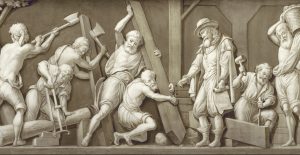
One of the most heartening endeavors was the Brotherhood of Timber Workers in the years 1910–1916, which rose in opposition to timber baron John Kirby, “The Prince of the Pines,” who reigned over the company town of Kirbyville in the Piney Woods of Texas along the border with Louisiana. Vast timber empires such as Kirby’s had been made possible by abuse of the Homestead Act, in which corporate and foreign interests bought up massive tracts of land for as little as $1.25 an acre.
Like work on nineteenth-century railroads, service in the timber forests was often dangerous. Workers were wounded by giant saws, lost hands or fingers in mulchers, or were crushed by falling trees. In lieu of decent medical care, it has been suggested, workers had recourse to cocaine, heroin, and morphine at the company store, while for their long hours of toil their pay was often distributed in scrip, good only at those same Kirby-owned commissaries.
Because of the remoteness of the Piney Woods, there were few foreign workers available, so a large number of Black Americans and Mexican immigrants filled the ranks. The resulting Brotherhood also allowed women to join, though the gesture was only enlightened up to a point: Membership was granted in recognition of women’s contributions to the movement as supportive wives and mothers. Their presence was said to not only ennoble husbands’ union militancy but to physically protect the men, as Griscom notes: “If armed thugs or hooligans were sent to attack the striking workers, they first had to look into the eyes of the women of the Brotherhood of Timber Workers.”
Kirby was not about to relinquish his feudal hold, however, and retaliated against the strike by shutting down mills, blacklisting union leaders, unleashing the Klan, and even hiring a prominent Black populist to preach Booker T. Washington’s “self-help program” in the hope of sowing racial division.
In 1917, the momentum of the Socialist cause was undercut by patriotic enthusiasm for the US entry into the First World War. Some union members enlisted, but conscientious objectors and anti-war activists were targeted by the government, accused of disloyalty under espionage and sedition laws. Eugene Debs, a vocal opponent of the war, was sent to prison. In this tumultuous period, Populists, Socialists, and working people’s advocates nationwide faced accusations of anti-Americanism; labor activists were hounded or, in the case of the Wobblies, imprisoned; and Black unionists in the South were hit with poll taxes and a variety of intimidation methods including grandfather, literacy and “understanding” clauses designed to frustrate and deny Black voter registration.
“The whole world is under obligation to the Negro,” Debs observed, “and that the white heel is still upon the black neck is simply proof that the world is not yet civilized.” Debs criticized fellow Socialists who failed to come to the aid of their Black comrades in this period, but against the overwhelming reactionary energies of the South in the late nineteenth and early twentieth century—what the Black scholar Rayford Logan termed “the nadir” of the Black experience in America, a period marked by the exclusionary policies of Jim Crow, rampant lynching, and the desperate regional exodus of Black Americans—on-the-ground resistance was largely unsuccessful. White Southerners chose to destroy rather than repair their society. “[There] was a different path that the South could have taken in the twentieth century,” Griscom reminds us. Instead, white Texans’ horrific failure of principle and morality would long cripple the region.
An appreciation of the manifestations of past progressive activism in Texas must be met with cautious optimism as to its return. Griscom is impatient with the Left’s complacent assumption that the increased Latino vote in twenty-first-century Texas would enable the state to “turn purple.” Any such faith that Latino voters will automatically support Democratic candidates has been a bust. After turning out solidly for Joe Biden in 2020, Latino Texans stunned political observers four years later by shifting noticeably to Donald Trump. “In 2024, the idea that non-white voters were just Democrats in waiting exploded in Democrats’ faces—both statewide and nationally,” Griscom writes, disabusing vote-watchers of the “demographics are destiny” argument.
He also punctures the myth that Texas is conservative by nature, pointing out that recent Republican power has come largely from new arrivals—conservative Californians and transplants from other states—who’ve turned suburbs of Dallas and Houston into GOP strongholds.
There’s undeniable glory in Texas’s historic progressivism but also a stark warning of the precarity of even the most sure-footed efforts to reignite that legacy today. In the twentieth and twenty-first centuries, the author reminds us that Texas, like the rest of the nation, experienced the civil rights movement, the antiwar movement, struggles for the environment, and campaigns for the rights of women and gay Americans. Yet capitalism itself—the target of earlier Texas radicalism—is today rarely a central focus of campaigns outside of the Democratic Socialists of America, who have burgeoning chapters in Austin, San Antonio, and the Rio Grande Valley. “As it currently exists, the Texas left, much like the broader US left, is much more ‘class-focused’ than it is ‘class-rooted,’ ” Griscom writes. “The difference is key. Left populists like Bernie Sanders and Jeremy Corbyn opened the political conversation up to broader discussions of class, but discussions of class are different from class movements.”
James Talarico’s questioning of the monied influence in our nation’s elections, his promised egalitarian reforms for better housing and childcare options, and support for public education, in addition to his brand of progressive Christianity, has drawn a backlash from Evangelicals and other conservatives. But he has proved himself a charismatic campaigner, and facing a weak candidate in Ken Paxton, Talarico may be 2026’s best chance in decades to reconnect Texas with its radical past. “Contrary to popular belief, Texas is not a conservative state,” Griscom reminds us. “Conservatives have ruled the state for a long time, as both Democrats and Republicans, but there is a radical tradition with deep roots beneath the surface.”