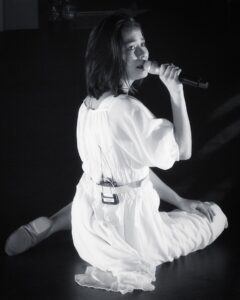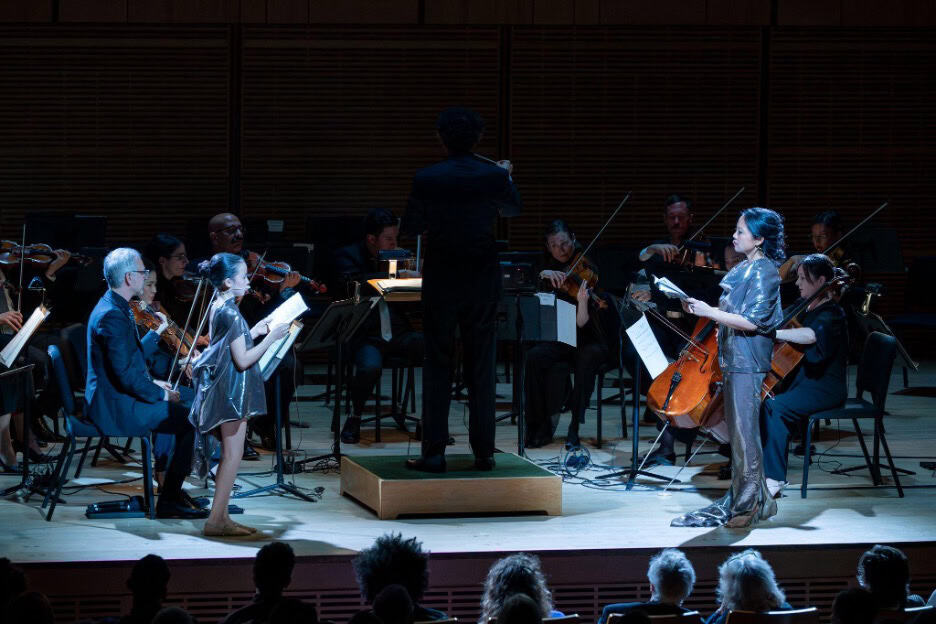
Sayuri Ishida (left) and J. Mae Barizo (right) perform Cloud Variations with The Knights (2025) | Jennifer Taylor / Carnegie Hall
Poet and performer J. Mae Barizo’s monodrama Cloud Variations is a transdisciplinary foray interweaving poetry, chamber orchestra, visual art, and theater. The piece places Barizo’s “Cloud Pantoum,” a poem previously published in The Atlantic, in conversation with Philip Glass’s Symphony No. 3 to create a kaleidoscopic meditation on body, technology, and desire. Presented in collaboration with The Knights—an orchestral collective known for their intrepid arrangements and expansive repertoire, including collaborations with Yo-Yo Ma and Yuja Wang—Cloud Variations received its world premiere at The Knights’ opening performance of their season at Carnegie Hall.
Cloud Variations feels emblematic of a broader shift in contemporary performance—one in which language, sound, and technology are increasingly intertwined. Though staged only once, its debut offers a glimpse into where hybrid classical work is headed. Under the direction of George R. Miller, an exciting emerging voice on the American opera scene, the piece unfolds in what Barizo describes as “five loosely structured movements.” As the lights dim, a child glides onstage to deliver a promise: “My future selves, I wait for you on the emerald lawn.” Beginning with this brief prelude recited by child performer Sayuri Ishida—a member of Metropolitan Opera Chorus and School of American Ballet who embodies the poet’s younger self—the first movement is followed by Glass’s full symphony, whose pulsating rhythms and layered repetitions resonate with the recursive and distorted textures of Barizo’s pre-recorded text:
From the rotunda from the fleshwound from the long distance telephone
from from the cloud slope from the front row from the lake shade from
the fade-out from the from the bedsheet from the slaughterhouse
from the filthy avenue from the cesspool from the true signature of love
Drawing inspiration from the Malay oral poetic form pantun berkait—with its pattern of interwoven and repeating quatrains—the text becomes both an exploration of genre and identity, and an experiment in language itself, tracing the slippages and mistranslations of Barizo’s Malayo-Polynesian mother tongue, Tagalog. This exchange takes shape most clearly in the counterpoint between Ishida and Barizo, whose dialogue renders visible the work’s preoccupation with translation and return.
In Miller’s staging, Barizo’s voice is paired with its mirrored counterpart, extending the monodramatic form into a double embodiment: two performers voicing the same consciousness across time. As Miller notes of their collaboration, “The two of us were thinking a lot about how to subvert these containers of time and how we can represent more expansive approaches within a very Western classical framework.” First appearing as a youthful echo in the prelude, Ishida returns for the final act as a spectral reflection for a parting duet with Barizo, evoking the pangs of splintered memory and loss amid time’s ongoing drift.
The accompanying string ensemble, conducted by Eric Jacobsen, conjures a shifting soundscape of chord clusters—what Barizo calls chord clouds—punctuated by sweeping glissandos and pizzicatos.
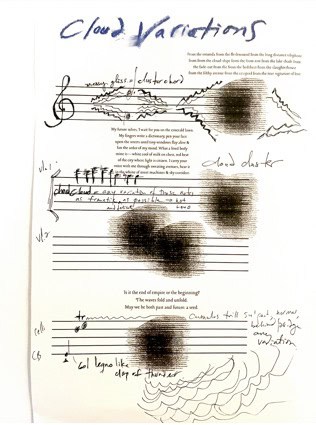
Comprised of circular graphic texts mapping stage and sound spatialization, the scoring collapses into a hybrid object, retaining the sonic fluency of a musical text while simultaneously functioning as a visual poem, interpretable across multiple sensory registers. This transdisciplinary approach forms the conceptual and compositional framework for Barizo’s work and underpins her creative thinking writ large: “A poem can be many things: a performance, a sculpture, an opera,” she comments.
Building on a history of experimental approaches to classical music, Cloud Variations emerges from the minimalist experiments of the 1960s—popularized by Glass in the 1970s—and continues a lineage of compositions that foreground texture, rhythm, and temporal perception over strict narrative or harmonic progression. Like Glass and his contemporaries, who sought to expand inherited conventions, Cloud Variations broadens the scope of the orchestral form, blurring the boundaries between poetry and sound. As Miller observes, “Working in a classical music framework, we’re already in a container of convention and tradition, so the idea of creating an orchestral sound poem really stretches what multidisciplinary symphonic programming can be.”
Beyond text and sound, Barizo and Ishida’s movements—staged with a deliberate sense of fluidity—were further articulated through the wearable art pieces designed by Parsons School of Design alum Yuchang Xiao, which transformed the performers’ bodies into living extensions of the work’s hybrid score. Both Barizo and Ishida’s costumes were cut and draped from the same semi-translucent fabric panel, reflecting the nature of encounter, or, as Xiao puts it, “the concept of meeting yourself.”

Xiao envisions the wearables in a Cageian sense, as instruments of unpredictable encounter—sites where the perceived distance between self and material dissolves and reemerges. “Costume for me is a device for transformation,” Xiao explains. For John Cage, whose mid-century happenings reimagined performance as a field of encounter, these events were not merely aesthetic experiments but spaces of attentiveness and openness, arising from shifting cultural, linguistic, and historical terrains of the postwar era. In Cloud Variations, this spirit of openness is reconfigured for the twenty-first century, where the boundaries between body, text, and technology continuously blur—a tireless search for self amid the indeterminacies of language and the unfolding of desire and empire.
It feels fitting that this performance should occur only once, existing as a co-constitutive encounter that implicated performers and audience alike in its fleeting, singular realization. Extending the Cageian tradition of the happening, Barizo enlisted the audience, “from the front row” onward, as active participants in the generation of the work—of empire, of love—eliciting reflection on complicity amid the complex entanglements of desire and hegemony. Though Barizo’s voice carries most of the text, it is her mirrored younger self who delivers the final reverberating lines: “Is it the end of empire or the beginning? / The waves fold and unfold.”