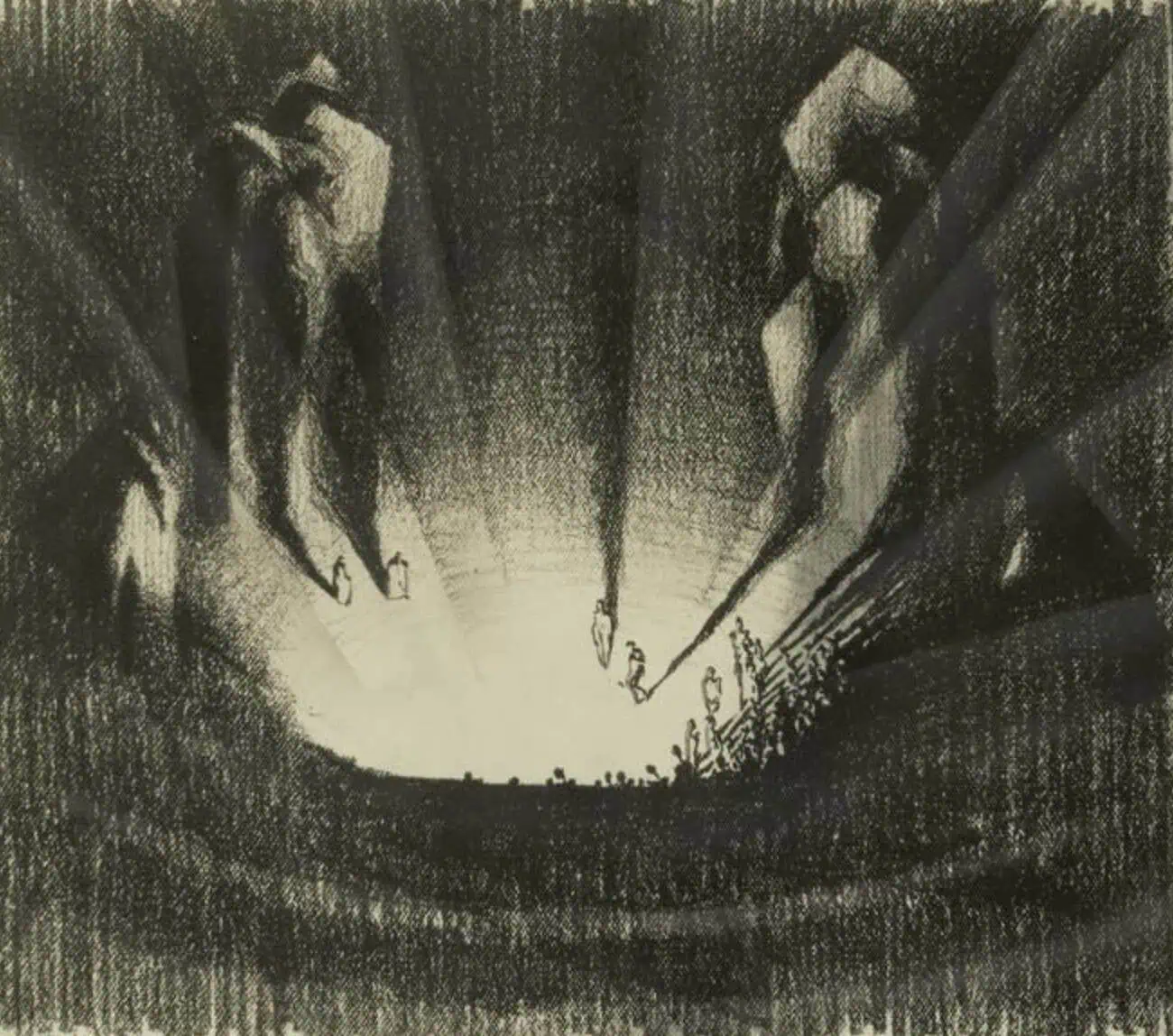
Drawing for a stage setting of The Divine Comedy (ca. 1860–1920) | Norman-Bel Geddes / New York Public Library / Copyright status unknown
It hasn’t escaped the commentariat that, among other things, the appeal of Trumpism is rhetorical. “I love the way he talks,” a supporter told Vanity Fair in 2020. “I understand him more than any other president.” Iterations of the same remark have become a refrain over the last decade. There is a rhetorical honesty to Trump that overshadows his myriad falsehoods. What you hear is what you get.
No one in the upper echelons of MAGA lies as readily as the president, but nor does anyone possess so sharp a ring of authenticity. Secretary of War Pete Hegseth deploys a performative badassery. Vice President J. D. Vance balances sanctimony and superciliousness. For the most part, these have been rhetorically unpersuasive strategies. Americans recognize them as an act.
By contrast, Trump’s rhetorical posture is oddly unassailable. One can mock it, sure, but there isn’t exactly a class of carnival barkers ready to expose it as a sham. After all, it isn’t a sham—it’s who he is. Democrats, for their part, have taken ill-conceived steps to out-Trump Trump. This is why ESPN’s Stephen A. Smith—a notorious loudmouth—has been floated as a Democratic candidate in 2028, as well as why polished Democrats have taken to awkward embraces of profanity.
With Trump approaching lame-duck status—not to mention old age—it is safe to say that there will be changes in American political rhetoric. Among those who seem to have taken note is Secretary of State Marco Rubio.
In February, at the Munich Security Conference, Rubio delivered a speech to European heads of state that earned him a standing ovation. Politico described it as a “love letter.” It might actually have felt like one to the Europeans who were chided by J. D. Vance at the same gathering a year earlier. To Republican strategists back in the States, Rubio looked to have emerged successfully from the penumbra of MAGA.
The reason for such plaudits? Take it from Eliot A. Cohen, writing for The Atlantic: “We need to remember that rhetoric—the art of persuasive speech—still matters. Marco Rubio, the U.S. secretary of state, gave an excellent demonstration of that fact.”
Rhetoric employs the techniques of style in order to persuade an audience. For Rubio, the intended effect was European buy-in on MAGA’s program for Western greatness: reindustrialization, an end to mass migration, and the overhaul of global institutions.
The techniques of Rubio’s speech, however, were more interesting than its contents. In contrast to Trump’s vulgarity and Vance’s pecksniffery, Rubio opted for a mode of classical exhortation: I neither threaten nor shame you, our fraternal allies; instead, I remind you of the greatness to which you are called. The crescendo of the speech occurred when Rubio lauded Europe as the origin of “the rule of law, the universities, and the scientific revolution,” singling out the figures of Mozart, Beethoven, Dante, Shakespeare, Michelangelo, and da Vinci (as well as the Beatles and the Rolling Stones).
One could make much of Rubio’s interpretation of the West, but there was something exceptional and ironic about the reference to Dante in his oration. This is because, as many readers of Dante know, the most famous episode of the entire Divine Comedy centers on the status of rhetoric.
In the eighth circle of Hell, Dante and Virgil meet Ulysses, who tells of his final adventures in life: Uninterested in domestic life with Penelope, he rounded up the old crew, set sail for the west, reached Gibraltar, and exhorted his men:
“O brothers, who amid a hundred thousand
Perils,” I said, “have come unto the West,
To this so inconsiderable vigilWhich is remaining of your senses still
Be ye unwilling to deny the knowledge,
Following the sun, of the unpeopled world.Consider ye the seed from which ye sprang;
Ye were not made to live like unto brutes,
But for pursuit of virtue and of knowledge.” [Trans. Longfellow]
Roused by Ulysses’s words, the men could hardly resist an expedition into the unknown. They sailed, therefore, beyond the pillars of Hercules. Reaching the shores of Mount Purgatory, the crew lost itself in a storm and perished in its wake.
Why does Dante place Ulysses so low in Hell? Some commentators argue it is because of his overweening adventurism, but the text supports an alternate view: By using his eloquence to lead men to their deaths, Ulysses had provided fraudulent counsel.
It is ironic, therefore, to hear Rubio cite Dante in a speech that so strikingly resembles the “orazion picciola” (“little oration”) of Ulysses. Consider the pieces of Rubio’s speech that resemble that of Ulysses:
- Fraternal Decrepitude: Rubio and Ulysses both address their audiences as aging brethren at risk of decline. The Secretary of State, construing Americans and Europeans as heirs of the same forefathers, continues: “Many came to believe that the West’s age of dominance had come to an end and that our future was destined to be a faint and feeble echo of our past. But together, our predecessors recognized that decline was a choice … We in America have no interest in being polite and orderly caretakers of the West’s managed decline.”
- Shared Hardship: Each of the men’s speeches relies on communis fortuna, a rhetorical strategy that establishes credibility and feeling through an appeal to shared experience. Ulysses opens his speech with a reference to the “hundred thousand perils” the men have endured together. Rubio opens his speech with an extended discussion of common trials borne by Americans and Europeans: a divided continent, communism, the Cuban Missile Crisis, the memory of the Second World War, et cetera.
- The Lure of the West: Rubio and Ulysses both glorify and romanticize Europe’s forays into the “new” world. “For five centuries before the end of the Second World War,” Rubio says, “the West had been expanding. Its missionaries, its pilgrims, its soldiers, its explorers, pouring out from its shores to cross oceans, settle new continents, build vast empires extending out across the globe.” Later: “A Europe that has the spirit of creation and liberty that sent ships out into uncharted seas and birthed our civilization.”
- Knowledge as Ideal: Rubio and Ulysses conflate western adventurism with ideals of knowledge. The latter urges his crew on a dangerous mission, ostensibly in “pursuit of virtue and of knowledge.” The former sells a vision of hard power while extolling European arts and sciences.
- Spiritual Patrimony: Ulysses appeals to his crew’s highest vision of themselves: “Consider ye the seed from which ye sprang; Ye were not made to live like unto brutes, But for pursuit of virtue and of knowledge.” Rubio does exactly the same, in only slightly different words: “We are part of one civilization, Western civilization. We are bound to one another by the deepest bonds that nations could share, forged by centuries of shared history, Christian faith, culture, heritage, language, ancestry, and the sacrifices our forefathers made together for the common civilization to which we have fallen heir.” Both men make appeals to a spiritual patrimony that compel their audiences to action.
Rubio invokes Dante as a totem of Western excellence, but in a predictable irony, fails to realize that he summons a poet who indicts the very rhetorical mode in which Rubio operates.
Rubio’s rhetoric earned him a standing ovation and the plaudits of commentators and strategists. On the other hand, it appears that most of his audience savored the speech without being persuaded. Since the start of the war on Iran, Rubio has pled in vain with his European brethren to help secure the Strait of Hormuz. Either Ulysses was a more persuasive rhetor, or the European heads of state are a shrewder audience than the ancient crew.
It remains to be seen whether the Rubio of Munich is the orator who successfully positions himself for a presidential run in 2028. But there is already evidence that Rubio, like Ulysses, is fated to inhabit an inner circle of hell, win or lose.
If not Ulyssean eloquence, what sort of speech should we hope to see succeed the vulgarity of Trumpism? If we were to take Dante seriously, as Rubio has failed to do, we would find a fully developed theory of language and its dangers. As a poet and stylist, Dante cared deeply about language, ethics, truth, and beauty—and was correspondingly alert to its abuses.
Unsurprisingly, then, he was at pains to distinguish his exercise of language from that of a rhetor like Ulysses. Repeatedly in the Divine Comedy he refers to the poem as his “little bark,” and indeed, like Ulysses, he purports to undertake a remarkable journey. But unlike Ulysses, Dante makes clear that his journey is divinely sanctioned. Unlike Ulysses, Dante accepts guidance. And unlike Ulysses, whose speech moves men to act on his behalf, Dante imagines that his poem will move readers to God. At its best, he suggests, language demands humility. Notwithstanding his repeated humiliations by President Trump, Rubio—and most politicians, for that matter—will struggle to strike a posture of humility. But for whomever accedes to the office of president in 2028, there will be more than enough reason to do so.