Film still from Yalla Parkour (2024) | Dir. Areeb Zuaiter
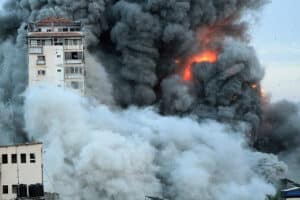
A decade ago, filmmaker Areeb Zuaiter was glued to her screen watching the 2014 Israeli offensive on Gaza when a different kind of video interrupted her feed: smiling young men laughing between backflips as bombs darkened the sky behind them. The Nablus-born documentarian was partly curious and partly enamored with this group of young people’s unique way of challenging an ongoing military offensive and refusing to allow the encroachment of their homes to take their spirits.
In the resultant documentary, Yalla Parkour, Zuaiter connects with Ahmed Matar, a young Gazan man for whom parkour—the acrobatic sport in which urban environments serve as both training grounds and arenas for ambitious vaults, climbs, and runs—offers relief under occupation. The videos Matar shares, his exchanges with Zuaiter over many years, and the director’s reflections on her own relationship with Palestine are woven together to make Yalla Parkour a time capsule of a particular Gaza—one unrecognizable now, more than two years into Israel’s aggressive bombardment of the region.
After premiering at DOC NYC in November 2024, where it won the Grand Jury Prize, Yalla Parkour screened at The New School in MENA Creative Collective’s three-night festival last December. Recently, Zuaiter spoke with Rida Chaudhry about what cinema can do that journalism cannot, and what it means to watch a film succeed while the people in it are dying.
Rida Chaudhry: Your and Ahmed’s relationship serves as the central thread throughout the film. Can you tell me about how this came to be and why parkour specifically caught your attention?
Areeb Zuaiter: I’m not somebody who’s interested in parkour at all or even knew about it before I met the team or Ahmed. It all started in 2014, when there was a really serious offensive happening against Gaza. It was 50-plus days of continuous shelling. Nothing compared to what we’ve seen recently during the genocide, but it was unbearable to watch. I was following closely and at the same time, I had just given birth to my daughter. I felt really miserable that she’s coming to a world that looks like this.
I was following the news, specifically on YouTube, and this clip pops up on my feed of young men doing acrobatic moves and challenging this colossal bombing in the background. They were making fun of it, as if raising the middle finger … it gave me a really different feeling from all the feeds I was receiving. That’s when I thought I’d start a connection.
Back then, Facebook was the place to get connected to people, so I sent them a message, and Ahmed was the one who picked up. We started talking from that moment on. They were treating everything as a joke—for me, it was horrific to watch, but they were the ones living it. It gave me a sense of—I’m not sure if this is the right term—how thick their skin is. Though it’s more than that, they know they are the people who own [Gaza] and they stand there saying, “Okay you’re going to bomb us, but we are not going to surrender. We aren’t going to surrender the sport we love, we’re not going to hide, we’re going to continue.”
Chaudhry: And the geopolitics of the region only intensified after October 7, when the film was in postproduction.
Zuaiter: Yes, this changed the film a lot. I never intended to be in the film as a character until this happened, when we felt as a team that it would be insensitive to not address what’s going on. I kept thinking of ways to do it, and the only thing that kept popping up in my mind was my mom’s image when she would react to these atrocities in Palestine. She would be very emotional. I kept thinking what if she was alive, what would she have done? So I decided to do the film as more of a letter to her. This opened up really important layers of us as Palestinians being so dispersed, so different, but there is something stronger that brings us together.
Chaudhry: Your correspondence with the parkour athletes in Gaza is virtual. How did this affect the project?
Zuaiter: There is this question of access. It was brought up whenever I pitched the film. Everybody was telling me, “Be careful, it’s really challenging to achieve this film if you don’t have access to Gaza.”
The cinematographer on the ground, Ibrahim Al Olta, did an outstanding job conveying my vision. I would describe him as both cinematographer and production manager; he would be the one telling me, “Listen, this is happening right now. Do you want to follow it?” Of course, I was in constant conversation, but he is the one there. He knows what happens before anyone, before Ahmed tells me what was going on. He would be on set and start a video call to show me what’s going on, then we would discuss the angle in the beauty shots of Gaza. Sometimes I would tell him, “This is not what I have in mind, I would love for you to stay more on the image, to sense the place more.” And he would repeat it, he would go again and film again. It wasn’t an easy process but what made it easy and enjoyable was working with people where we clicked and understood each other.
Chaudhry: When working on a project that navigates intimate and vulnerable experiences, how do you work to honor the complexity of the story within the runtime of a feature film?
Zuaiter: A lot of characters came in and out of the film. I had to cut a lot of scenes I was attached to, a lot of characters I felt had great potential. It took time, it took time for me to understand that I needed to let go of certain perspectives, certain scenes, that I feel are very powerful and telling about the people in Gaza. At one point, I was thinking, “There’s a lot we can speak about when we talk about the women in Gaza, but then that is not what this film is.”
Chaudhry: Where does maintaining a cinematic narrative fit in within all this complexity? How did you grapple with this for a project spanning over a decade?
Zuaiter: News tells you what happened, and the people you see in it just pass and go. You can’t identify with them as much, you don’t put yourself there. With cinematic documentaries, you want [the audience] to click with the characters, understand them, feel them, and be encouraged to know more about these people. This is a very, very important layer from the beginning of this journey: showing how entrapped they were. Everyone speaks about October 7, but what led to October 7? Even back then, it wasn’t a habitable place. It was an open air prison. Now, the situation is a hundred or a million times more severe. After October 7, Gaza was transformed into a concentration camp. It was important for me to show how entrapped they were, but how human they are as well. And for Ahmed, it was a very compelling [project] because he had this dream of participating in international competitions, showing his skills to the world. He told me, “If I were able to go out and come back to Gaza, I would never stop living in Gaza.”
Chaudhry: Yalla Parkour is making its way across the festival track. What has that experience been like?
Zuaiter: I’ve really enjoyed meeting all the people who came to watch the film in the festivals. I tried really hard to be there with the film wherever it went because I wanted to meet with the people, talk to them about what this film means, what the layers are, and address their questions. I feel like festivals these days resemble film clubs and they’re displaying these alternate films you won’t necessarily see in mainstream media and platforms. People who really want to know and understand these films come.
There is also something heartbreaking at these moments. The genocide ongoing and people dying and trapped, while this film is flying everywhere and I’m going with it. There was that side preventing me from enjoying the film’s success, but I really felt the importance of connection and how enjoyable it is to see people changing their minds, see the important issues, and sit with them.
Chaudhry: You’ve been working as a filmmaker since the early 2000s, with most of your work looking to the multiplicity of belonging and identity as its central theme. What draws you to such explorations?
Zuaiter: The question of identity is my research, always. In most or every film I work on comes from me feeling like I’ve never settled in a place where I felt, “Yes, I belong here.” The only place I felt that feeling is in Nablus when we would visit, where everyone knows who you are, who your grandmother is, who your great grandmother is. It’s different when you go back to your roots. The lack of belonging and question of identity became stronger when I had my kids and I brought them up in the US.
People tell me, You are Palestinian, why do you question it if you believe it? But it has a difference, there is a different meaning with you living there alongside the legacy of being Palestinian itself. How can I carry this identity with me when I’m not actually living there?
Chaudhry: How does Yalla Parkour differ from other projects?
Zuaiter: Across all my work, I try to go towards the poetic side. With Yalla Parkour, it’s told in two places—in Gaza and in my home. When I decided to be in the film, an important layer is the isolation of displacement and being somewhere that does not reflect who you are or where you come from—versus somewhere that’s really more alive, more a place where I wish I could live but I can’t because of the safety of my family and being entrapped. Though, with the freedom of living elsewhere, there is this banality which seems like death; everything is dull, everything is empty. While Ahmed’s world is really alive and full with people and support everywhere.
This film really opened that door. These are two different worlds, the concepts in each are so striking. They are the ones who are trapped but they are the ones who are alive. I’m the one who is so free but I’m somehow not there, you see me through reflections. I was listening to a podcast and they were speaking about how all the world is living an alternate reality while the reality of the world we’re living in is happening in Gaza. This resonated with me a lot.