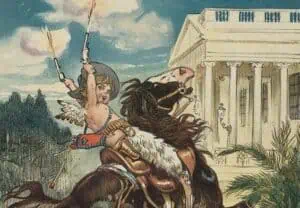
“What America Means” | by Memphis CVB | | May 26, 2012 | [CC BY-NC-ND 2.0]
Was Ronald Reagan’s famous image of America as a “shining city on a hill” truly just an illusion, a Fata Morgana of the United States as a beacon of democracy, freedom, and moral leadership, a trick played on the world’s collective mind?
In a podcast aired on January 14, 2026, Tucker Carlson, the far-right MAGA media figure, certainly suggested as much, shrugging off the Trump administration’s attempted land grab of Greenland: “If I have the power, I get to take what I want,” he said, ventriloquizing the president. The postwar liberal international order embodied by the United Nations and human rights laws, Carlson explained, were merely “theoretical rules,” a kind of ruse “designed to pretend that’s not true.” Carlson was implying that what previous Conservative leaders like Reagan had presented as an American ideal in fact represented rank hypocrisy.
Carlson’s comments reminded me of a recurring discussion I have seen take place in my classrooms over more than two decades of teaching twentieth-century US foreign policy history at Wayne State University, in Detroit.
Each year my course would cover moments of boldly articulated American optimism: Woodrow Wilson’s claim at the end of the First World War that the United States’ war aims were for the world “to be made safe for every peace-loving nation which, like our own, wishes to live its own life, determine its own institutions, be assured of justice and fair dealing by the other peoples of the world”; or Franklin Delano Roosevelt’s address of 1941 where he stated that the United States looks “forward to a world founded upon four essential human freedoms”; or Ronald Reagan’s famous 1987 demand in front of the Brandenburg Gate in Berlin to “tear down this wall” because “freedom and security go together” and “the advance of human liberty can only strengthen the cause of world peace,” during what turned out to be the final years of the Cold War.
Most of my students immediately pointed to the hypocrisy involved in all of these lofty statements. And it’s true, of course, that no serious scholar would deny that the United States always made sure that its material wealth, military might, and geopolitical security came first. Despite this, I always used to push back against the argument that the US commitment to human rights, national self-determination, and a multipolar security system was merely self-serving.
Such lofty goals were always, to a certain extent, illusions, but, as George Orwell once put it, writing about another empire in distress: “They may be illusions, but they are very powerful illusions. The belief in them influences conduct, national life is different because of them.”
Orwell wrote these words in the year 1940, in an essay titled “The Lion and the Unicorn,” at a time when the British were in a brutal fight against totalitarian Nazi Germany. In this piece, he criticized his contemporaries “within the left-wing intelligentsia” who liked to argue that democracy was “just the same as” or “just as bad as” totalitarianism—a proposition that Orwell ridiculed as the “half a loaf is the same as no bread” argument.
Orwell didn’t deny that British imperialism could be a nasty business, but he thought that it nevertheless makes a difference whether or not an empire aspires to democratic notions of self-determination, based on a professed belief in the equality of all human beings.
When the Trump administration published its 2025 National Security Strategy, it made clear that it would no longer pretend to uphold any such aspirations or ideals. Its foreign policy would not be “grounded in traditional, political ideology” but instead in a frank promise to promote “what works for America—or, in two words, ‘America First.’”
The pursuit of this transactional strategy is leading to the collapse of the post-1945 international order. NATO still exists, for now, but the US government has made it all too clear that it no longer feels bound by the alliance.
The same is true for other long-standing principles and rules: Pete Hegseth, the head of the institution formerly known as the Department of Defense, wrote a book called The War on Warriors, in which he argues in favor of disregarding the Geneva Conventions. Instead, he wants the US military to become “unleashed,” so that it can act as “the most ruthless” and “the most uncompromising” fighting force in the world.
The way the Trump Administration, in alliance with Israel, started the war against Iran in late February 2026 illustrates the new shape of US foreign policy. The United States decided not to even inform its NATO allies of the decision to go to war. Interestingly, this “go it alone” attitude in the international arena was mirrored in how the Trump Administration handled the buildup of this war domestically. There was no serious attempt to prepare or sway the American populace before the attacks began. They were just as surprised by it as America’s international allies.
No matter the outcome of this war, one result is already clear: The United States is more isolated in the world than ever before.
At the same time, we are seeing a replacement of democratic ideals with a crusading Christian nationalism that boldly and violently pursues unrestrained American power abroad.
The world will suffer greatly if the United States continues on this path because old-style American exceptionalism was more than a hypocritical attempt to justify US global domination. At its basis was also a widely shared ideological commitment by many Americans to the belief in democracy and equality—and to Christian values like compassion, humility, and forgiveness. This commitment served as the mask America wore to cover its more shameful face and prevent its worst impulses from taking total control.
As Orwell rightly said, years before the abyss of Nazi Germany was to be revealed: “Even hypocrisy is a powerful safeguard.”
It is, however, one that America no longer has.