Testa Anatomica (1854) | Filippo Balbi / Wellcome Collection / Public Domain Mark
Donald Trump has a kingly approach to his presidency—and to language. Yes, it is well-recognized that Trump does not command mastery of the basics of syntax and grammar of any language, including the one his supporters want to be declared the US national language, i.e., American English. No bother: Trump mangles his own words to regally assert his own meanings—that is, he rules meaning-making by fiat rather than accepted protocol. He gets to decide the meaning of his pronouncements after the fact, bending and rebending the significance of almost anything important or trivial, as in falsely saying his tariffs were raking in billions from foreign countries but then complaining about having to pay back importers who actually paid the tariffs once they were ruled illegal, or grossly understating gas prices even when they were at a low point but then switching to saying they eventually will come back down after their sudden rise. This tactic leaves the putative subjects of his political rule, the citizens of his country, to capitulate to his redefinitions, since our representatives have failed to hold him accountable to his distortion. Reality, then, is repeatedly redefined according to Trump’s wishes. This has largely succeeded as an approach to cement his authoritarian control over his words and his government.
Michael Silverstein, the renowned late linguistic anthropologist, coined the term “metapragmatics” to refer to language’s ability to comment on itself. Trumpism leans heavily on language’s metapragmatic function as a rhetorical form, meaning that Trump and his followers can incessantly relitigate what was meant by what was said. Aurora Donzelli, also a linguistic anthropologist, says that Trump’s metapragmatic discourse has evolved to where it gets enacted in a “linguistic state of exception,” where he is not bound by conventional rules on how to talk and what his words mean. As a result, Trump is allowed to take a linguistic sledgehammer to democratic discourse and prevent meaningful public dialogue about his utterances.
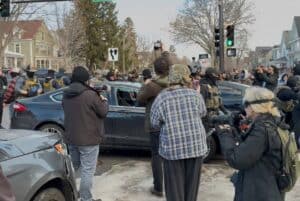
We see just how fraught the relationship of language to democracy is in Trump’s second term, when his brazenness approaches the limits of authoritarian rule. We are seeing that the Trumpist speech can kill as in the unsubstantiated claims about boats in the Caribbean supposedly running drugs or when Trump administration officials justify the killings of Minneapolis ICE protesters Renée Good and Alex Pretti by implying they were “domestic terrorists.”
Trump’s dictatorial approach to meaning has reached its zenith with the war on Iran. When Trump commenced his latest military attacks on Iran just before the beginning of March, he had been for some time mangling the word “obliterated.” He claimed his earlier bombing campaign in June 2025 had “obliterated” Iran’s nuclear bomb-making capability but now the US had to go further, evidently beyond obliteration. Then he rearticulated the mission to be one of “regime change.” That was a necessary part of his insistence on “unconditional surrender”—a situation which, confusingly, Trump claimed he could unilaterally determine when it arrived. That is, Iran did not evidently have to actually surrender; Trump could decide it for them. That rather extreme redefinition of unconditional surrender the press had been more than willing to forget until Trump began signaling his supposed withdrawal from bombing Iran.
Then, after more than a month of bombing and the world having to deal with Iran’s blockade of critical oil shipments from the Strait of Hormuz, Trump seemed to sense he had to switch gears with rising opposition to his warmaking. On his ironically named “Truth Social” social media platform, Trump used his trademark preference for ALL CAPS to emphasize a most flagrant metapragmatic recharacterization. He pronounced on March 30 that “negotiations” had progressed to the point where there were “serious discussions with A NEW, AND MORE REASONABLE, REGIME to end our Military Operations in Iran.” Yet Iran hadn’t, at that point, even confirmed any such negotiations; instead, there were reports the Iranian parliament was proposing to impose a toll on ships passing through the strait. Since then, the toll has been in effect.
Trump’s use of “regime” and “regime change” is perhaps the president’s most regal abuse of language yet. What is a regime? Evidently, for Trump it is whatever he decides. We see this with his January 2026 kidnapping of Venezuela’s President Nicolas Maduro, when Trump pronounced that the sitting vice president, Delcy Rodríguez, was working out just fine as a new leader, in spite of the fact that she had been firmly ensconced in the drug-dealing Maduro regime. Yet, now we see that Trump seems to have mistakenly thought that what happened with Venezuela could be easily replicated with Iran. Instead, a prolonged stalemate has set in.
Even though Trump himself had renamed the Department of Defense “the Department of War,” he insisted and all his cabinet insisted that the war on Iran was not a war but a “military operation,” the same characterization he gave his earlier 2025 bombing campaign. Therefore, Trump said, he did not need the congressional authorization as required by the US Constitution. Almost in the same breath, Trump incongruously claimed that Iran had been a threat to the US for 47 years and therefore it was an “imminent threat” that allowed the president to take unilateral action under the War Powers Act. This was itself yet another rewriting of a recent Trump Administration position: In early January 2026, Trump had said he did not think the War Powers Act was itself a constitutional piece of legislation because it improperly limited the President’s war-making power. Trump now tells Congress he does not have to report them about the conflict as required under the law. In fact, there are media reports that Trump is seeking to get around the requirement to report to Congress by rebranding the military operation from “Operation Epic Fury” to “Operation Sledgehammer,” a name that not only implies a new war but nods—perhaps intentionally—to Trump’s continued demolition of the Constitution and credible political discourse.
Trump puts his words beyond conventional understandings and his actions beyond the reach of the law. Imminent threat, military operation, regime change, unconditional surrender, sledgehammer, on and on, his redefinitions extend his unilateral powers. Trump continues to justify his unilateral war-making by relying on lawmakers’ tacit acceptance of his right to redefine words already said. His speeches may be a semantic muddle, but that’s what makes them an autocratic success.