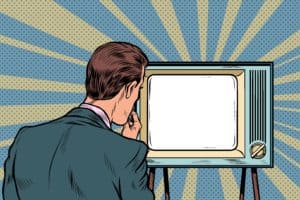
Televisions (2009) | Pat Guiney / Flickr / CC BY 2.0
Amateurs, crafters, operators, gatherers, counter-coders, monkey-wrenchers, gamers and players, parents, epimeletes, bards and reciters, spectators and fandoms, and puzzlers: These are the 11 categories that the Friends of Attention collective use to describe the types of people reclaiming powers of concentration offline. All perform what the Friends call “attention activism,” one of many snappy expressions the group coins in their new book, Attensity! A Manifesto of the Attention Liberation Movement (Crown, 2026). See also “human frackers,” the research scientists and tech overlords who are fracking our minds for what the Friends call “soul water”: our attention.
Written by D. Graham Burnett, Alyssa Loh, and Peter Schmidt (three main contributors to the Friends of Attention coalition), Attensity! presents a cumulation of the group’s efforts on how and why we should regain our attention (at least, their idea of attention) by reducing the time we spend staring at our screens. The authors situate their manifesto alongside the offerings of the group’s Strother School of Radical Attention, which hosts online and in person seminars, free attention labs, and art programs, alongside selling merch—a category of consumer activism in which the manifesto may fit best.
A feel-good tract, Attensity! works as a token on a bookshelf that declares, “I am a part of this group,” rather than as a functioning tool to get the reader offline. The Friends of Attention seem to know this. Acknowledging the likelihood that “human frackers” already have your attention, the writers themselves don’t profess high hopes that reading their book will get you to turn off your phone. Instead, their project is to affirm that the offline acts of attention that readers already do—taking care of children, knitting a sweater, or in this case, reading a book—will make the reader feel good. “If you are reading this, you are in a good attention-place,” they promise.
In its potted history of how we lost our attention to the soul-sucking internet machine, the manifesto focuses on the research and study of attention in psychology labs during the twentieth century. The authors describe this period of time as the collapse of attention into a “single, narrow, cybernetic (i.e., machine-engaged), quantifiable, and ultimately always-already-instrumentalized THING.” This is stated before steering for a moment into a quasi-distrust of scientists and science research. The authors ask why scientists are failing to acknowledge how constant visual stimulation and flashing lights on our screens are bad for our brains (and attention spans and eyeballs that tech overlords want). But scientists have hardly been silent on this issue. Studies abound showing that social media use increases the risk of depression in teens and young adults, for example. Twenty-five states have proposed social media bans for minors. The negative effects on children’s development and risks of early neurodegeneration and memory loss for adults have been widely reported.
The chapters of Attensity! arrive in short bursts of roughly ten pages, broken apart by various elaborations of their mission statement, interspersed throughout the book 22 times in bright coral-colored font; specific sentences are further highlighted to guide the reader. This format makes the book unbelievably easy to skim—and, ironically, easy to put down to scroll on your phone (or do any other task besides reading). The book decries shortened attention spans and panders to them in turn.
In the end, the Friends of Attention’s work lives in a place of contradiction. They admit to borrowing “the very tools that are harming us to effect the revolution,” using the strategies of research groups and business models to group like-minded people with “shared attentional commitments” by “marketing” the importance of attention activism back to them. And they continue to rely on social media and an online following to fuel their movement—not trusting that like-minded people would find them offline. (A fair assessment when we all continue to seek information online, even if it’s how to get away from our screens.)
The Friends of Attention look down upon not just the “human-frackers,” and research scientists but also the major tech companies who are running the “attention economy,” which is a “globe-spanning industrial farm that extracts money from a billion vegetative humans suspended in an infinite web, eyes glazed.” The term “vegetative humans,” echoes of conspiracy theory tropes like “non-playable characters” (the phrase which has been taken from video games to describe people as being programmed to act a certain way) and “lizard people” (the theory that high-level politicians and celebrities are actually shape-shifting reptilians) can leave a sour taste in a reader’s mouth. After all, many of those vegetative humans are people who are so exhausted by financial insecurity, loneliness, and lack of leisure time in late-stage capitalism that they turn to online spaces for a semblance of relaxation and escape from the day-to-day.
The Attensity! authors go so far as to compare themselves and their work to “those engaged in the long struggles for dignity” such as the suffragists and the civil rights movement. But one of many differences between attention activism and the work of women’s suffrage and civil rights activists is the proposed impact of asserting such a right. The Friends of Attention believe the potential benefit of reclaiming attention cannot be “pinned down … It’s too big for that.”
This inability to prove value then spirals out into a confusing, albeit hopeful, sermon on truth and infinity:
In fact, it is precisely the nature of this truth—that our humanity cannot be reduced to numbers, or even to language—that makes it impossible to put forward in a way that will “compel ascent”! This truth is infinite, because it is the truth of our infinitude. Afraid of truths like that? Fair enough. Worry that under the banner of the “infinite” people have done all kinds of weird and bad and destructive things? Okay, yes—that’s true. But the history of efforts to avoid such truths is plenty messy, too. Want only the kinds of truths that can compel assent, in math or logic? You are likely to find yourself in a world you don’t like. Because freedom is freedom, and freedom is the central to the beings we are—the beings we know we can be.
The claim that all offline attention is good attention, while initially inspiring to a reader looking to cut down on screen time, eventually falls flat; the book never really digs into the history of attention or any serious interrogation of the concept. Sure, Attensity! isn’t making anything worse, but it’s not adding much to the already existing narratives on how to regain control of our “soul water.”