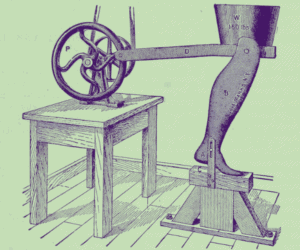
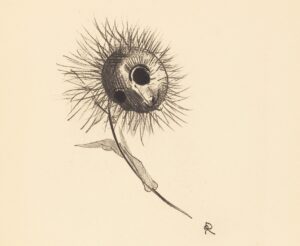
Anatomical Illustration II (1680–1688) | Jan Claesz ten Hoorn / Rijksmuseum / PDM 1.0
“For me, the curiosity of the microbe rests on the ambivalent outcomes of its extreme connectedness,” says writer Charlotte Strange: “Its capacity to spoil, sour, and upset, and the slipperiness with which it moves through medical and colloquial speech.”
In their chapbook Strange Biology (Wendy’s Subway, 2025), a collection of essays, poems, and fictions,Strange presents a semiotic breakdown of the microbiome—the community of trillions of microorganisms including bacteria, fungi, parasites, and viruses that live upon and within the human body, acting as a mysterious yet essential organ responsible for our health across physical, psychological, and even sociological planes. In their concise yet expansive text, Strange explores the representation of the microbiome in the zeitgeist and its symbiotic relation to society, including the capitalist consumption of the body with many buying into trendy health supplements that promise quick, simple fixes to ailments whose root causes remain largely mysterious in the medical world; the definition of “resistance” spanning from the defectiveness of antibiotics to medical gaslighting of patients to the defaming discourse of the positive potential of social movements; and the romanticization of “gut issues” as an accessory in online and colloquial discourse. The book acts as a projectile purging of medical language that “shapes” the body, relinquishing the vocabulary of control in order to feed a more collective and evolving understanding.
Strange Biology consists of personal and analytical essays, fictional scenes, concrete poems, and ads for probiotics and health supplements that seem to be scraped directly from phone screens and subway platforms. Advertising messages are smeared across the page like specimens on petri dishes, where Strange analyzes the militaristic metaphors that compare antibiotics to nuclear bombs and separate (misleadingly) the microbiome’s organisms into “good guys and bad guys” to be conquered and controlled. Strange introduces images without explanation then tears them apart and scatters their fragments throughout the book.
Elsewhere, a scene in a waiting room for a colonic procedure is told through an absurdist dialogue between nurse and patient:
SHE: You are twisting up
YOU: You are swallowing a rock
SHE: You are swallowing a rock
Near the end of the book, Strange offers a brief comparison between the aesthetic quality of the frail consumptive Victorian housewife with the contemporary term “Hot girls have IBS”—a social media trope that went from making a gut disorder visible to trivializing it as a cute quirk—then punctuates their prose with a concrete poem comprised of lines lifted from Jonathan Swift’s satiric poem about the disenchantment of peeping into a lady’s dressing room (“Oh! Celia, Celia, Celia shits!”), which Strange rearranges into the silhouette of a dog in a familiar squatting position, pushing out letters from under its lifted tail. The reference underscores the timelessness of the tug-of-war between disgust and desire and the romanticization of “delicate” health—in particular, sickness related to white womanhood with the attendant desire linked to vulnerability. In reshaping the comic poem into an even more irreverent image, Strange doubles down on ideas of domesticable illness, questioning which expressions of gut function can still be considered endearing, even sexy—and which go too far.
In the longer, more structured essays, Strange builds their arguments and observations atop seemingly disparate references, such as an analysis of human essentialism and individualism discussed alongside scholar Kyla Wazana’s book on the microbiome’s ability to catalyze social paradigm shifts, Deviant Matter: Ferment, Intoxicants, Jelly, Rot (New York University Press, 2024), and Doctor Seuss’s memorable message from Horton Hears a Who (“A person’s a person no matter how small”). Strange weaves chaos into cohesion, revealing inherent connections and patterns between materials not usually allowed to stand beside one another and be examined up close.
The structure of this short book nourishes a slippery text in which language transforms, mutates, and evolves with what Strange identifies as the same “capriciousness” as the bacteria in our guts. In doing so, Strange challenges medical (or medical-adjacent) language, revealing how it promises a false sense of control over our bodies as entities that are fundamentally separate from other organisms. In the gaps and blank spaces between the text, the author invites the reader to infect the page, urging participation in the expansion of the definition of self and being. Instead of forcing an answer, they offer simple questions that reground readers to their physical truths, asking one to touch and trace their own apparent edges and feel for themselves: “Body, Not-Body. Where do the fingers drop off?”