Installation view of Hito Steyerl’s Mechanical Kurds, single-screen video (2025; 2026) | Photograph courtesy of the author
The current artificial intelligence boom has birthed an ocean of concerns and considerations about the role of technologies in shaping humanity and its place in the future. The exhibition New Humans: Memories of the Future, which inaugurated the New Museum’s recent reopening in late March, makes clear: These questions might have a new urgency, but they are not new. Across three vast floors, packed with hundreds of artworks, New Humans explores the meaning of being human amid technological change through an extensive survey of modern and contemporary art.
Opting for a historical narrative, the exhibition is divided into sections featuring artworks that highlight themes of innovation, renovation, retrogression, and progress. How the visitor experiences this historical order depends on their access point: whether they walk up the stairs of the new expansion or take the elevator to a specific floor. Past the first-floor entrance, the “Reproductive Futures” section shows how artists in Europe imagined the “New Man” in response to the groundbreaking scientific discoveries of the time. Definitive modernist works feature heavily, such as Francis Picabia’s 1915 Intervention of a Woman by Means of a Machine and Salvador Dalí’s 1943 Geopoliticus Child Watching the Birth of the New Man, in which a man hatches from an egg-shaped globe at the point where North America should be. The room’s focus on human-technology natal symbiosis becomes pronounced. Jean Painlevé’s 1927 film on the embryonic development of the stickleback fish sits well with Jenna Sutela’s eye-catching 2022 installation HMO Nutrix, a fountain of milk-like liquid housed in a pipe. Installed upright on the floor, it operates by wires from breast pumps to explore the “poetics of human milk.”
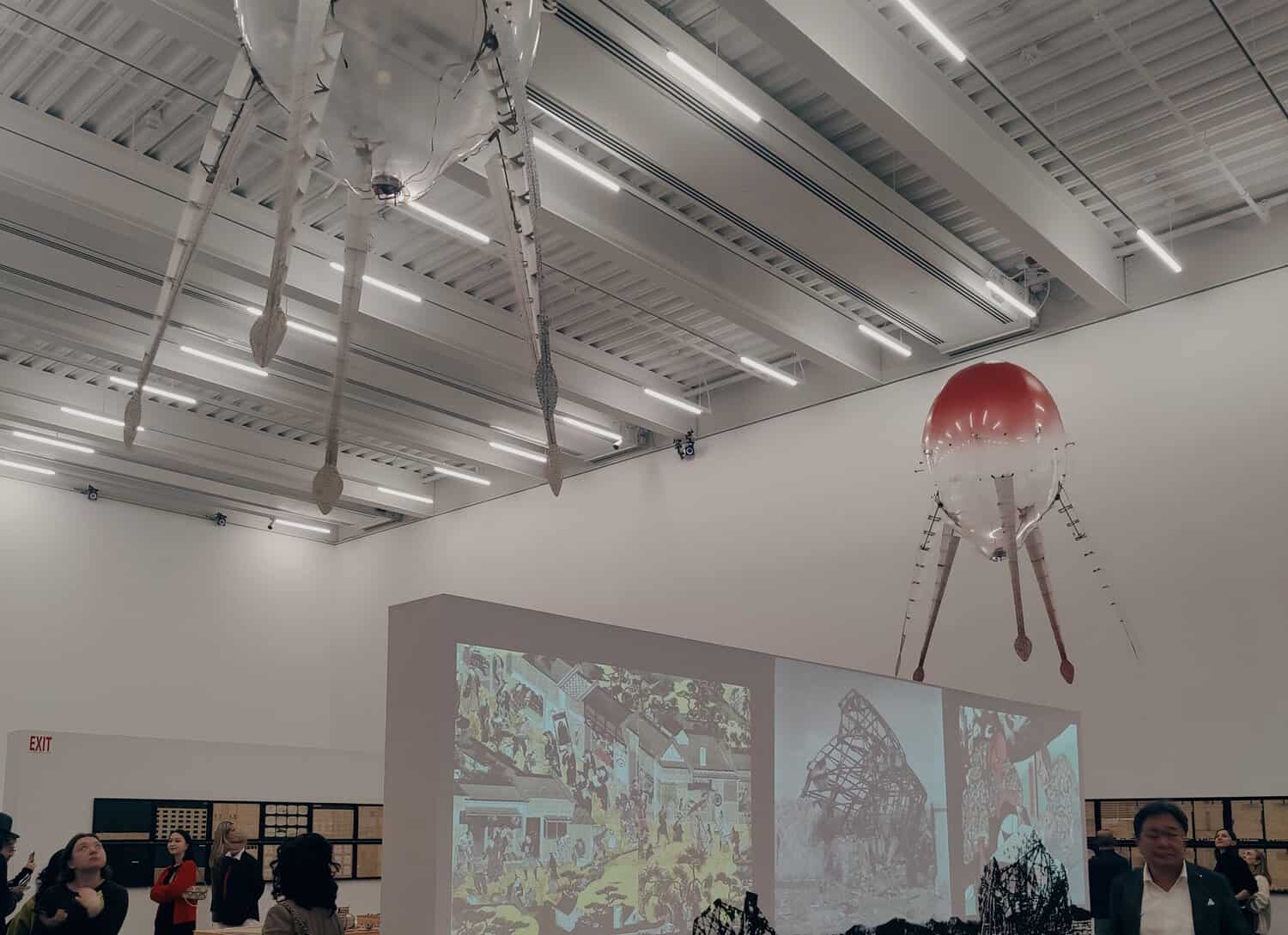
The urban environment as a site of transformation is an ever-present theme and given explicit focus in the “Future Cities” section. There, the situationist artist Constant Nieuwenhuys’s mid-twentieth-century anti-capitalist architectural models are surrounded by dozens of framed drawings from Hariton Pushwagner’s sixties-era pop art graphic novel Soft City, while in conceptual artist Anicka Yi’s In Love With the World, two balloon-shaped marine life–like machines, dubbed “Xenojelly” and first exhibited in 2021, fly over the audience’s heads, appearing to scale the ceiling in fixed diagonal lines to simulate artificial life in its more-than-human forms.
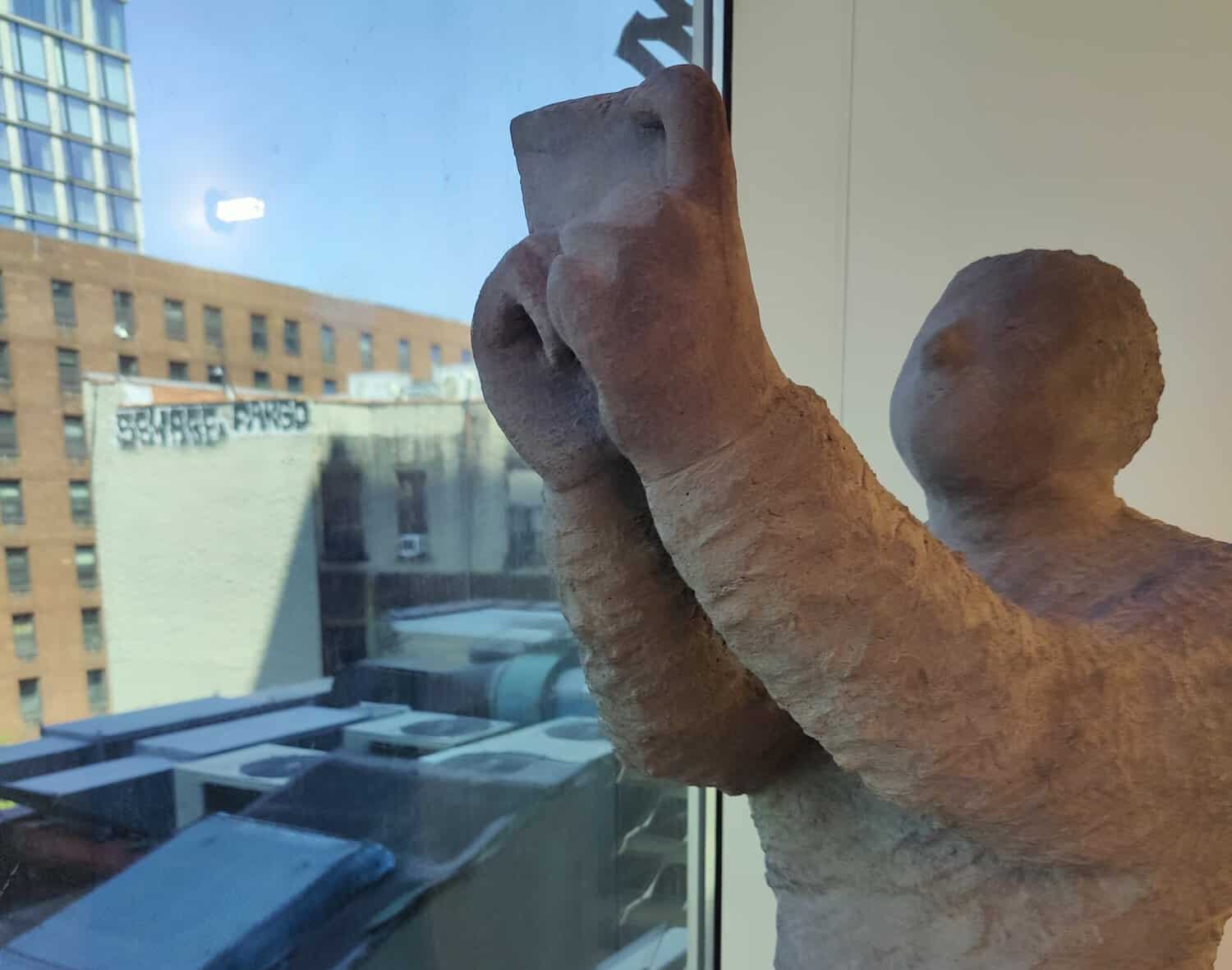
The exhibition is unabashedly maximalist, as if every inch of the newly expanded museum had to be filled. Throughout, there is an abundance of wall text and generous explanations. When the New Museum first opened in 1977, it proved a hit with everyone but the art market; an art dealer reportedly complained to the board that the museum had “too much theory and explanation,” rendering it less financially interesting. While the museum now exhibits a wealth of valuable works prized by collectors, New Humans stays true to founder Marcia Tucker’s original vision of experimentation and public education. The exhibition sections are well researched and thought provoking, yet it takes physical and intellectual stamina to maintain focus across the museum’s three massive floors. The boldly dotted “Hall of Robots,” for example, features a saturated display arrangement on disorienting stark pink carpeting. The visitor is surrounded by robots, aliens, and cyborgs in all directions. The wealth of content is both a nod to and a strain on attention spans in our current technological age. Fittingly, to the side of the hall, the visitor will find Judith Hopf’s Phone User 5, a rough, concrete statue of a person with a featureless face gazing up into a phone in its hands, frozen and lifeless—like Lot’s wife in Genesis, turned to a pillar of salt for staring against divine orders. The sculpture’s placement by a window overlooking the city renders it wry.
Many of the works exhibited either point to past notions of the future, realized or not, or to unsettling (and unsettled) contemporary technological moments. Examining the last century, there could be little doubt about technology’s death-dealing capacities after World War II. Artists in the decades that followed reckoned with existential fears that are still felt today.
Given the show’s wide scope, there is, however, a surprising dearth of work addressing today’s most fraught question about technology: the rise of artificial intelligence. The exhibition makes scant explicit reference to AI. The most notable exception is Hito Steyerl’s 2025 video installation Mechanical Kurds, a visually arresting commentary on human labor and AI warfare. In Steyerl’s single-screen video, we learn of Kurdish refugees in Northern Iraq training AI by image-tagging and labeling work that eventually benefits automated drone warfare. The people whose invisibilized labor trains these systems can themselves end up being made visible as the killing machines’ targets. Using AI to produce her AI-critical video, Steyerl’s work carries one of the exhibition’s main propositions: The critiqued tool can be utilized as a tool for critique.
Throughout New Humans, curatorial decisions refuse to treat technology as necessarily synonymous with hope and progress, or with distrust and despair. Rather, the technologies featured are framed as tools for material and imaginary construction. In Berenice Olmedo’s Olga, for example, a sculpture consisting of a hip-knee-ankle-foot orthosis is motorized to take a life of its own, but it struggles to do so. The prosthetic raises functionalist questions about the normality of an able human body while speculating on forms. In Frieda Toranzo Jaeger’s 2025 sculptural painting To Imagine Is to Absent Oneself, a stitched canvas triptych opens like a toolbox to show a painted set of tools typical of a car mechanic. For Jaeger, like many of the twenty-first-century artists represented in New Humans, the human imagination is invoked as a tool to tighten, loosen, hammer, and unplug our place as humans in late capitalism.