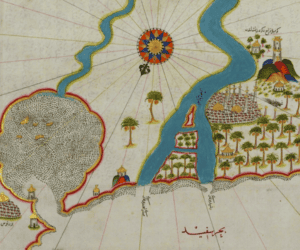
Geography: a mirage in the straits of Messina. | Charles H. Whymper / Wellcome Collection / Public Domain
On June 7, 1955, the Italian national newspaper La Stampa announced—with the pompous optimism typical of the postwar years—that “work on the bridge over the Strait of Messina will begin in one month.” The bridge would stretch across the Mediterranean to connect Messina, the port city at the northeastern corner of Sicily, to Reggio Calabria, the town that faces it from the very tip of the Italian peninsula. A company rather wishfully named “Messina Strait Bridge Corporation of America” had already been created to oversee the construction of this bridge in the heart of the Mediterranean. One hundred million lire—about $2 million today—had been allocated to start surveying the seabed. When asked when people would finally be able to walk from Sicily to the Italian mainland, the Italian-American engineer Mario Palmieri was unusually precise: June 30, 1962.
That June, no one walked across any bridge, and 70 years later, there is still no such thoroughfare. The fact is that this will never be an ordinary bridge. The depth of the strait would require this to be the longest single-span bridge in the world, with a suspended section stretching 2.05 miles. To give a sense of scale, consider that the longest suspension span in the United States, the Verrazzano Bridge connecting Brooklyn to Staten Island, measures only 0.81 miles. The site itself is unforgiving: a violently seismic area with unstable hydrogeology and persistent high winds. Decades after its promised completion, it remains a project of unprecedented complexity—the kind that approaches technical impossibility.
Yet fascination with the project continues to enrapture both ambitious technicians and the Italian public, which for decades has imagined, desired, or despised the idea of the bridge. The debate over it is such an ingrained part of the country’s culture that when an Italian refers simply to il ponte, everyone knows exactly which bridge is meant. Not only is the bridge still discussed as a construction site on the verge of opening, but it also continues to boast projected completion dates, revised at regular intervals. Few projects better capture the peculiar melancholy of contemporary Italian public life: the perpetual anticipation of a national redemption always said to be just at hand, capable of finally normalizing a country that has never entirely ceased to experience itself as somewhat unfinished.
While these promises have been made and remade since June 30, 1962, the contemporary vision of a bridge across the strait dates back to the premiership of Silvio Berlusconi. It was Berlusconi who, in 2001, formally classified the project among the country’s “infrastructure works of primary national interest.” His government oversaw the drafting of a definitive plan in 2010. That then-Prime Minister Berlusconi elevated the bridge among national infrastructural priorities and moved early to associate his own name with the construction of the Messina Strait Bridge reflected his role as a precursor of a distinctive new style of politics in the 21st century, one that hid the personalization of power behind the rhetoric of unifying Sicily. In Berlusconi’s case, the project did not derive from a coherent nationalist vision. Rather, it emerged at the intersection of a highly individualized form of leadership and a calculated awareness of the political returns such an undertaking could yield. A project of this magnitude promised to generate a vast economic hinterland of contracts, expectations, and dependencies, thereby binding electoral support in southern Italy in a distinctly personalistic way to the figure of Berlusconi. Then successive governments followed and allowed the bridge to slip down the list of national priorities, as the public spending it demanded no longer seemed suited to a country that had been at the heart of the eurozone storm.
Things changed in 2023, when the far-right government of Prime Minister Giorgia Meloni moved to allocate nearly $16 billion to the project, drawing on resources from the Italian state and European development funds. At the center of the latest—and by far the most dedicated—revitalization attempt yet is a figure familiar to anyone who has followed the rise of global populism: Infrastructure and Transport Minister and Deputy Prime Minister, Matteo Salvini.
That this very man, of all people, should entwine his own story with that of the bridge is a tale in keeping with the bridge’s history of reversals. Salvini began his political life in the 1990s as a far-left militant within what was then a secessionist party, the Northern League, a formation intent on rallying voters across northern Italy to break away from the lazy and wasteful South, which includes the region surrounding the Strait of Messina.
But in the early 2010s, having risen to the top of the party, Salvini remodeled himself accordingly as a tribune of the Italian far-right at large. The politician who once marched under secessionist banners and hurled insults at citizens from the southern regions is now the Minister of Infrastructure and Transport, intent on binding the country’s farthest south, Sicily, to the rest of the nation. Strange as it may seem, Salvini’s push for the construction of the Messina Strait Bridge—so far removed from the core of his electorate—makes considerable sense considering the contemporary political landscape. Precisely because the bridge would be built in a region where support for the Lega has traditionally been weak, it offers the minister an opportunity to put the party’s secessionist origins definitively behind him and to relaunch more convincingly its newer nationalist orientation. At the same time, the bridge exists within a political world that has become increasingly centered on individuals and on their capacity to embody and stage power. For Salvini, pushed into the background by the ascent of PM Giorgia Meloni, the project offers a chance to return to the forefront. To bring it to completion would allow him to claim the distinction of being the one who finally achieved what all others had merely promised. In this sense, the Messina Strait Bridge continues to be framed as an instrument of national unification, in a language that resonates with a broader nationalist desire to “complete” the country, one that sits comfortably within the agenda of the current far-right government. Yet, in material terms, it reflects a more traditional clientelist logic, recast in contemporary form as a means of consolidating authority in a leader-centric arena. In this context of a struggle for primacy, a single, almost thaumaturgic project appears to make more sense than sustained investment in smaller, existing infrastructures.
But Salvini is hardly the only one dreaming this dream. In 2025, the polling agency IZI asked Italians whether they supported or opposed the construction of the bridge over the Strait of Messina. The country appeared almost evenly divided: 5 percent in favor, 49 percent against. A good half of the country now seems persuaded that the Messina Strait Bridge is a national priority, probably because its political proponents have always described it that way: as a project that could bring almost miraculous economic relief to the South. And perhaps, after hearing it so many times, it becomes difficult not to believe that something so often promised must, eventually, be possible.
Sicily and Calabria, the two regions that would be connected by the bridge, are among the poorest in Europe; based on GDP per capita, these two regions align with former Communist countries like Lithuania or Romania. They sit at the bottom of all national rankings: literacy, quality of life, employment rate. They top the list only in one category: emigration.
Not everything is the disaster these indicators suggest. Sicily and Calabria have improved over time and have benefited from the general rise in Italian living standards. What they have never managed to do is close the gap with the northern regions, which have continued to run ahead, becoming in some cases, among the most prosperous and productive areas of Europe. Both regions present an uneven landscape: areas of dynamism alongside pockets of destitution and stagnation. They also share a serious problem with organized crime. Sicily, for decades the global emblem of the Mafia, has resolved its most acute public-order crises, yet still suffers from a troubling entanglement between criminal networks and public administration. Calabria continues to grapple with the power of the ’Ndrangheta, a criminal cartel which has carved out a prominent position in the global drug trade. Both regions suffer from an infrastructural deficit that affects every sphere: healthcare, education, transport. Large swaths of both regions lack highway connections (in September 2026, the Ministry of Transport warned that two of Sicily’s three principal motorways could soon be closed entirely on safety grounds) and conventional rail lines; neither is served by high-speed rail infrastructure. An inextricable mix of unequal resource allocation, poor local governance, and geographic isolation has left this part of the country drastically underprovided with transport infrastructure compared to northern Italy, which, by contrast, boasts one of the most developed and efficient networks in Europe.
The more palatable reasoning of the bridge’s supporters goes like this: today, to travel from Calabria to Sicily, or vice versa, you must take a ferry that takes about 30 minutes to cross the strait. It is an unavoidable passage for everything that enters or leaves this island of five million inhabitants. Commuters, civilians, goods, livestock, the military, everything must board a ferry. Flights apart, there is no alternative route. This bottleneck causes delays, a sense of detachment between the two economies, and above all, an isolation of Sicily from the rest of Italy’s economic system. Build the bridge and you remove a blockage, letting exchanges among Italian territories flow more naturally. Official reports insist that the greatest benefit lies in the time saved across all economic sectors. The idea presents itself with the elegance of things that look obvious on paper.
But this reasoning hides a small omission. As we have seen, one of the starkest divides between southern and northern Italy is the infrastructural gap separating them. In essence, this monumental work, a triumph of human engineering, would connect two regions whose infrastructural endowment is extremely weak. One would glide effortlessly over the two suspended miles only to sink into territories with poor railway networks, inadequate and aging roads, and a disastrous public transportation system.
The Messina Strait Bridge project, in the end, solves nothing except the problem of building it. And yet, listening to the language around it—“projected gains,” “scenarios,” “surplus,” “modal shifts”—you begin to hear something else, something older: the idea that one object, one place, might concentrate hopes, expectations, even a kind of faith. It is striking that this belief is shared by both aspiring political demiurges and of those most marginal to power. Il ponte becomes the point where everything converges, as if the uneven development of a country could really be reduced to a strip of water. But this is precisely why the bridge can never satisfy the expectations invested in it. Italians have asked of it far more than any infrastructure could possibly deliver: not merely the connection of two coasts, but the completion of the nation itself and, for some, the miraculous elevation of their own destinies.