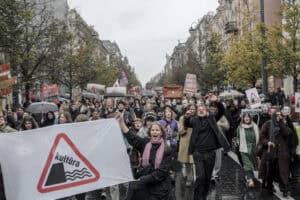
Hungarians in Pecs celebrating Péter Magyar’s election (April 12, 2026) | István Csak / Shutterstock
This April, the celebrations in Budapest evoked images of the fall of the Berlin Wall: hundreds of thousands poured into the streets, teens climbed on top of buildings, and twenty-somethings in baggy thrifted jeans chanted old slogans of the 1956 revolution against Stalinist tyranny. After 16 years of gradual entrenchment, Viktor Orbán’s regime collapsed overnight. But despite the unforgettable experience of collective liberation, Hungary’s path to sustainable democratization will be long and treacherous.
The new prime minister, Péter Magyar, certainly knows how to put on a show of social cohesion. His administration has turned the regime change into a livestreamed spectacle with a massive audience. Both the victory celebrations and Magyar’s inauguration drew crowds in the hundreds of thousands, and Magyar was followed by a camera crew as he entered government buildings for the first time to expose the extravagant luxury of the old elite. Orbán’s HQ near the old Habsburg royal palace is now open to the public. Put on display next to invaluable artifacts such as paintings by the great masters of the Romantic Era, original copies of nearly all volumes of Diderot’s Encyclopédie, and King Matthias Corvinus’s funeral shield, was a document shredder left behind by the former occupant from the Orbán government. After the new government assumed office, viewership for parliamentary livestreams spiked dramatically, climbing from 13,000 views on February 23 to a record 269,000 on June 22.
The new government, dominated by Magyar’s Tisza Party supermajority, has also used news media reforms as another opportunity to create a memeable collective experience. After the government passed a new media law to reclaim public service broadcasting from Orbán’s propaganda machine, the screens of public television suddenly went blank, displaying only the following message in white letters: “Public media should not lie. We are sorry for doing it for several years. Public media now will be reformed, so it will be independent and trustworthy. Our news program is currently suspended. Stay tuned!” At 7:56 p.m., the program resumed with “The Witness,” a classic political comedy poking fun at the absurd paranoia of the Stalinist Rákosi regime. The Hungarian internet was quickly flooded with photos of people’s television screens, as well as memes imitating the apology. Even the Hungarian branch of a discount retailer jumped on the opportunity for an inexpensive marketing stunt.
Hungary’s regime change is entertaining by design, and the popularity of parliamentary livestreams and Magyar’s video updates about the daily business of government suggests that thus far the Hungarian public is paying attention. And so far, the actions of the new parliament, such as joining the European Public Prosecutor’s Office, suggest that Magyar’s Tisza is serious about implementing the anti-corruption agenda the party campaigned on. But it remains an open question whether Magyar’s so-called “TikTok-governance” proves an adequate means of revitalizing a hollowed-out public sphere—and whether his powerful supermajority can restrain itself from antidemocratic overreach.
When it comes to democratizing reforms, the current moment places contradictory demands on Hungary’s new government. Dismantling a regime in which loyalists occupied all levels of the administrative state will require the kind of instrumentalization of state power that, on the surface, resembles what Orbán did in the first place—like the overhaul of state media and the use of legislation to remove key public officials. Sustained democratization, however, requires the reconstruction of the system of checks and balances that were gradually dismantled over the last 16 years. In other words, the government must first use its power to dismantle the old regime, but after this transitional period it must place limits on its own power—either voluntarily or under pressure from civil society.
Orbán’s system was made up of power networks that extended far beyond the state. The regime turned Hungary’s public broadcaster into a tool of partisan propaganda and heavily distorted the private media market. Regime-aligned oligarchs accumulated astronomical wealth from overpriced state contracts, only to use it to buy up almost every independent radio, TV channel, newspaper, or news website in the country. After having organized a protest against my university’s expulsion from the country, I saw my name in an “investigative piece” presenting a “list of Soros-mercenaries.” While my alma mater, a genuinely independent private university, was forced into exile, most public universities were privatized and handed over to boards of trustees packed with regime loyalists. And Orbán’s clientelism extended beyond the elite. Village mayors were tasked with distributing public works to the rural poor, and many used this leverage for voter intimidation; municipalities with leaders who did not support the regime got their funding cut. (Budapest was near bankruptcy as a result.) Even a license to open a tobacco shop was the privilege of low-level insiders.
During the 2026 election, I took part in the effort to monitor electoral irregularities in a rural district where vote-buying had previously been documented. There, I had a rather uncanny encounter with the local mayor, an Orbán loyalist who, according to the locals I spoke with, was responsible for bussing, bribing, and/or coercing voters to the polls to support Orbán in past elections. Just a few minutes after the polls closed, the mayor got out of his large, darkened SUV and approached our group of volunteer observers with a friendly smile. I asked him to take a selfie of us, and he complied. “Whatever happens tonight, we are all Hungarians at the end of the day,” he proclaimed. This exchange left me feeling uneasy. I could not help but speculate that the mayor perceived us as the people of the potential “new lord” and wanted to signal his willingness to kiss the ring “whatever happens.” If these reflexes continue to work after the transition, it can become easy for any future leaders to behave as feudal overlords rather than public servants.
He was not the only one to send such signals. Gyula Balásy, the man nicknamed the “propaganda pope” for making a fortune producing and distributing government-funded advertisements under Orbán, also had a sudden change of heart after his party’s electoral meltdown. He offered to hand over his companies to the state while sobbing through a livestreamed interview. His tears, performative though they may be, are understandable: If it can be proven that Balásy’s contracts with the government were indeed grossly overpriced, he could easily face criminal accountability.
Magyar currently commands a constitutional supermajority allowing him to swiftly purge state institutions of Orbán appointees. The first constitutional amendment passed by the new parliament introduced an eight-year term limit for the prime minister; terms served before the passing of the amendment are also counted, so the bill, nicknamed “Lex Orbán,” effectively bans Viktor Orbán from ever becoming prime minister again. Magyar later announced “Operation Cleansing Fire,” aimed at dismantling “the mafia” that captured the Hungarian state. His combative language might evoke memories of Orbán’s “spring cleanup,” but in this case populist rhetoric is directed against regime insiders with a track record of undermining democracy as opposed to the vulnerable minorities and NGOs that Orbán targeted. As part of this campaign, parliament passed a constitutional amendment involving sweeping changes such as removing President Tamás Sulyok, forcing some Constitutional Court judges into retirement by imposing an age ceiling, a 12-year term limit for parliamentarians, and establishing a new anti-corruption body called the “Office for the Recovery and Protection of National Assets.” Following the template of “Lex Orbán,” the amendment excludes the bulk of Fidesz’s old guard from ever entering parliament again. Under regular circumstances, such naked weaponization of a parliamentary supermajority against one’s political opponent would be a clear and unacceptable overreach. While supporting President Sulyok’s removal, Amnesty International Hungary criticized the government for doing so through a rushed constitutional amendment rather than pursuing regular impeachment proceedings. (Meanwhile, in an absurd reversal, Orbán’s far-right Fidesz party has suddenly become acutely concerned about democracy and the rule of law. The party that used its supermajority to spend the last 16 years dismantling democracy even had the audacity to organize a demonstration titled “Stop tyranny”)
How we might judge such aggressive use of government authority against the “ancien régime” depends on the nature of both the outgoing regime and the accompanying political transformation. If the fifth Orbán government had come to power through a free and fair democratic process, Magyar’s purge might constitute an authoritarian excess, and Orbán would be right to cry tyranny. Political scientists, however, tended to describe the Orbán regime as a dynamically evolving system situated somewhere between liberal democracy and open dictatorship—one that has been gradually sliding towards the authoritarian end of this spectrum throughout its tenure. Similarly, at least one group of political scientists has recently argued that given the scale of the popular mobilization that made regime change possible, Orbán was ousted in a process that fell in the gray zone between a regular election and a revolution: that is, an “electoral revolution.” Revolutions (or revolutions from above) often alter the social and economic foundations of the old order; leaving these unaltered invites risks further down the line. One could, for example, argue that the top-down revolution that followed the American Civil War did not go far enough in this, and the result was the eventual emergence of a subnational authoritarian enclave ruled by the old planter class. If the concept of “electoral revolution” is indeed a fit for what happened in Hungary, measures that go way beyond the rotation of political appointees during an ordinary election can be justified and necessary as long as they proceed within the bounds of legality. Magyar not only has the democratic mandate to take extraordinary steps to remove public officials who enabled authoritarian rule and to undermine the economic position of Orbán’s crony capitalist class, but the success of the transition also depends on disarming these powerful factions with strong incentives to restore Orbánism with or without Orbán. Criminal accountability for corrupt actors and the possible recovery of public funds would also strengthen public trust in the country’s democratic institutions.
Tisza’s current near-absolute power is a result of the extreme majoritarianism of Orbán’s electoral law, but this dynamic is not new. The multi-party liberal democratic system that emerged in Hungary in 1989 had a flaw in its institutional design. The electoral system was designed to produce comfortable majorities and stable governments, but perhaps its designers didn’t do the math: the threshold for amending the constitution was set relatively low. The constitution could be changed by a two-thirds majority vote in a unicameral parliament with no additional requirements. This flaw proved fatal in 2010, when Fidesz reached this threshold and ruthlessly exploited the system to achieve de facto parliamentary absolutism by making it even easier to win a supermajority. While the 2010 election was the first since 1989 to hand a single party more than two-thirds of parliamentary seats, every subsequent election since has resulted in a supermajority by one party. Now a supermajority has handed the Tisza party the constitutional powers necessary to undo the harm done by Orbán and his cronies. But when an electoral system keeps producing outcomes that allow a single party to pass constitutional amendments on a whim, the constitution itself becomes meaningless.
In Hungary, the best chance of establishing and sustaining long-term democratizing institutional reforms is passing legislation to make the electoral system more proportional, thereby reducing the chances of a single party winning over two-thirds of the seats ever again. Magyar must go against the political interests of his own party if he is serious about restoring the system of checks and balances Orbán dismantled, and an important sign of the success or failure of Hungary’s attempted democratization will be whether subsequent elections will be held under conditions favorable to genuine political pluralism. Other methods, such as raising the threshold for passing constitutional amendments, granting veto powers to different actors, or even adopting eternity clauses, could also help ensure that the party in command of a majority cannot change the basic rules of governance at will.
The picture emerging from the incoming government’s early symbolic gestures suggests grounds for cautious optimism. In his victory speech, Magyar championed an inclusive vision of patriotism rooted in the liberal-nationalist revolution of 1848. He broke with the Orbánian tradition of dehumanizing his political opponents and addressed Orbán supporters with a conciliatory tone. The high point of Magyar’s inauguration ceremony was a performance of a folk song known as the unofficial “Roma anthem” by a children’s ensemble, suggesting that improving the situation of one of Europe’s most discriminated communities is on the new administration’s agenda. The six representatives of the neofascist Our Homeland Movement walked out in protest as the Roma children entered the chamber. The recent repeal of several Orbán-era anti-LGBT+ laws also signals the government’s commitment to a more inclusive vision of the national community. At the same time, a series of high-profile corruption-related arrests offers hope that the days when Hungary’s powerful and well-connected could act with impunity may be coming to an end.
Yet even if Hungary’s new leaders are genuinely motivated by the purest patriotic intentions, they should not be blindly trusted to carry out the necessary institutional reforms without bending the system in their own favor. Long-term democratization is contingent on the current government rebuilding the institutional checks and balances that Orbán dismantled, thereby placing limits on itself.