Review of Jodi Dean’s Crowds and Party

On Collectives, Communicative Capitalism, and Suspension of the Individual Ego

Nowhere was this sense more palatable than in Zucotti Park, where the #OccupyWallStreet protesters set up camp. It was a moment when, especially for the Left, the world paused as if the railroad switch of history might suddenly direct the country on a new, more equitable track. Six years later, even ...
Read More

Will Trump Defund Culture?

History Says No

It doesn't surprise me that the first Trump budget proposes to eliminate all federal cultural and public broadcast funding. It's the same script we have been seeing for almost forty years. First, the amounts of federal money devoted to arts and culture are infinitesimal, particularly when you compare them to ...
Read More

Why I Wish To Thank Fareed Zakaria

(Even if I don’t always agree with him)

I first read his essay, “The Politics of Rage: Why Do They Hate Us?” in Newsweek several years after he wrote it in October 2001. In the essay, he explained that political stagnation in the Arab World, where he remarked that many Gulf countries had even fewer freedoms than they ...
Read More

Queer History on Stage

A Review of The View UpStairs by Max Vernon

No, it is not, they responded. We do not call the LGBTQ community ‘family’ because we don’t need to. We no longer live in a world where we need to call each other family and create homes in public spaces. However, we have already forgotten that it wasn’t always this ...
Read More

Fighting Over and On the Streets of New York

A Review of the ‘Whose Streets? Our Streets!’ Exhibition

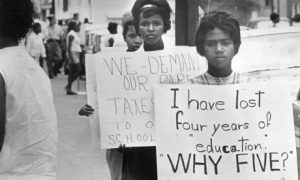
“Whose Streets” features the work of thirty-eight independent photojournalists who documented -- and participated in -- protests in New York from 1980-2000. The issues ranged from housing, abortion rights, housing, queer activism, AIDS, education and labor, police brutality, race relations, the war and environment -- there were a lot, and ...
Read More

Simianization in the Film “Sing”

Glaring caricature and stereotype provides teachable moment about racial bias

The animated film “Sing,” which opened on December 21, features a lazy, tone-deaf, and hurtful character choice by writer and director Garth Jennings. Whether conscious or unconscious, Jennings’ script perpetuates systemic racism and the history of simianization and oppression of black people by depicting them as gorillas, monkeys, and apes. “Sing” ...
Read More

“Great Books Camp” as Political Education

A Reply to Molly Worthen

In “Can I Go to Great Books Camp?” which recently appeared in the New York Times, Molly Worthen provides an historical account of the development of the “Great Books” program and related curricula inside American universities. It is a report about the present deployment of such “canonical” works in various ...
Read More
“Great Books Camp” as Political Education

A Pure Solar World

Sun Ra and the Birth of Afrofuturism by Paul Youngquist

One of my favorite moments of personal cognitive dissonance goes back to my time at Michigan State in the mid-1970s when at brunch at IHOP one Sunday morning I looked over to see John Gilmore, June Tyson, and Marshall Allen seated a couple of tables over from me. They were ...
Read More
A Pure Solar World

The Lady in the Van (2015)

Movie Review

“One seldom was able to do her a good turn without some thoughts of strangulation.” Mary (or is it Margaret?) Shepherd was a pianist. And then she was a nun. And then… well, it’s not clear just what happened next. But by the time we meet her, in Alan Bennett’s ...
Read More
The Lady in the Van (2015)

What Can Cinema Teach Philosophy?

Badiou and Rancière on Film

Philosophy’s general distrust of cinema is a thing of the past. Cinema no longer serves only as a placeholder for reproving wrong conceptions of time (Bergson on the “cinematographic illusion”), as the incarnation of the distraction industry (Adorno), as a symptom of cultural depravation (Heidegger on the remove from “Japanese ...
Read More
What Can Cinema Teach Philosophy?

Remaking the Rust Belt

The Postindustrial Transformation of North America

The decline of American manufacturing and what to do about it has been a key topic in the current election cycle. The demise of the nation's industrial plant, and its implications for manufacturing cities such as Detroit, Akron, and Pittsburgh, has often been seen as inevitable, a result of blind ...
Read More
Remaking the Rust Belt