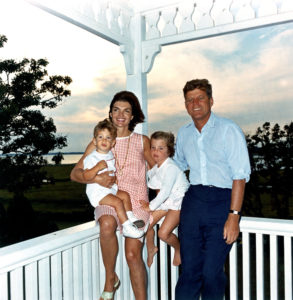
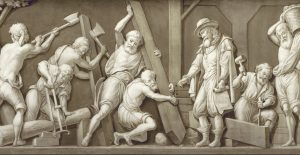
José Clemente Orozco, Call to Revolution and Table of Universal Brotherhood (Struggle in the Orient), 1930–31 (detail). Photo by Fernanda Kock/Galo Studios. Courtesy of The New School Art Collection.
The public refuses TO SEE painting. They want TO HEAR painting. They don’t care for the show itself, they prefer TO LISTEN to the barker outside.
— José Clemente Orozco, in Orozco “Explains” (1940)
CAST IN ORDER OF APPEARANCE
Portrait of Joseph Stalin, revolutionary and leader of the Soviet Union: “Struggle in the Occident” panel
Portrait of Vladimir Lenin, revolutionary, political theorist, and leader of Soviet Russia: “Struggle in the Occident” panel
Portrait of Felipe Carrillo Puerto, revolutionary, journalist, and governor of Yucatán: “Struggle in the Occident” panel
Portrait of Mahatma Gandhi, revolutionary, political theorist, and leader in the Indian Independence Movement: “Struggle in the Orient” panel
Portrait of Sarojini Naidu, revolutionary, poet, and leader in the Indian Independence Movement: “Struggle in the Orient” panel
WITH
Portrait of an unnamed woman: “Homecoming of the Worker of the New Day” panel
Representatives of global types: “Table of Universal Brotherhood” panel
Unnamed workers: “Science, Labor and Art” panel
EXT–ROOM AT 66 W. 12TH STREET, NEW YORK CITY
JOSEPH STALIN
(irritably)
Why can’t I see the students dining? I hear them. But I only see yellow. Is the sun shining all the time now?
VLADIMIR LENIN
Do you think you control the weather, Joe? You’re sideways, with only one eye. A partial view of the world. I face the world directly. I see revolution for the whole world!
(pause)
But right now, all I see is yellow too.
FELIPE CARRILLO PUERTO
It’s temporary, my comrades. Yellow once covered me—bold as La Ciudad Amarilla in Yucatán—and then it did not. I know it was lifted up by my people, by farmers and peasants. Now, once again, I can see land reform, votes for women, rights for those indigenous to this land. My comrades from Russia, we share the same wall and the same world, with all achievements due to the workers. We stand united as socialists.
STALIN
You’re still saying that? Face it, comrade, you only made it into the mural because you got shot.
LENIN
(chuckling)
Don’t forget the New York girlfriend who pulled some strings. What was her name again?
CARRILLO PUERTO
(with dignity)
Power is never yours alone. It is gathered from our comrades, the oppressed, the marginalized, the forgotten. You Soviets have forgotten that work existed before capital. And your ruthless quest for power means you are feared but not revered. I have been called the Abraham Lincoln of Mexico. Like him, I was killed because I acted on my beliefs. I am the true revolutionary.
LENIN
And yet no one remembers you. At least I dominate this wall. My ideas have changed the course of history. I have laid out What Is to Be Done.
(LENIN waves a booklet of remarks written between the autumn of 1901 and February 1902, titled What Is to Be Done?)
STALIN
Your ideas live on paper. My power is material: land, agriculture, military.
MAHATMA GANDHI
(from across the room)
We walk, we sit, we stand. The most powerful weapon is our moral authority. That is the revolution the world needs.
LENIN
Revolution does not walk. It rises as a wave. The proletariat throwing off the chains of capitalism to overthrow the bourgeoisie. First in one country, then around the world.
STALIN
Waves and chains? You’re mixing your metaphors again, Vladimir. How naïve, all of you. Ideas need to be controlled, managed.
CARRILLO PUERTO
Ideas are useful only in that they are practiced by all our comrades! We seize haciendas so that farmers reap the harvest they sow. As with land, so with ideas. We grasp them to realize liberation with others.
STALIN
What of those with a gun to shoot your “ideas”? Ideas need to be enforced by power.
GANDHI
Power comes not from violence but from righteousness.
CARRILLO PUERTO
Comrades, please. Let’s not be avaricious like capitalists. Here we sit—embalmed in fresco—in a school, a new school. We are here because José Clemente Orozco, my fellow Mexican, imagined a world of progress, where the unfed would be fed, the unschooled would be schooled, the unfree would be freed. It is not a revolution if there is not betterment for all.
SAROJINI NAIDU
May I suggest that we include everybody in that revolution? Women, for instance.
LENIN
Can barely hear you. Your voice sounds like a bird. Are you the one in the corner, on your own?
NAIDU
(quietly)
I am indeed like a bird, and I sit here alone. I must have a broken wing. But at least I am not caged behind a curtain. I sit and watch time moving. It too is like a bird.
(Audience sees overlaid text of NAIDU’S well-known poem “The Bird of Time/Songs of Love and Death/The Bird of Time.” There is silence for a beat.)
GANDHI
My fellow revolutionaries, an idea—philosophical and poetic—has silenced you. My countrywoman, the “Nightingale of India,” knows the power of ideas and artistry. She walks beside me and reminds me of the impermanence of life, the constancy of change.
NAIDU
Once I sang. Now I sit. I hover in your shadow as a reminder of those whose voices do not break above the bluster and din.
(Many voices speak at the same time.)
CACOPHONOUS CHATTER
Nobody knows us either.
No one cares who we might represent.
They think we’re trapped in brotherhood rather than liberated by it.
They blame us for not having any women among us.
The chairs are hard and straight, so damn uncomfortable.
It wasn’t just romance; it was a meeting of the minds!
It’s still entirely a figment of the artist’s imagination that the historically oppressed are at the head of the table.
What kind of perspective is this? I constantly feel as though I’m sliding toward the ground.
UNNAMED WOMAN
Gentlemen! If you feel trapped by representation, what about me? I am the wife of the returning soldier, the one who remains at home, who feeds and cares for family, who serves the men and children around her. I don’t even know my own name.
LENIN
We believe that women need to be workers.
WOMAN
And do all the housework too?
STALIN
Of course.
LENIN
(grumbling)
Felipe, could you get your workers to take down this curtain?
UNNAMED WORKER
(faintly, from outside)
At least you’re in the room, next to one another, battling ideas. We don’t even represent people! Just areas of knowledge. A school’s purpose. Science, Art, Labor. The barker outside.
(There is silence.)
UNNAMED WORKER
Hello?
Inspired by a video by New School students Yun Hee Chang, Haley Chopich, Kayeon Nam, and Ari Spool, If the New School Murals Could Talk, and discussed by Spool here.
This essay is part of a series of interdisciplinary responses to Mexican artist José Clemente Orozco’s 1931 mural cycle A Call to Revolution and Table of Universal Brotherhood. The mural, one of The New School’s earliest commissioned artworks and the only surviving permanently installed public example of classic Mexican fresco painting in New York City, is currently the subject of a multi-year conservation project that will see its surface restored and environmental conditions stabilized for years to come. While conservators prepare to gently treat the efflorescence clouding Orozco’s imagery, Public Seminar has invited scholars from across The New School to look at the artwork with fresh eyes.
The preservation effort has been made possible by funding from the Mellon Foundation, Frankenthaler Climate Initiative, and the Terra Foundation for American Art.