OOPS versus MOOCs
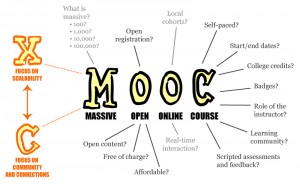
I first thought of writing this post over a year ago as a follow up to my piece “Against the Educational Uncertainty Principle.” I was struck by the way that recent interventions to address the various dimensions of higher educational crisis have made matters worse. MOOCs, Massive Open Online ...
The Social Condition and the Ghetto
Jeffrey Goldfarb and Iddo Tavory (recently joined additionally by Tim Rosenkranz) have been trading pieces in this forum toward sketching the outlines of an existential sociology based on a concept they call "the social condition." The social condition, if I understand them correctly, is the intrinsic potential for ...
Neoliberalism and the Feminine Subject*
Foucault’s radical intervention in feminist theory, and more generally in the philosophy of the body, has been the crucial claim that any analysis of embodiment must recognise: how power relations are constitutive of the embodied subjects involved in them. His studies of disciplinary technologies, for example, show how individuals are ...
A Continuing Conversation: From the Archiv to Social Research
The Graduate Faculty of the New School for Social Research was founded in 1933 by Alvin Johnson, the president of the New School, who created there the “University in Exile” to provide a safe haven for scholars who were endangered by totalitarian regimes.[1] The University in Exile became necessary after ...
The Long Counter-Revolution
Alan Baas | Philosophy Talk Series | @NSSR
A reading of On the Cult of Fetish Gods
Since Marx' and Freud's influential usage of the term, we became accustomed to talk about fetishism as a topic for psychology and social theory. It is rarely remembered that the topic was originally a topic in theology and ethnology. Why has fetishism assumed such a wide meaning? Why do theorists ...
#Accelerate and inertia
#Accelerate in reverse
Extrapolation, not Acceleration
Joseph Needham, the Great Amphibian
The Capitalism of Affects
In her groundbreaking book about emotional labor, The Managed Heart, Arlie Russell Hochshild suggests that emotions are not simply stored in us waiting to be expressed: they are also produced and managed. The notion and practice of affects management, both privately and socially, are not specific to ...