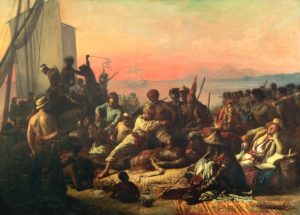
The Ostriches: Part V

“the padded paws in tactical gloves”

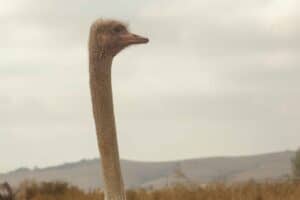
THE OSTRICHES: PART V, FORT SNELLING, MN Our hair is full of the sand of cliché,but the ostrich does not hide her head.When the big cats and jackals dancethrough the dry grass, the ostrich liesflat on the horizon, a plumed moundon the definitive curve of the earth.The brown feathers hide among ...
Read More
The Ostriches: Part V

Brick by Brick: Richard Siken Rebuilds His Interior World

In I Do Know Some Things, the poet proposes an “encyclopedia of self”

“Who you are and who you think you are: They grind against each other, sand in the frosting,” poet and painter Richard Siken writes in his long-awaited third collection. I Do Know Some Things (Copper Canyon Press, 2025) continues his previous exploration of selfhood, but with a harrowing purpose. In ...
Read More
Brick by Brick: Richard Siken Rebuilds His Interior World

The Ostriches: Part IV

“Forty to a clockless cell”

THE OSTRICHES: PART IV, 26 FEDERAL PLAZA Leonardo’s first inventions were machinesTo tear the bars off windows and openA prison from inside. He escaped the gibbetAnd the stake and wandered the marketBuying caged birds to set free. Every sketchAnd painting an endless draft for a pictureOf the mind in its movement, infinite. He ...
Read More
The Ostriches: Part IV

A Transdisciplinary Foray Into Classical Performance

Cloud Variations presents performers, chamber orchestra, and poetry in a prismatic exploration of language, translation, and mother tongue

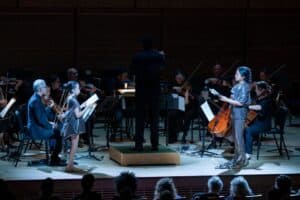
Poet and performer J. Mae Barizo’s monodrama Cloud Variations is a transdisciplinary foray interweaving poetry, chamber orchestra, visual art, and theater. The piece places Barizo’s “Cloud Pantoum,” a poem previously published in The Atlantic, in conversation with Philip Glass’s Symphony No. 3 to create a kaleidoscopic meditation on body, technology, ...
Read More
A Transdisciplinary Foray Into Classical Performance

Palestinians in Their Own Words, Their Own Genres

A review of Gaza: The Story of a Genocide

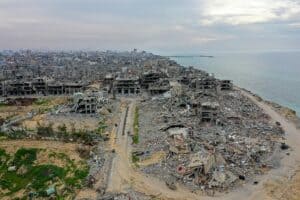
With the release of Gaza: The Story of a Genocide (Verso, October 2025), editors Fatima Bhutto and Sonia Faleiro bring us a powerful addition to a lamentable literary genre: the genocide anthology. Comprising more than 20 works of poetry, art, essays, and reportage by 23 contributors—many of them Palestinian—this volume ...
Read More
Palestinians in Their Own Words, Their Own Genres

The Ostriches: Part III

“Here at our sea-bashed gates she gloats and stands”

THE OSTRICHES: PART III, THAT OLD COLONIC So like the braised gullet of bleak shame,With plundering lips that glide on branded hands;Here at our sea-bashed gates she gloats and stands,A bronzy woman with a piece, whose flameIs an enfrissoned blighting, and her nameBreeder of Exiles. From her beaked handSpews world-wide hell—come, ...
Read More
The Ostriches: Part III

The Ostriches: Part II

THE OSTRICHES: PART II But he though blind of sight,Despis'd and thought extinguish't quite,With inward eyes illuminatedHis fierie vertue rouz'dFrom under ashes into sudden flame,And as an ev'ning Dragon came,Assailant on the perched roosts …And though her body die, her fame survives,A secular bird ages of lives. —Samson Agonistes Captain Kirk: crisscross ...
Read More
The Ostriches: Part II

Can Poetry Re-Enchant the Modern World?

The philosopher Charles Taylor goes hunting for cosmic connections

When the protagonist of Miranda July’s recent novel, All Fours, plummets into a crisis, she realizes, at age 45, that she “had entirely misunderstood the assignment, the scale of what life asked of us.” She had “only been living second to second—just coping—this whole time.” Being a writer, the character’s ...
Read More
Can Poetry Re-Enchant the Modern World?

Animated by Not Knowing

A conversation with Wendy Xu on thinking through poetry in Your Historical Loveliness Knows No Bounds: Form, Futurity, and Documentary Desire

Poet and educator Wendy Xu’s new book, Your Historical Loveliness Knows No Bounds: Form, Futurity, and Documentary Desire (University of Michigan Press, 2025), traverses multiple genres of poetry, poetry criticism, essay, and memoir, presenting close readings and “thinking-throughs” of works by poets such as Layli Long Soldier, Inger Christensen, Ocean ...
Read More
Animated by Not Knowing

The Ostriches: Part I

“This is the plague after the plague”

THE OSTRICHES: PART I Catch for us the foxes, the little foxes that ruin the vineyards, for our vineyards are in blossom.—Song of Songs, 2:15 I have become a brother to the jackals, and go about in the company of ostriches.—Job, 30:29 Our vineyard is titanium and glassand the little foxes flickerin the ...
Read More
The Ostriches: Part I

Sisyphus, From Memory

An excerpt from Your Historical Loveliness Knows No Bounds: Form, Futurity, and Documentary Desire

He was a god, or he wasn’t. He was a king, at least. He had some relation to both the gods on high, their glamour and power, and the lowly world of mortals. Of course you must imagine him with the stone, and it was a stone I’m sure, and ...
Read More
Sisyphus, From Memory

Can Poetry Still Unite Us?

An interview with Sarah V. Schweig on her new poetry collection The Ocean in the Next Room

For Sarah V. Schweig, writing poetry has always been a question of looking for the most truthful way to record things that had seemed otherwise inscrutable or difficult to understand. Her new collection, The Ocean in the Next Room (Milkweed Editions, 2025), peels back the noise of daily life to ...
Read More
Can Poetry Still Unite Us?