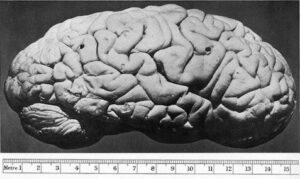
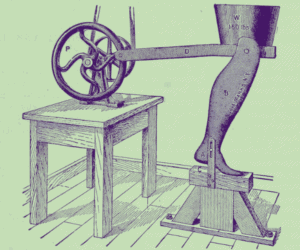
Illustration from On the Writing of the Insane (1870) | G. Mackenzie Bacon / John Churchill and Sons / Public Domain Worldwide
Here is a definition of the sentence, strict and recent:
the minimal theoretical entity required to account for the formal syntactic relationships found to exist among the constituent syntactic units of a language. It is the entity which allows coherent statements about the lower-level constituents of the language, identifying a domain within which other units can be specified.
(Levinson 1985, 123)
Ian Robinson adopts this definition from the linguist Joan Levinson and appends his own epitome: A sentence is “the syntactic domain of a finite verb” (Robinson 1998, 2). He writes as a historian of modern prose, arbitrating between generative and descriptive paradigms. He understands sentences to be well-formed structures defined by a finite grammar, but also to be historically emergent in their style and the criteria of correctness, and elegance, that they project. For now I want to mark two of the definition’s aspects: first, that a sentence is a structure of relation among its parts, and second, that it is a whole, or, to recombine two of Levinson’s terms, a coherent domain. Sentences so understood, of course, will not account for much of spoken language, nor indeed for much writing, from text messages to street signs. So with the concept of exteriorization in mind, let me draw back to reflect on writing more generally—back both in cultural scope and species time.
I borrow “exteriorization” from the paleoanthropologist André Leroi-Gourhan. In his Gesture and Speech, he writes, “The whole of our evolution has been oriented toward placing outside ourselves what in the rest of the animal world is achieved inside by species adaptation.” Biological evolution gave us an upright posture and freed our hands for gesture and toolmaking, and evolution, from there, became a matter of the development of our powers by exteriorization—by technics (les techniques) that enhance and transform what we can do as individuals and as members of a culture. “The most striking material fact is certainly the ‘freeing’ of tools, but the fundamental fact is really the freeing of the word, and our unique ability to transfer our memory to a social organism outside ourselves” (Leroi-Gourhan [1964] 1993, 235). The hammer exteriorizes the skills of building, extending and remembering and teaching them in its material form. Writing is an exteriorization of memory. On clay, on papyrus, on paper, it can be inspected, reorganized, revised; it is available for reflection and manipulation. All this it can do even if separated from the writer by long time and long distances.
The sentence may impress us as the basic unit of written communication. Historically, it is not. Writing, in the lineage that begins in the ancient Near East, circa 3500 BCE, was originally for administrative and economic accounting. Marks pressed or incised in the clay of cuneiform tablets recorded distributions of foodstuffs, crops, and livestock. (Writing, as Jac Mullen [2025a] puts it, “was bound to the birth of the state and the consolidation of its power—an asymmetric information technology designed for governance, not yet for the poet.”) Over the centuries of its currency, cuneiform added a repertoire of phonetic signs to its ideograms and came to record events, laws, even poems; the next two millennia of imperial rise and fall promoted systems like the syllabic notation of Mycenaean Greek (known as Linear B) and the consonantal notation of the Semitic languages, before ancient Greek adapted the writing of the Phoenicians to produce the first fully vocalic alphabet (Martin [1988] 1994, 8–15). That new flexibility in transcribing sound meant that writing could, in principle, avail itself of the full lexical and syntactic capacities of spoken language. But the anthropologist Jack Goody emphasizes that early writing (and not just early writing) takes many forms that are non-sentential, “tables, lists, formulae and recipes … ‘figures of the written word’ rather than ‘figures of speech'” (1977, 17).
So when Goody and successors speak of the population-level cognitive transformations that result from reading and writing, they are not talking primarily about the sentence as an ideal of eloquence. Writing cannot be separated from its institutions and occasions, the uses by which its specific technics develop. What writing changes about thinking is not some root capacity for reasoning or inference, argues David Olson, but rather “the techniques, technologies, systems, schemes, forms and formats for managing these processes” (1994, 23). Sentences are employed in some domains and not in others. Nor can the sentence claim special privileges as a mimesis of speech. Speech is grammatical, with criteria for correctness and error, fluency and disfluency—but from the standpoint of prose, it is fragmentary, redundant, elliptical, often difficult to understand without the contextual support of gesture, expression, and above all the cadences of the speaking voice. (Something you only notice, of course, if you transcribe it.) Wallace Chafe, in the 1970s, characterized speech as made up of “idea units” of seven or so words, with a single intonational contour (1985, 106). More recent work in linguistics has complicated the idea of an “idea” and emphasized the contextual variety in unit length (Degand and Simon 2009), but the claim that ordinary speech is not sentential can be confirmed by any act of attentive eavesdropping.
All of which is to say that the sentence as I first defined it is a specific form of exteriorization within the larger exteriorization of writing. Its promise is its capacity to relate the elements of speech in a discrete whole. Behind that idea of a coherent domain there is a long history: the sentence as a single thought, a single act of mind, attributed (precariously) to Aristotle; ancient rhetorical theory’s concept of a period, a complete arc of persuasion; the seventeenth-century grammarians’ formal definitions of completeness and incompleteness (Robinson 1998, 13–19, 166–84). An equally long history has treated the sentence as an ideal orthopedics of speech, how we talk if we are educated, if we are civilized (Harris 2000, 1–16). Even the free-thinking Czech-Brazilian theorist Vilém Flusser allows himself to worry, in a book about the end of writing, whether speech, without a model, will become “along with a good deal of thinking … barbaric” ([1987] 2011, 64). I do not want to treat the well-formed sentence as though it were inevitably a marker of privilege. On the contrary, it is a potent unit of vernacular pedagogy and expression. But Leroi-Gourhan’s fellow traveler Bernard Stiegler, who builds his philosophy from the concept of exteriorization, reminds us of the good and the bad in all technics, and the bad, in the case of the sentence, is the potential for its forms of eloquence to be re-interiorized as marks of class difference (2016, 30). To understand its practical affordances, for any writer, a change of scale is necessary.
This essay was first published in Social Research: An International Quarterly, a John Hopkins University Press publication, in its Summer 2026 edition. Reprinted with permission.