No. 4 Le Roi des Porcs (1899) | Lenepveu, V. / Duke University Libraries / Public Domain
In October 1899, Parisians could purchase a large color lithograph depicting a grotesque human-pig hybrid, complete with spectacles and a curly tail, wielding a paintbrush and smearing a map of France with this brown “caca international”—“international poo.” The picture was a caricature of the novelist Émile Zola, or “Le roi des Porcs” (“the King of Pigs”), as the cartoon suggested: a writer pooping out and spreading filth. Rather than inventing a new insult, the lithograph gave visual form to a long-standing criticism of Zola’s naturalist fiction, which was often thought of as morally degenerate. But Zola was no longer just a controversial (and enormously popular) novelist; he had become the public face of the polarizing Dreyfusard cause after publishing his famous open letter, “J’Accuse…!” in the newspaper L’Aurore, on January 13, 1898.
The Dreyfus Affair had begun five years earlier. In 1894, Captain Alfred Dreyfus, a Jewish officer in the French army, was falsely convicted of treason and deported to Devil’s Island. By late 1897, new evidence of Dreyfus’s innocence, along with increasingly intense press campaigns and public interventions, transformed the Affair into a national controversy. Zola’s “J’Accuse…!” propelled it onto the international stage. Newspapers, illustrated journals, posters, and postcards turned the Dreyfus Affair into the first modern media event of the fin-de-siècle in France. Long before digital social media, these media contributed to political polarization by reinforcing shared convictions as images and arguments circulated within like-minded communities. The postcard’s boom as a mass medium around 1898 occurred at a moment when public opinion had already largely crystallized around the Affair.
The “Le roi des Porcs” poster was part of a much larger visual campaign. It was one of fifty-one lithographs published under the title Musée des Horreurs by Victor Lenepveu between October 1899 and December 1900, before the Paris police banned their distribution. Issued weekly, then in bi-monthly installments and sold as a collectible series, the Musée des Horreurs turned the Dreyfus Affair’s cast of characters—Zola, Dreyfus himself, the Rothschild family, and the journalist and politician Joseph Reinach among them—into a rotating gallery of hideous figures. Every figure in the series was rendered through the same zoomorphic device, fused with an animal to produce a hybrid creature designed to degrade and dehumanize. The series prompted viewers to consume political caricature—and to collect it.
Like a number of Lenepveu’s images, “The King of Pigs” was reproduced as a postcard, turning a large lithograph into a miniature object that could be mailed, commented on, and collected. Copies of both the lithograph and its postcard version survive today in institutional archives such as the Lorraine Beitler Collection of the Dreyfus Affair at the University of Pennsylvania.
More than a souvenir or a mere illustrated message, the postcard was already seen as a social technology by the end of the nineteenth century. First introduced in the Austro-Hungarian Empire in 1869, postcards were adopted in France during the Franco-Prussian War of 1870 to enable wounded soldiers to communicate with their families. The popularization of the postcard coincided with the 1889 Paris Exposition Universelle, where Léon-Charles Lebonis’s iconic depiction of the Eiffel Tower became the first great postcard success thanks to advances in photomechanical printing. With mail deliveries occurring several times a day, the postcard functioned not only as an occasional form of correspondence but also as an extension of everyday sociability. Like family photographs, postcards were meant to be kept, whether or not the sender added a single word of their own. And like stamps, they were sought after by emerging cartophilist associations, whose members turned domestic correspondence into a curatorial practice. Although political postcards existed before the Dreyfus Affair, the controversy helped turn them into a mass medium of political expression.
It didn’t take long for activists on both sides of the Dreyfus Affair to recognize the political potential of postcards. The Dreyfusards also produced their own postcards, most notably Edouard Couturier’s famous illustrated eighteen-card series, “Histoire d’un innocent” (The Story of an innocent man), published shortly before Dreyfus’s retrial in 1899. Even the Dreyfus family collected postcards about the Affair, as evidenced by the collection they donated to the Musée de Bretagne in Rennes long after Alfred Dreyfus’s exoneration. In 1899, Emile Straus, founder of the first association of postcard collectors, had written, “From a political standpoint, the postcard will prove to be a strong ally of the satirical and polemical illustrated press. Let us welcome it: from the very beginning, it has served the cause of law, justice, and humanity by scourging the injustice of the Dreyfus trial and the crimes of the military.”
To date, no reliable figures exist regarding the production and circulation of postcards related to the Dreyfus Affair. However, it is generally acknowledged that thousands of such postcards were in circulation. On the front page of its October 16, 1899 issue, the anti-Dreyfusard newspaper L’Intransigeant crowed that the first issue of Musée des Horreurs had sold some 300,000 copies, implying that there were 300,000 anti-Dreyfusard partisans. This, the newspaper claimed, despite the fact that the head of the Prefecture, Louis Lépine, had stopped many vendors from selling the first issues of the Musée des Horreurs. Although 300,000 copies seems impressive, the figure is difficult to verify and may have been inflated to stimulate demand. However, the increase in the subscription price for the full series (from 25 francs at launch to 40 francs starting in February 1900) suggests that collecting images had indeed become a popular way of showing one’s political allegiance.
Rather than contributing to an open public debate, it seems that most postcards circulated through established networks of collectors and sympathizers. But by the time postcards began circulating en masse during the Dreyfus Affair, the major lines of division between Dreyfusards and anti-Dreyfusards had already hardened. Sold in series, by subscription, or directly by publishers, as well as through newspaper kiosks, the postcards increasingly became objects of collection that reinforced existing political commitments rather than persuading undecided French people.
During its publication, the Musée des Horreurs changed addresses several times, indicating that its publishers may have encountered increasing police scrutiny. If so, this suggests that the posters were recognized by Paris authorities as sowing dangerous political discord and extremism; it also meant that distribution shifted away from ordinary newsstands toward more discreet channels—i.e., they moved further from their role as objects of public discourse and more toward in-group affirmations of existing beliefs. Once reproduced as postcards, these posters underwent miniaturization, turning political propaganda into a portable, mass-reproducible form. Reduced in scale, the images could circulate beyond the private spaces where they were originally displayed, allowing people to share and comment on them. Miniaturization expanded the reach of political imagery, reaffirming a shared political identity. The same logic applied across the entire political spectrum, as Dreyfusard postcards began circulating through networks of readers and supporters already invested in one side of the Dreyfus affair.
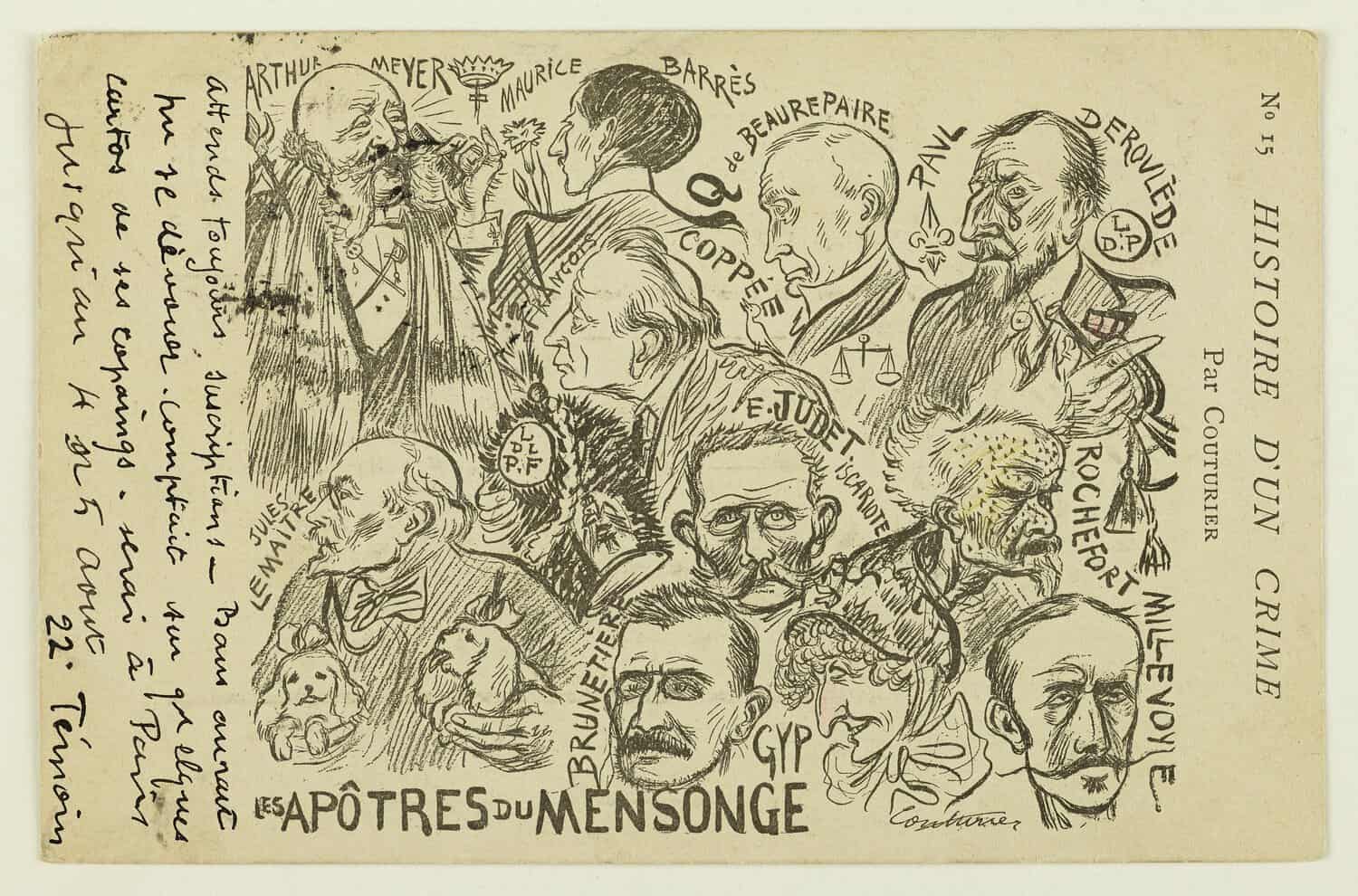
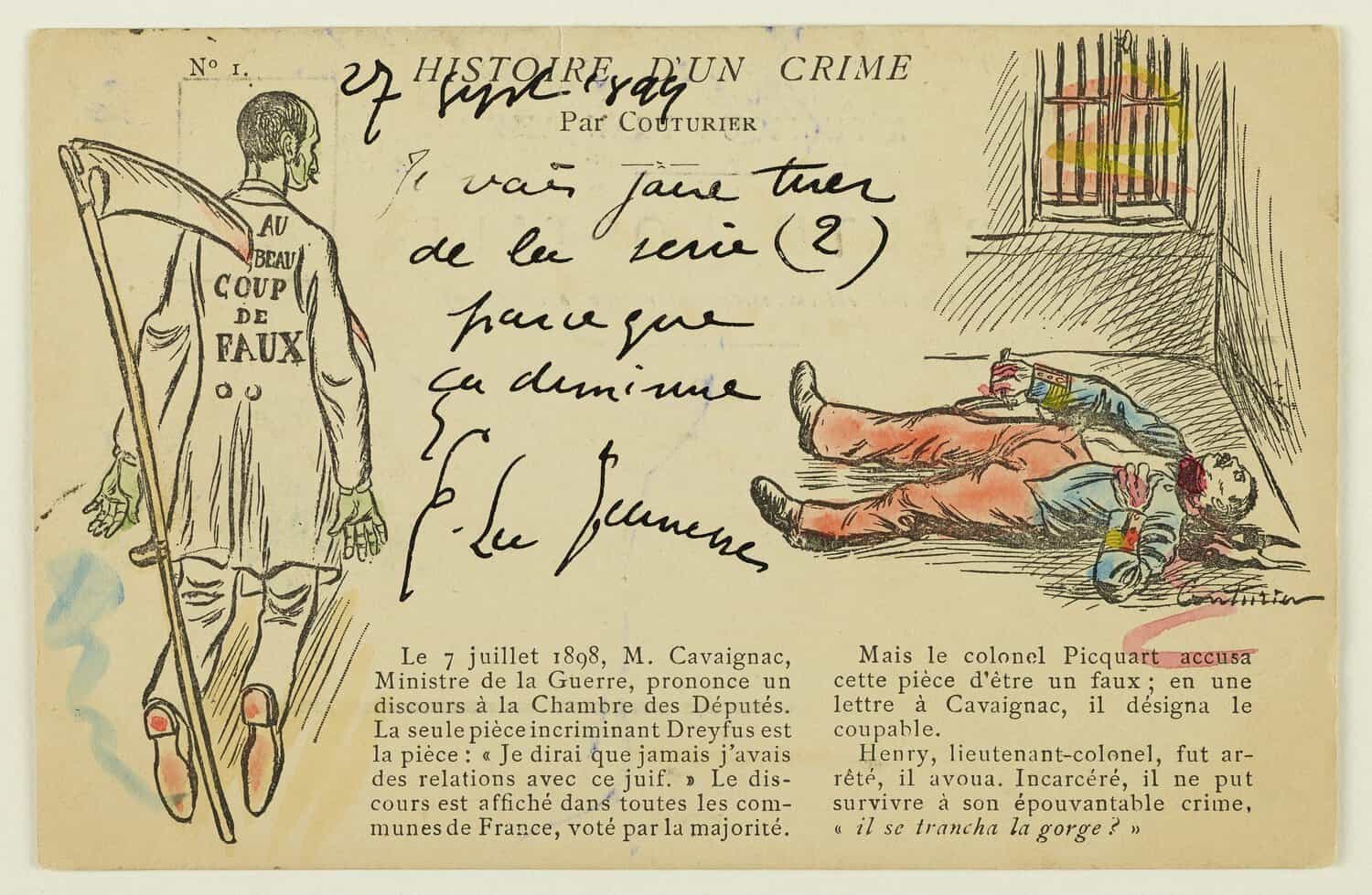
Perhaps the comparison with today’s digital world commences here. Around 1900, nobody had the power to decide what people should read. Collectors did so, organizing themselves into pressure groups that publishers could not ignore, capable of shaping which series and themes were illustrated.
Today, Facebook feeds and algorithmic recommendations constitute what author and activist Eli Pariser calls a “filter bubble”: the invisible personalization of information by internet platforms, meaning that users are more likely to encounter affirmations of—rather than challenges to—their existing beliefs. The filter bubble is often pointed to as a key culprit in social polarization. But Dreyfus Affair postcards reveal that the practice of building selective information networks is far older than the Internet, supporting Cass Sunstein’s notion of the “echo chamber,” which describes a phenomenon with deep social roots in which people tend to seek conversations and sources that confirm views they already hold.
People themselves made the choices. They selected the postcards they bought, the people they wrote to, and the images they collected. More than a century before platforms started automating this process, political communities were already creating selective environments of their own. The postcard of Zola, “king of the pigs,” was a direct response to the news that Dreyfus had been pardoned by French President Emile Loubet. A number of anti-Dreyfusards with antisemitic views refused to accept that the Affair would end there. Its pot of “international poo,” representing overseas support for Dreyfus, also drew on a familiar antisemitic trope that portrayed Jews as a foreign and corrupting force within the French nation, and cast Zola as an accomplice who had swallowed a Jewish agenda and was now, via his writing, excreting it as “caca.” While the anti-Dreyfus political vitriol it portrayed might have been fresh, the Zola postcard hinged on stereotypes that were for its audience, perfectly accurate—and nothing new.