Becca Rothfeld’s Essays in Praise of Excess

A celebrated young critic hungry for more than our contemporary culture typically offers

Like William Blake, Becca Rothfeld believes that “the road of excess leads to the palace of wisdom.”   A widely praised young critic (winner of the National Book Critics Circle Nona Balakian Prize for Criticism and the Robert B. Silvers Prize for Literary Criticism), Rothfeld is the nonfiction book critic for The ...
Read More
Becca Rothfeld’s Essays in Praise of Excess

Poetic Rage, Anti-colonial Avant-gardes

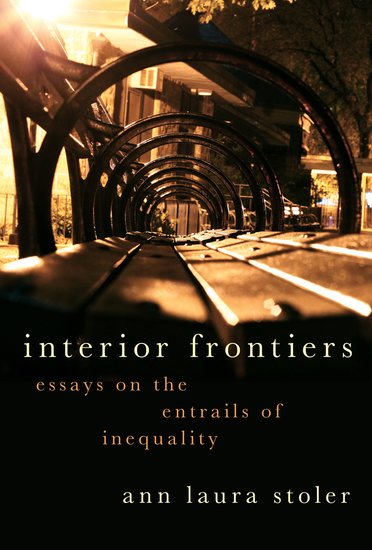
An excerpt of Interior Frontiers

This essay distills what I see as a fugitive, peripatetic set of counter-colonial avant-gardes, innovative and mobile to different degrees, challenging both what avant-gardes do and who are included among them. I do not treat them as a movement but as convergent spaces of work and thought, of “counter-conducts,” of ...
Read More
Poetic Rage, Anti-colonial Avant-gardes

Turning Art into a Political Weapon

Scholars Terri Gordon-Zolov and Eric Zolov discuss the aesthetics and significance of the Chilean estallido

Wearing protest iconography was also a way to support the movement. And it was potentially risky. You could wear a handkerchief to cover your eyes from tear gas or to make yourself more anonymous or you could wear a green scarf to support reproductive rights. ...

Read More
Turning Art into a Political Weapon

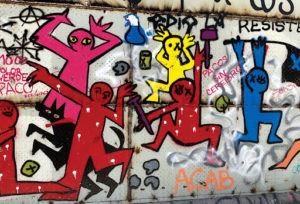
The Walls of Santiago

How the Joker and Pikachu become symbols of the Chilean social uprising, in an excerpt from Terri Gordon-Zolov and Eric Zolov’s new book

Humor provided a powerful weapon in the fight to topple the civic-military dictatorship. The radical deprivation of human rights during the Pinochet regime had secondary costs, among which were the loss of a sense of freedom, spontaneity, and overall well-being. ...

Read More
The Walls of Santiago

Souvenir

Adapted excerpt from Activities of Daily Living

For her project about the Artist—at least that’s what she was calling it for now, a project—Alice read all that she could find about his yearlong performance works before he renounced making art altogether. There was the year he locked himself in a cage. The year he punched a time clock ...
Read More
Souvenir

How Charlie Brown Remained A “Good Man”

Peanuts creator Charles M. Schulz went to great lengths to avoid political controversy. But as culture became more political, he navigated that challenge with skill and grace

_____ Charlie Brown had a hard time choosing sides. This was always part of the humor of his character. It was also one of the many things he hated about himself. On New Year’s Eve 1965 Charlie Brown, the star of cartoonist Charles M. Schulz’s Peanuts, decided to change: he would be decisive, clear-cut, ...
Read More
How Charlie Brown Remained A “Good Man”

What Can’t be Contained

A conversation between Alexandra Délano Alonso and Macushla Robinson

_____ In March of 2020, with the pandemic devastating New York and Queens being declared the “epicenter of the epicenter” it felt impossible to find words to describe the uncertainty, the losses, the distance. Over the coming months, Alexandra Délano Alonso gathered images and fragmentary language to hold what was (and still ...
Read More
What Can’t be Contained

Thinking Design through Literature

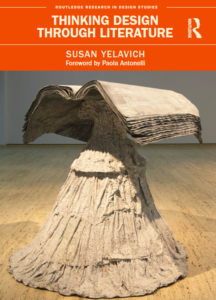
Identity: The cultural politics of things and places

_____ Where design projects possibilities, literature activates their potential and shows their effects. Brought together in Thinking Design through Literature, they form a new and wider tributary in the thought of things and places.  That said, in this excerpt from the chapter on culture, readers will note that the word ‘design’ ...
Read More
Thinking Design through Literature