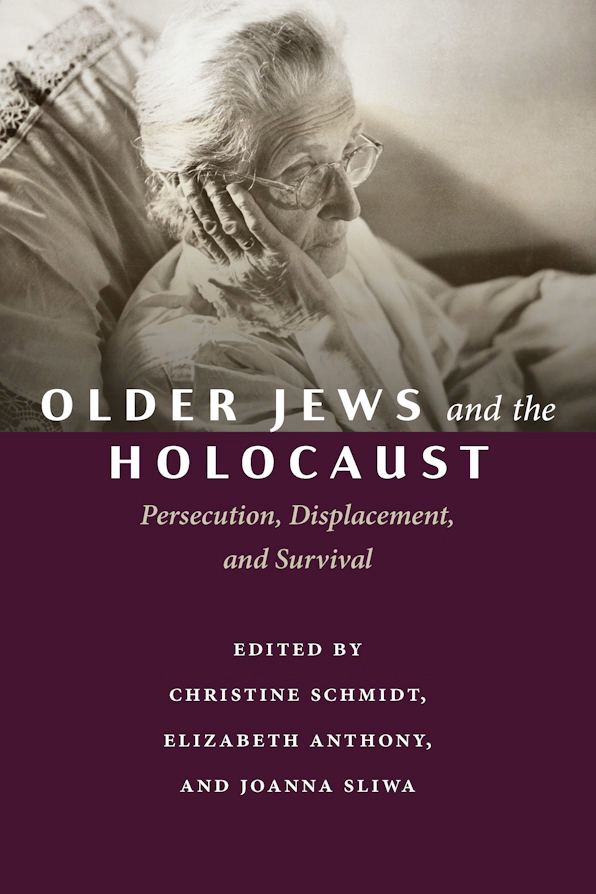
Cover image for Older Jews and the Holocaust: Persecution, Displacement, and Survival, edited by Christine Schmidt, Elizabeth Anthony, and Joanna Sliwa (Wayne State University Press, 2026)
Many older Viennese Jews lived and survived in the city under the Nazis because of different protected circumstances. Historian Brigitte Ungar-Klein demonstrated that 25 percent of those who survived in Vienna in hiding (termed U-Boote [literally, submarines]) were aged 51 or older. Dr. Hugo Glaser, a founding member of the U-Boot Verband (the association for those who survived in hiding), was indeed 57 years old at the time of the Anschluss. His marriage to a gentile wife shielded him for a while, but he spent most of his time under the Nazis living on false identification papers and moving from hiding place to hiding place. Intermarriage did, however, protect Jews in Nazi Vienna throughout the war. Moritz Freiberger, who was 64 at the end of the war, survived because of his non-Jewish wife Mimi. Because the Freibergers and their children were members of the Jewish community, theirs was termed a “nonprivileged mixed marriage,” which meant that they found themselves subject to the same treatment as the Jewish population, including their exclusion from staple food rations and eviction from their home. There was actual privilege to their marriage, though; Moritz was exempt from deportation as long as he remained married to his “Aryan” spouse.
The children of intermarriage—so-called Mischlinge, like Moritz and Mimi’s daughter Lotte—were also protected. An August 2, 1945 report of the Jewish Telegraphic Agency likely overestimated that 6,000 of the 8,000 Jews in Vienna (75 percent) were married to non-Jews.
Such numbers are difficult to pinpoint, but statistics compiled in 1943 by the Ältestenrat (Jewish community leadership reconstituted under the Nazis) indicated only slightly fewer at that time, about 65 percent. Historian Jonny Moser counted 4,783 so-called mixed marriages, or Mischehen, in Vienna (or about 60 percent) at the end of February 1945. In any case, it is clear that a majority of those who survived in the city were intermarried with gentile Austrians.
Another factor that affected the number of elderly survivors in Vienna after the war was the disproportionate number of elderly Austrian Jews who had been left in the city to be subject to Nazi deportation to camps and ghettos in the East. At the time of the Anschluss in March 1938, the number of Jews in Austria totaled 185,028; of them, 169,978 lived in Vienna. It is estimated, however, that more than 201,000 Austrian citizens were subject to persecution under Nazi laws due to their Jewish heritage.
Thanks to the extraordinary efforts and tireless work of the Viennese Jewish community, which operated under the extreme pressure of the Nazi authorities and a massive, forced emigration program, a total of 146,815 Austrian Jews had fled to other countries by November 11, 1941. A ban on Jewish emigration from the Reich issued on October 23, 1941, prevented any further flight from Austria.
Those who had escaped were mostly younger and middle-aged adults who often organized their departures ahead of their older relatives, with plans to get settled in their new homes and then bring their elders along as soon as possible. Neither the extensive requirements of the Nazi authorities nor those of the destination countries favored older emigrés, and as such the opposing sides inadvertently worked together to leave the remaining Jewish population of Vienna middle-aged or older. Thus, the Israelitische Kultusgemeinde Wien (IKG, the Viennese Jewish community) reported that by the end of December 1939, after the emigration of 117,409 Austrian Jews, 70 percent of those remaining were over the age of 45; 42 percent were over the age of 60. Older Jews left behind were impoverished and entirely dependent on the IKG for support, and in most cases never managed to get out to join their families.
It is also true that many older Viennese Jews never even sought to emigrate, and others decided too late and missed any small window of opportunity that may have existed. Historian Melissa Jane Taylor argues that the elderly felt they had more to lose, and worried about losing their pensions and property. Some also refused to leave other family members behind. On top of that, older Jews were accustomed to the antisemitism endemic in Viennese society. They had grown up in the late nineteenth century and the early part of the twentieth, and did not necessarily think that this new version would be much different. They thought they knew how to navigate it, or they just did not believe that the Nazis’ “racialized,” eliminationist antisemitism would last.
But alas, it did. Most of the Viennese Jewish community’s remaining elderly were deported during the mass deportations of October 1942, which left fewer than 8,000 Jews in Vienna, the majority of whom were intermarried with gentile Austrians. Deportations and, of course, persecution continued in 1943, so that by the end of the year a little more than 6,200 people who were subject to Nazi persecution as “Jews” lived in the city. Many Viennese Jews, including the elderly, were sent to Theresienstadt, where certain conditions improved, even if slightly, older prisoners’ chances of survival.
Theresienstadt had specific and important propagandistic purposes. In 1942, the Nazis billed it as a ghetto for elderly German and Austrian Jews, which served to cover up the true nature of the transit camp and ghetto. By offering it as a “preferential alternative,” Theresienstadt helped maintain the illusion that other transports to the East were for workers. The Nazis went so far as to require elderly German Jews to sign Hei-meinkaufsverträge (literally, home purchase agreements) that supposedly bought them accommodation, meals, medicines, and laundry services in Theresienstadt, as well as medical and end-of-life care. With these contracts, German Jews could consider their relocation to be a normal move to “Bad Theresien,” as it was euphemistically called, and the Nazis could rob them before their departure. Adolf Eichmann, the architect of this plan to fleece elderly Jews bound for the “spa town,” did not bother with any such masquerade for Austrian Jews. The Nazis simply expropriated the IKG’s supposed charitable contributions and confiscated its remaining property with the help of the Superior Tax Authority of Wien-Niederdonau, the Reichsgau (the Reich’s administrative subdivision of annexed Austria) that encompassed the municipality of Vienna.
Theresienstadt was also infamously staged for a Red Cross visit in June 1944 to present it as a seemingly desirable retirement destination for older German Jews. In reality, of course, Czech, German, and Austrian Jews of all ages were collected at Theresienstadt for intended deportation to ghettos and killing centers in the East, but the relatively high number of elderly interned there became a key part of camouflaging the true nature of the deportations. Unlike in other Nazi camps, the elderly were not murdered upon arrival there, and—however terrible—specific housing for the elderly existed. To be clear, conditions in Theresienstadt were horrible, and most elderly Jews suffered and died there. Historian Anna Hájková writes that “old people occupied the bottom layer of the sharply segmented inmate community.” Non-Czechs and the elderly made up the lowest class of prisoners, so older German and Austrian Jews found themselves in the worst position, and many died in Theresienstadt. Nevertheless, for the elderly among the 15,000 Viennese Jews deported to Theresienstadt, the possibility of survival existed, however slim.
Excerpted from Older Jews and the Holocaust: Persecution, Displacement, and Survival, edited by Christine Schmidt, Elizabeth Anthony, and Joanna Sliwa (Wayne State University Press, 2026). Used with permission.
Click here to read the authors’ conversation with Alex Rossen about their research into the histories of elderly Jews before, after, and during the Holocaust.