Before Charlottesville

An interview with Carolyn McAllaster on the Greensboro Massacre of 1979

Carolyn McAllaster, the Colin W. Brown Clinical Professor of Law and director of the HIV/AIDS Policy Clinic, said the events in Charlottesville and the president’s response to them sparked memories of the Greensboro Massacre in which five protestors died and 11 were injured even before news of the apology broke. ...
Read More

Why Do You Call Us Ladies?

History, gender, and manners in public life

Consider the story of Abigail Adams and her most famous quote. When Abigail Adams asked her husband John to “Remember the Ladies” as he drafted the Declaration of Independence, she was not advocating for the rights of American women who were predominantly poor, indentured, and enslaved. Rather, she called specifically ...
Read More

Is it Time for the Kneeling Freedman Statue to Go?

Remolding our Political Aesthetics

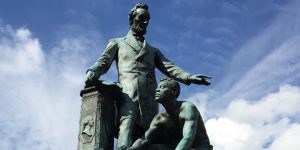
The contrast between the two is striking and one reason why I take students there. The Emancipation Memorial, designed by Thomas Ball, portrays a stern Abraham Lincoln standing over a kneeling, newly freed black man. In one of Lincoln’s hands is the Emancipation Proclamation; the other floats above the prone ...
Read More
Is it Time for the Kneeling Freedman Statue to Go?

Triangulation is the Not-So-New Black

Party Coalitions, Racial Scapegoating and the Carceral State

Bill Clinton vilified African-Americans with his draconian crime bill while pushing for economic deregulation policies that he hoped would woo Republicans while also not upsetting the labor base of the Democratic Party too much. By the time Obama came around, African-Americans went from being vilified by the Democratic Party to ...
Read More

March for Racial Justice and March for Black Women

Sept. 30, 2017 DC

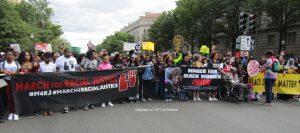
Black Women First! Black Women First! Shouted several thousand people as they marched up Pennsylvania Ave. from the Capitol on September 30.  They were leading two marches, which started at two different points on Capital Hill before joining to march to the Department of Justice on 10th St. There they planned to turn south to go to ...
Read More
March for Racial Justice and March for Black Women

Empire, Epidemics and Visions of Racial Apocalypse

The Precursors of Contemporary Xenophobia

In the numerous violent clashes the book depicts, like the one in which Belgian soldiers stationed in consular offices in India massacre thousands of advancing migrants, murder is depicted in orgiastic fashion while officers recite the victories of great conquerors past to raise morale -- tales of crusading knights slaying ...
Read More

The Political Landscape Post Charlottesville

Where Should Students and Academics Stand?

I had thought that the scariest sight that weekend would be the images of the “Unite the Right” rally. Men can be scary enough on their own. Men with violent ideologies are simply terrifying. The white supremacist rally was toxically masculine, looked utterly fascist and sounded like a historical period ...
Read More

Why Colin Kaepernick Isn’t Working

Football’s Sketchy Labor History

Football may be entertainment for most of us, but it is labor for those who play it, a kind of work that requires as much preparation and discipline as any academic or white collar professional training. In fact, many parents begin fantasizing about an NFL career when their children are ...
Read More

Remembering Romanian Fascism; Worrying About America

Losing Our Moral Compass between Past and Future

Living under Ceausescu was in some ways like living with Donald Trump as president. There was a lot of nationalist swagger, posturing, and boasting about independence from the Soviets. When Ceausescu refused to send troops into Czechoslovakia in 1968 as part of the Warsaw Pact crackdown on student protests, people ...
Read More

Aristotle on Charlottesville

‘Mixed Actions’ and Exercising Judgement on Violence

In the opening movement of book 3 of his Nicomachean Ethics, Aristotle argues that, at bottom, each and every human being is responsible for essentially every action they undertake; put another way: there is nothing a human being does for which they ought not to be praised or blamed. This ...
Read More
Aristotle on Charlottesville