
Dancers in rehearsal during choreographer Brian Golden’s Dance Lab NY residency (2026) | Jenna Maslechko / Rights reserved
Early last year, I brought a friend along to a Trisha Brown performance at Sadler’s Wells in London. The friend, new to postmodern dance, listened patiently as I droned on about its principles: “It’s a lot of holding strange shapes and multi-tasking with different parts of the body,” I summarized. “It’s a form of movement that emerged out of a kind of Vietnam protest era exhaustion with meaning and storytelling.” And though I knew the take was reductive, when one of the principal dancers walked onstage and assumed a posture resembling a preflight ibis, I couldn’t help feeling like I had nailed it.
Being tasked with the same kind of neat summarizing of choreographer Brian Golden’s Dance Lab NY residency would have been a more challenging affair. During rehearsal in the lab’s midtown Manhattan studio, pairs of dancers recited Golden’s poems in unison, Micah Sell practiced juggling toilet plungers from atop Marcus Sarjeant’s shoulders, and an ensemble marked an elaborate routine involving shimmying wigs.
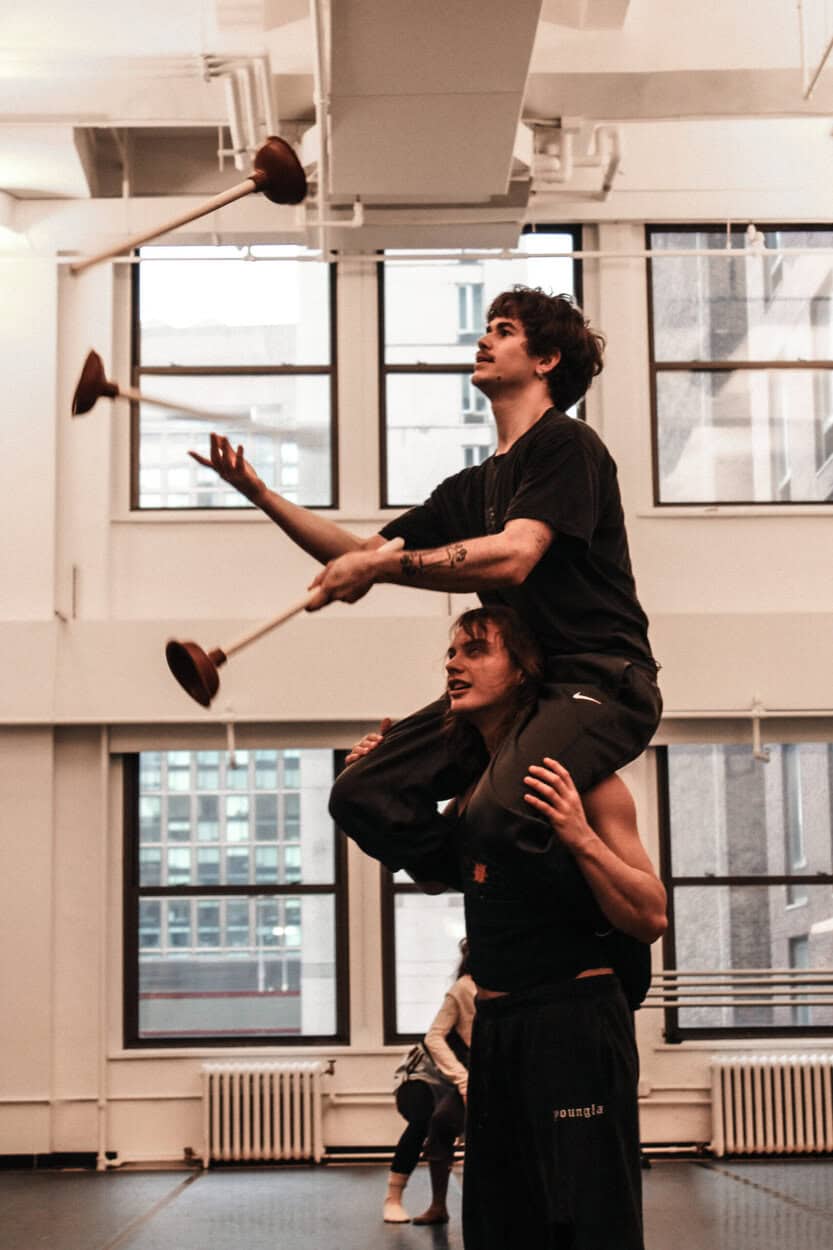
Golden’s work is always shapeshifting; I’ve seen him present abstract, theater-like pieces as a solo performer, danced in acrobatic works of his featuring an array of flamingo blow-up toys, and watched dance films he created that look like A24 movies shot in a homoerotic boxing gym. This interest in variety is also a critical element of his residency, part of an inaugural series directed by Jerron Herman called the DLNY Disability Led Lab, which pairs disabled choreographers with cohorts of disabled and nondisabled dancers. Taking a rest at the end of the rehearsal, Golden told me:
If you see an artist that is Japanese, or Latinx, maybe their work uses music from their culture or has distinct dance styles … if someone just saw [a disabled artist’s] work, I don’t think they would know that this choreographer is disabled. What are the things you take away from just seeing the work without reading the program notes or knowing the backstory? And is that something to strive for?
In other words, what does disabled dance look like in America? Golden poses a question that feels increasingly important at an inflection point in arts funding in the US. This year’s National Endowment for the Arts, funding priorities include two lines in support of disabled artists: “Advancing or sustaining the creative work or careers of people with disabilities through employment, industry training, technical assistance, and organizational capacity building,” and “Make America healthy again, including support for arts and health programs, including creative arts therapies, that advance the well-being of people and communities, with a special interest in supporting learning for people with autism spectrum disorder or intellectual disabilities.” The language of these statements, and still more the couching of one of the funding streams under the banner of a public health initiative, reflects the reduction of disability art to a form of rehabilitation, therapy, and eventual recruitment to the workforce. Art, in this paradigm, is a method of transforming disabled people into effective contributors to the economy.
What these funding priorities don’t imagine is that disability dance is an art movement in and of itself. The field of physically integrated dance emerged in the late 1980s and early 90s, and received increasing recognition following the passage of the Americans with Disabilities Act in 1990. AXIS Dance Company, an ensemble of disabled, nondisabled, d/Deaf, and neurodiverse performers, was founded in 1987 and played a vital role in introducing a wider public to disabled dancers by commissioning works by well-known choreographers, including Bill T. Jones, Stephen Petronio, and Yvonne Rainer. In 2011 and 2012, the company performed on FOX TV’s So You Think You Can Dance, bringing physically integrated dance to an audience of nearly 10 million viewers. Other physically integrated American dance companies, including Kinetic Light and Heidi Latsky Dance, emerged between the 1990s and 2010s, generating more opportunities for disabled dancers to work professionally. These companies, alongside choreographers including Herman, Kayla Hamilton, Elizabeth Motley, and Victoria Marks, have made disabled dancers and dance-makers more visible in institutional art spaces, presenting their work in venues including the Whitney Museum of American Art, Park Avenue Armory, Jacob’s Pillow Dance Festival, and Museum of Contemporary Art Chicago.
Following a convening on the Future of Physically Integrated Dance in the USA, a 2017 report by AXIS Dance Company found that one of the key priorities for making dance more welcoming to disabled artists remains “leading with the art, not the disability.” In contrast, when funding bodies view art as a methodology for reforming or rehabilitating disabled bodies, they limit what Pierre Bourdieu might call the creative and professional “field of possibilities” for those artists.
Entities like the NEA play a key role in constructing the relative success of a particular art movement or art practitioner. In 1993, a group of performance artists who came to be known as “the NEA Four” sued the NEA following a veto of their peer-reviewed grant funding by then chair of the National Endowment for the Arts, John Frohnmeyer, who cited homosexual and feminist themes in the artists’ work. Although the artists won the case, and were rewarded their vetoed grants, their case ultimately resulted in amendments to NEA agreements stating that “none of the funds authorized to be appropriated for the National Endowment for the Arts may be used to promote, disseminate, or produce materials which in the judgement of the National Endowment for the Arts may be considered obscene, including but not limited to, depictions of sadomasochism, homoeroticism, the sexual exploitation of children, or individuals engaged in sex acts and which, when taken as a whole, do not have serious literary, artistic, political or scientific value.” What constitutes “serious literary, artistic, political, or scientific value.” then, is determined by these funders, and shapes collective understandings of what themes, gestures, and ideas serious art interrogates.
For the NEA Four, clear political imperatives limited the content these artists were permitted to address. In the case of disability funding, however, the stakes are more ontological. NEA funding priorities place limitations on whether a disabled artist is understood as a person or a patient.
This framing is entangled with the development of a disability aesthetic. As Rancière argues in The Politics of Aesthetics, the political positioning of a particular artist or art movement shapes aesthetics by producing horizons of visibility for particular artists:
The arts only ever lend to projects of domination or emancipation what they are able to lend to them, that is to say, quite simply, what they have in common with them: bodily positions and movements, functions of speech, the parcelling out of the visible and the invisible.
The NEA’s positioning of works by disabled artists as part of a project of rehabilitation makes these artists visible only as beneficiaries of therapeutic practices and refuses to see them as participants in cultural production. In turn, the language that disability artists use to talk about themselves is circumscribed: “When I’m vulnerable [about my disability], I get rewarded,” Golden confesses. “I get the residency. I get the festival. I get the opportunity. I get the grant. And it only comes with vulnerability. It doesn’t come without it.”
As long as funding bodies continue to view art by disabled artists as a form of rehabilitation, works that are platformed and uplifted as exemplars of that art movement will be shaped by this limited lens. “Is there any quality about being a disabled artist that then invariably needs to be transmitted or materialized in the work itself?” Herman, the Disability Led Lab resident director, asks toward the end of my studio visit.
The question hovers between us for a moment as a group of dancers point plunger-encased flashlights around the room. DaMond Garner mumbles to himself as he rehearses a solo with a complicated snapping score, while Aliza Russell and Brooke Lutz push wigs-turned-brooms across the floor in perfect unison. Golden nods, master of chaos, as he prepares to engage the research in the room for his upcoming MoMA Artist Party commission on April 30. The commission accompanies MoMA’s current retrospective of Marcel Duchamp, a perfect fit for Golden’s plunger-inspired creations.
Rancière takes pains to note that although politics produces and shapes aesthetics, so too do aesthetics shape politics. Constructing a disability aesthetic that exists outside of the NEA’s therapeutic lens requires an articulation of who the disability community is, a project that scholar J. Logan Smilges demonstrates has been fraught from the beginning. “Despite their attempt to forge solidarity across differently disabled people, many disability rights activists struggled to make room for people’s differences beyond their disabilities,” they write in their 2023 book, Crip Negativity. “Issues of race and class, especially, were often jettisoned due to fear that they would dilute the potency of a unified disability identity.”
Behind this struggle for intersectionality is a history of shifting ideas about what bodies should look like, how they should function and behave, and how they should be regulated. This legacy includes the medical diagnoses used as tools of socio-political repression—think of the inclusion of homosexuality as a mental disorder in Diagnostic and Statistical Manual of Mental Disorders I and II—a reminder that disability as a category is socially defined, often at the expense of the very people such labels claim to protect.
Who takes up the mantle of “disabled artist” and what they determine as their chosen aesthetic can work to uphold or disrupt existing limitations set forth by funding bodies, including the binary categories of “artist” and “patient.” For Golden, at least, how his practice interfaces with building a disability aesthetic remains an open question. “I’m thinking about jumping as a form of fall and recovery, and then shaking and how we speed it up,” Golden says of his process, “Do I make a shaking dance style? To question the different ways of shaking and what they mean and how and why, this came up today, maybe an hour ago. I’m still figuring that out.”






Oh that’s so interesting, there is nuance here that requires more disability Justice perspectives. I think also thinking about who is being uplifted in Disability Dance. As a Disabled Chicana artist, I often find that there are still majority of white disability dance being uplift in funding especially those who can assimilate to nondisabled movement aesthetics.
It’s interesting to compare race and disability when for those of who are navigating intersecting identities can’t separate them into what gets visibility in the dance field and in one’s own work. My culture is an embodiment and how I show up in the world. It’s not only visible through music but the ways my voice carries an accent, the way I walk, interact with my own latiné community. It’s so much deeper.
And truly it’s a privilege to say “When I’m vulnerable [about my disability], I get rewarded,” Golden confesses. “I get the residency. I get the festival. I get the opportunity. I get the grant. And it only comes with vulnerability. It doesn’t come without it.”
Because it’s not the reality of the majority of multi-marginalized disabled artists. And to get to a point to say that erases the labor it took our ancestors to fight for our right to be seen. This statement also alludes that Disabled artists get opportunities “simply because they are disabled” and erases the actual labor of Disabled artists who actually work really hard to get their work funded. And doesn’t address how simply applying to funding and/or showing up to auditions, is a barrier to so many of us. I find it quite disrespectful.
What really needs to happen within our own community is anti-racism and anti-ableism work. Radical change requires radical internal inquiry of our privileges and position-ality.