Julie Le Brun (1780–1819) Looking in a Mirror (1787) | Elisabeth Louise Vigée Le Brun / The Metropolitan Museum of Art / Public Domain
In 1968, French critic and literary theorist Roland Barthes noted the increasing prominence of the “reality effect” in fiction writing, a literary and aesthetic device designed to produce an impression of realism or authenticity by including an abundance of banal descriptive details. Barthes pointed, by way of historic example, to novelist Gustav Flaubert’s inclusion of seemingly pointless details as a technique to insist on the presence of “the real” in his fiction. For Barthes, the “reality effect” made clear that the appearance of realism is insufficient to establish truth, especially when readers and audiences overlook the ways representations are selected, constructed, and circulated. The problem is not representation itself, but our tendency to treat the convincing appearance of reality as proof that we have accessed reality directly.
You Can See Everything (YCSE), the celebrated A24 documentary by Nathan Fielder and Lance Oppenheim takes Barthes’s point to its logical conclusion. The film, with Theranos founder and convicted fraudster Elizabeth Holmes as its enigmatic subject, exemplifies how aesthetic strategies designed to produce an impression of authenticity can ultimately undermine the status of the truth claims they seek to establish. Reading YCSE through Barthes’s concept of the reality effect allows us to move beyond the question of whether the documentary successfully establishes clarity on Holmes’s story. Instead, it directs our attention toward Fielder’s aesthetic choices, such as the inclusion of incidental details, the appearance of unscripted, spontaneous interactions, and the presentation of intimacy, through which the documentary produces an impression of truthfulness. What emerges is a tension internal to documentary realism itself: the very techniques that establish the documentary’s appearance of authenticity simultaneously complicate our ability to distinguish between the real and its representation. This production of reality trades ideological stakes for apparent neutrality, thereby absolving the documentarian from having any pure stakes or point of view. Far from presenting an honest inquiry into Holme’s culpability, Fielder returns to his obsessive study of behavioral conventions through the reality effect. This tension between performance and reality is the film’s primary spectacle.
Devotees of Fielder, a notoriously unreliable narrator, laud his projects for their unflinching intrepidness as well as their notable tampering with the boundaries between fact and fiction. Despite Fielder’s reputation, his marketing strategy for YCSE—in the spirit of its title—plays heavily on the promise of an in-depth autopsy of Holmes’ inner world leading up to her imminent incarceration. Using sustained close-up, most prominent directing strategy in the film, the trailer consists of an unblinking visual standoff between Fielder and Holmes, in which Fielder asks Holmes, “Are you being real right now?” And she responds, “I am always being real.” While Fielder concentrates his inquisitive gaze on Holmes, he simultaneously makes his audience the experimental subject of his documentary. The documentary offers a meta-commentary on the crisis of first-person authority in a post-truth era, revealing how the promise of unmediated access to reality can itself become a mechanism that renders reality increasingly elusive.
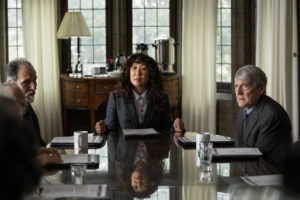
Fielder relies on a range of visual and narrative strategies, such as close-ups of micro expressions, physical proximity, and incessant inquiry, aimed at providing the most unmediated experience of Holmes and his fiancée, Billy Evans, as well as of Fielder himself. In a particularly revealing example, Fielder’s camera focuses its gaze on Evans completely naked with genitals on full display. Another jarring scene involves Holmes and Evans preparing breakfast. Evans abruptly takes the bowl and fork from Holmes to whisk the eggs himself. What might otherwise register as an inconsequential domestic interaction becomes, through Fielder’s sustained attention, an apparent revelation of the power dynamics structuring their relationship. Often, Fielder poses as a disgruntled third member in an unbalanced throuple, staring menacingly into the eyes of his interlocutors or his camera. In several scenes, we witness Evans and Holmes perform unmediated authenticity for the documentary crew, resulting in painfully awkward interactions (Evans’ declaration that Holmes is “good and true”). Through these moments, the audience delights in the shock and thrill of its own voyeurism, oscillating between ignorance and authority with the introduction of every novel narrative detail.
Scenes like the egg-mixing appear to offer precisely what the documentary promises: an unguarded glimpse into the private reality concealed behind Holmes’s carefully cultivated public persona. Yet its apparent transparency is also what makes it so ambiguous. Although the camera captures a concrete action, the psychological significance attributed to that action remains interpretive; the scene cannot, by itself, establish whether Evans’s behavior reflects a broader pattern of domination or whether Holmes’s response reveals anything definitive about her character. As one review observes, the film’s seemingly mundane domestic scenes become sites in which its subjects’ competing self-presentations begin to unravel. The reality effect operates here by converting an ordinary detail into evidence of a deeper truth: the viewer is encouraged to feel that, by seeing more of Holmes’s private life, they understand more about who she really is. But this apparent revelation remains inseparable from Fielder’s decision to film the encounter, emphasize its awkwardness, and invite its interpretation as significant. The scene therefore exemplifies the documentary’s central paradox: greater visibility yields a stronger impression of psychological access without necessarily increasing certainty about what that access reveals.
Despite these revelations and moments of searing clarity, the film’s transparency is swiftly obscured by the second act. Here, Fielder’s authority is traded for a naivete that results from a confused bond between Fielder and Holmes. During the second act, Fielder goes tete-a-tete with his audience, daring them to fall for his act the way he supposedly falls for Holmes. As Fielder’s apparent naivete begins to displace his earlier posture of relentless scrutiny, the film stages a reversal in which the documentarian, ostensibly responsible for exposing the artifice of his subject, becomes increasingly susceptible to it himself. This reversal produces a peculiar epistemic uncertainty: if Fielder can no longer be trusted to distinguish Holmes’s performance from her personhood, on what grounds can the viewer claim to do so? Yet the possibility that Fielder’s apparent credulity is itself another performance further complicates the question. This uncertainty provides the framing for the entire second half of the film, in which Amanda Seyfried, who portrayed Holmes in the Hulu series The Dropout, reprises the role in detailed re-enactments of moments in which the documentary cameras are no longer present. Here, Fielder seems committed to “transparency,” but at no point does Fielder confirm the accuracy of the reenactments (hence the revision he makes to Seyfried’s script, as they sit by her fireplace). His loss of authority may be genuine, strategically staged, or deliberately left indeterminate, transforming the documentary’s central investigation into a recursive game of deception in which the audience is compelled to scrutinize not only Holmes’s claims, but also the intentions of Nathan Fielder, the person ostensibly scrutinizing her.
This is what Barthes’s concept allows: an interpretation in which Fielder is not uncertain or neutral at all. Rather, Fielder elaborately toys with “truth” and “reality” vis-à-vis a notoriously deceptive figure because it raises the stakes of his play. His fascination with Holmes isn’t because he finds her as confounding as the documentary presents (she has, after all, verifiably lied about a military collaboration despite promising Fielder that she’s never told a lie), but because her extensive deception is a playground for his fascination with human behavior, deceit, and gullibility. Fielder finds, in Holmes, someone who is as committed to performing as he is. Barthes’s framework explains Fielder’s performance of uncertainty. Rather than parsing out his uncertainty with us, Fielder weaves together Holme’s deception with the audience’s investment in truth to accelerate his experimentation. What emerges is a culmination of Fielder’s evolution; a blockbuster, well-funded battle with the final boss of fraud herself, Holmes.
Far from an inquiry into the status of Holmes’s culpability, YCSE hinges on an aesthetic strategy that plagues our contemporary visual landscape. Here the proliferation of visibility betrays its relationship to knowability or transparency. A representation can make its subject appear entirely accessible while leaving the viewer unable to determine what the available evidence establishes. Hidden in its very name, You Can See Everything, is the same sort of sleight of hand deployed by shock-magician David Blaine. Indeed, Fielder explains one of Blaine’s tricks to Holmes on camera. The secret of the magic trick, in which Blaine pierces his palm with an ice pick, is that there is no revelation at all. Rather, Blaine “tricks” his audience into presuming there must be some illusion by literally piercing his palm. Similarly, YCSE, through its cinematic strategies, purports to reveal the facts of Holmes and Evans’s lives without revealing the “trick” at all. Instead, Fielder’s documentary acts as a final flourish: Fielder, infamous prankster, meets his Goliath with the audience as merely the backdrop for this showdown.